

Planning to leave your work experience? You’ll need a “Work Experience Resignation Letter”. It’s a formal way to inform your employer of your departure. The letter officially ends your work experience. It sets a clear date for your last day.
Writing this letter can seem tricky. It doesn’t have to be. We are here to help you get started. We have prepared several templates. There are plenty of examples available. You will find sample letters included.
These samples make writing your letter simple. Choose the best fit for your situation. Adapt the templates. Make it your own. Your letter will be ready in no time.
Work Experience Resignation Letter
Below is a sample of a Work Experience Resignation Letter:
[Your Name]
[Your Address]
[Your Phone Number]
[Your Email Address]
[Date]
[Employer’s Name]
[Company Name]
[Company Address]
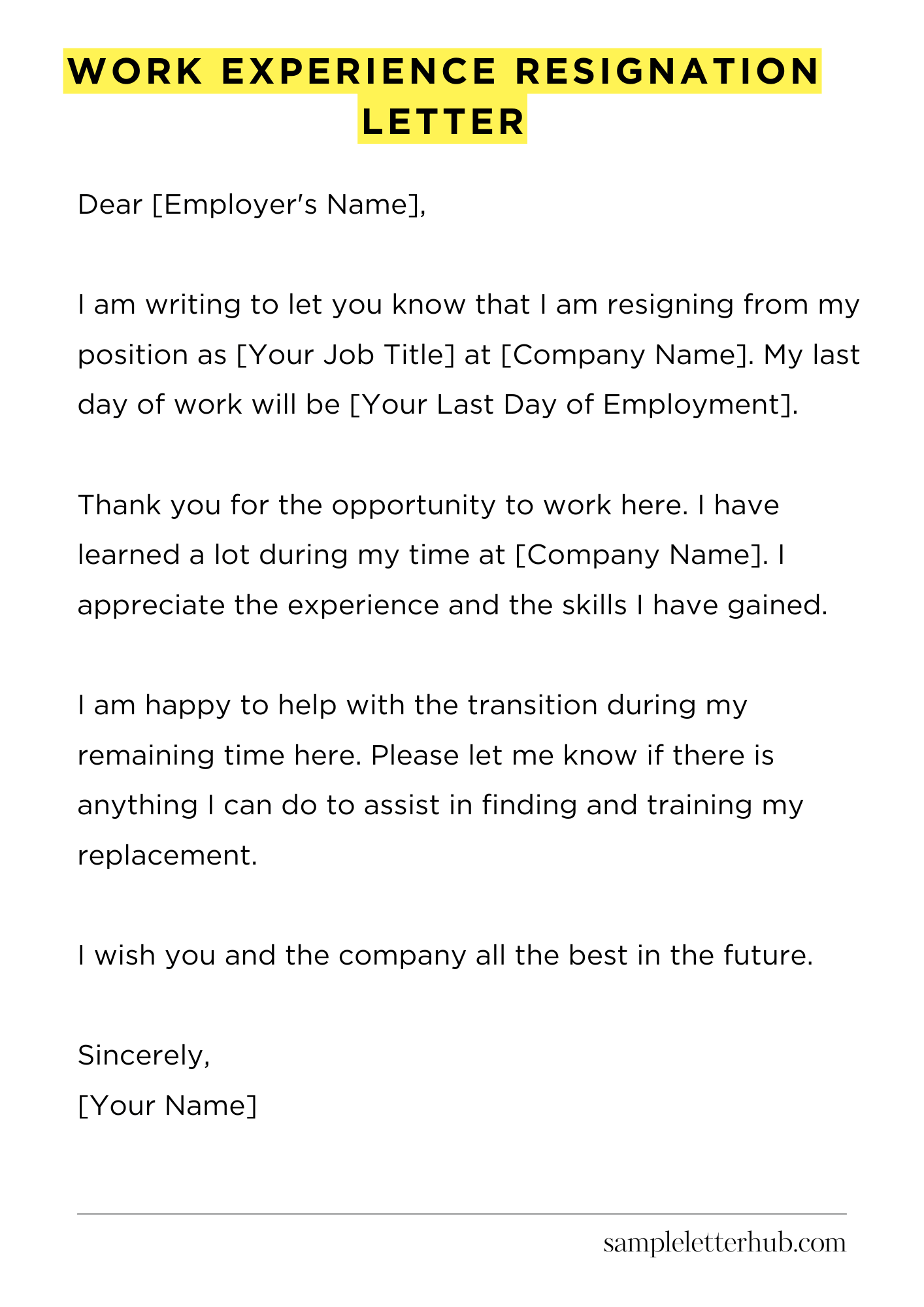
Dear [Employer’s Name],
I am writing to let you know that I am resigning from my position as [Your Job Title] at [Company Name]. My last day of work will be [Your Last Day of Employment].
Thank you for the opportunity to work here. I have learned a lot during my time at [Company Name]. I appreciate the experience and the skills I have gained.
I am happy to help with the transition during my remaining time here. Please let me know if there is anything I can do to assist in finding and training my replacement.
I wish you and the company all the best in the future.
Sincerely,
[Your Name]
How to Write Work Experience Resignation Letter
Leaving a job is a big deal. Whether you’re moving on to something new, or just need a change, it’s essential to handle your departure professionally. The first step? A well-crafted resignation letter. This letter is your official notice, and it helps you maintain a positive relationship with your former employer. It’s not just about quitting; it’s about doing it the right way.
Know the Basics First
Before you even begin typing, know your company’s policy. Your employment contract or employee handbook may outline specific requirements for submitting a resignation. This could include a specific notice period (like two weeks) and the person you need to address the letter to. Ignoring these details can cause problems, so be sure you follow all the rules.
Also, make sure you know the exact date of your last day of employment. This is a very important detail. Accuracy is key. Always keep a copy for your records, too. You’ll need it.
What to Include in Your Letter
Your resignation letter should be straightforward and concise. It does not need to be a novel. Begin with a clear statement of your intention to resign. Then, state your last day of employment. This is the most crucial information.
After that, express your gratitude for the opportunity to work there. You can briefly acknowledge what you’ve learned or the experience you’ve gained, but don’t overdo it. Keep it simple and sincere.
Finally, end the letter on a positive note, offering to assist with the transition if needed. This demonstrates professionalism, which is highly regarded. This is a good impression to make.
Crafting the Perfect Tone
Maintaining a professional tone is paramount. Even if you’re leaving because of negative experiences, avoid expressing any negativity. It’s easy to get angry, but don’t do it.
Your resignation letter is a formal document, not a place to air grievances. Keep your language polite, respectful, and neutral. Focus on the positive aspects of your employment, or simply state your intentions without going into detail about your reasons for leaving.
Proofread everything carefully! Always double-check your grammar and spelling. A well-written letter reflects positively on your character.
Formatting and Delivery
Formatting matters. Use a professional business letter format. This typically includes your contact information, the date, and the recipient’s contact information. Keep the letter single-spaced, with a clear and easy-to-read font like Times New Roman or Arial. Make sure your letter is very easy to read.
Regarding delivery, follow your company’s protocol. This could mean submitting a hard copy to your manager, or sending it via email. Always keep a digital copy for your records.
Example Resignation Letter
Here’s a basic example to get you started:
[Your Name]
[Your Address]
[Your Phone Number]
[Your Email Address]

[Date]

[Recipient's Name]
[Recipient's Title]
[Company Name]
[Company Address]

Dear [Recipient's Name],

Please accept this letter as formal notification that I am resigning from my position as [Your Job Title] at [Company Name]. My last day of employment will be [Your Last Day of Employment].

I am grateful for the opportunity to have worked at [Company Name] and for the experience I have gained during my time here.

I am happy to assist with the transition of my responsibilities, if needed.

Sincerely,
[Your Signature (if sending a hard copy)]
[Your Typed Name]
This is a starting point, adjust it based on your situation. Adapt it to your personal and professional needs. Good luck with your next endeavor!
FAQs about Work Experience Resignation Letter
What is the primary purpose of a resignation letter related to work experience?
The primary purpose of a resignation letter is to formally notify your employer of your intention to leave your current position. It serves as a written record of your departure and helps to initiate the offboarding process. This includes outlining the last day of employment and can sometimes briefly explain the reason for leaving, though this is often optional.
What essential information must be included in a work experience resignation letter?
A standard resignation letter should include your official resignation, the date of the letter, your name, the name of your employer, your job title, the effective date of your resignation (your last day of employment), and a professional closing. While not mandatory, it’s also common to express gratitude for the opportunity and, if desired, to offer assistance with the transition.
How much notice should I give when submitting a resignation letter based on my work experience?
The required notice period is generally specified in your employment contract or company policy. Common notice periods are two weeks or one month. It is important to adhere to the stipulated notice period. If no notice period is specified, it’s advisable to give at least two weeks’ notice to allow for a smooth handover.
Can I provide a reason for resigning in my work experience resignation letter, and should I?
Providing a reason for your resignation is optional. If you choose to, keep it brief and professional. Reasons can include accepting another job, pursuing further education, or seeking a better work-life balance. Avoid negative comments about your employer or colleagues. If you prefer, a simple statement like “I am resigning to pursue other opportunities” is sufficient.
How should I deliver my work experience resignation letter?
It’s generally recommended to submit your resignation letter both in hard copy (if your company requires it) and electronically, typically via email.
Address the letter to your direct supervisor or the appropriate person within the human resources department. Ensure you obtain confirmation that the letter has been received. This could be done by sending a follow up email or getting a formal acknowledgement.
Related:
Resignation letter due to rude boss
Resignation letter moving to another state
Resignation letter due to illness of family member
Resignation letter due to study