

A Visa Invitation Letter is a formal letter. It’s written to invite your father to France. It helps him apply for a visa. The letter confirms you will host him.
Planning to invite your dad to France? Writing the invitation letter can be tricky. Don’t worry, we’ve got you covered.
We’ll share awesome templates and examples. These samples will make writing your letter easy. Get ready to welcome your father to France!
Visa Invitation Letter to Invite Father to France
[Your Name]
[Your Address]
[Your Phone Number]
[Your Email Address]
[Date]
Embassy of France
[Embassy Address]
Subject: Visa Invitation Letter for [Father’s Name]
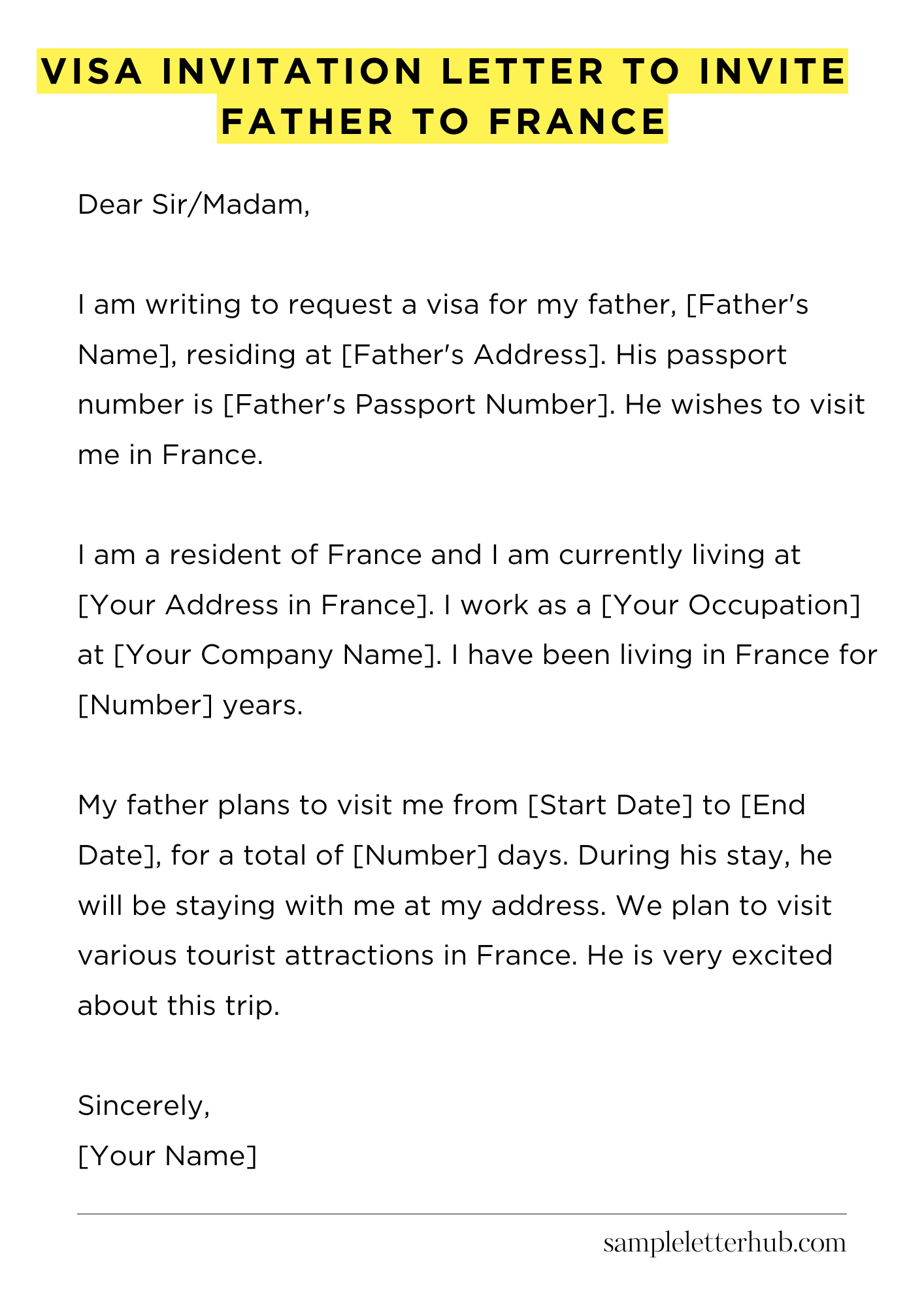
Dear Sir/Madam,
I am writing to request a visa for my father, [Father’s Name], residing at [Father’s Address]. His passport number is [Father’s Passport Number]. He wishes to visit me in France.
I am a resident of France and I am currently living at [Your Address in France]. I work as a [Your Occupation] at [Your Company Name]. I have been living in France for [Number] years.
My father plans to visit me from [Start Date] to [End Date], for a total of [Number] days. During his stay, he will be staying with me at my address. We plan to visit various tourist attractions in France. He is very excited about this trip.
I will be responsible for his accommodation and living expenses during his stay. I can provide financial support if needed. I have attached copies of my passport, residence permit, and proof of employment to this letter. I hope these documents will be helpful.
My father will, of course, return to [Father’s Country] before his visa expires. He has strong ties to his home country. I kindly request you to grant him a visa to visit me in France.
Thank you for considering my request. I appreciate your time and attention to this matter.
Sincerely,
[Your Name]
How to Write Visa Invitation Letter to Invite Father to France
Initiating the Epistolary Process: A Primer
Inviting your father to France necessitates more than just a casual “Venez!” It requires a formal invitation letter, a pivotal document in the visa application process. Think of it as your advocacy, a compelling narrative assuring the French consulate of your father’s bona fide intentions and your commitment to his sojourn.
Demystifying the Letter’s Structure
Structure is paramount. Begin with your personal details: full name, address, contact number, and email. Follow this with your father’s corresponding information.
Clearly state the purpose of the visit: a vacation, a family event, or simply quality time. Specify the exact dates of arrival and departure. An ambiguous timeline is anathema to a successful application.
Articulating the Purpose with Perspicacity
Elaborate on the reasons for the invitation. Is it a milestone birthday? A cherished family reunion? Be specific. The more detailed your explanation, the more credible your invitation becomes. A vague “just to visit” lacks the gravitas needed to sway consular officials.
Financial Undertakings: A Crucial Component
This is where you assuage any financial concerns. Explicitly state your commitment to covering your father’s expenses during his stay. This encompasses accommodation, food, internal transportation, and healthcare. Provide evidence of your financial solvency – bank statements, employment letters, or tax returns. These documents are the bedrock of your guarantee.
Housing and Accommodation: Ensuring Comfort
Detail where your father will be residing. If he’s staying with you, mention the address and the nature of your accommodation (apartment, house, etc.). If he’s staying elsewhere, provide the hotel name and reservation details. Clarity on accommodation eliminates ambiguity and demonstrates responsible planning.
The Formal Close: Imbued with Sincerity
Conclude with a formal closing. Express your enthusiasm for your father’s visit and reiterate your commitment to ensuring his compliance with French immigration laws. Include a sentence affirming your willingness to provide any further information or documentation required. Sign the letter with your full name and date it.
Submitting the Letter: The Final Act
Ensure the letter is printed on official letterhead, if available. Send the original letter to your father via a reliable courier service. A scanned copy is insufficient; the French consulate requires the tangible original.
Your father will then include this letter in his visa application package, alongside other supporting documents. Meticulous preparation is the sine qua non for a successful visa application.
FAQs about Visa Invitation Letter to Invite Father to France
What information should be included in the visa invitation letter?
The invitation letter should clearly state your father’s full name, date of birth, passport number, and purpose of visit. It should also specify the duration of his stay, your relationship to him, your full name, address, contact information, and occupation in France. Indicate that you will be responsible for his accommodation and financial support during his stay.
What documents should I include with the invitation letter?
You should include a copy of your French residence permit or passport, proof of accommodation (e.g., utility bill, rental agreement), proof of financial resources (e.g., bank statements, salary slips), and any other document that supports your ability to host and support your father during his visit.
How formal should the invitation letter be?
The invitation letter should be formal and professional in tone. Use clear and concise language, and avoid slang or informal expressions. Ensure that the letter is well-structured and easy to read. Proofread carefully for any errors in spelling or grammar.
Do I need to have the invitation letter notarized?
While not always required, notarizing the invitation letter can add credibility to the document. Check the specific requirements of the French embassy or consulate in your father’s country of residence to determine if notarization is necessary or recommended.
What if my father’s visa application is rejected?
If your father’s visa application is rejected, the rejection letter should provide the reasons for the denial. Review these reasons carefully and determine if you can address them in a new application.
You may need to provide additional documentation or information to support the application. You can also appeal the decision if you believe it was unwarranted, consulting the French embassy or consulate for guidance on the appeals process.
Related:
Resignation letter due to rude boss
Resignation letter moving to another state
Resignation letter due to illness of family member
Resignation letter due to study