

Need to say goodbye to your virtual assistant gig? You’ll need a resignation letter. This is a formal way to announce your departure. It officially informs your client or employer of your decision. The letter should clearly state your last day of work.
Writing this letter might feel tricky. Don’t worry, we’re here to help. We’ve gathered some great templates. You can adapt them to fit your situation. Whether you are transitioning smoothly or facing a difficult situation, we have got you covered.
Choose the sample that fits best. Then, customize it to make it your own. We’ll help you craft a professional and thoughtful letter. Make your exit as seamless as possible. You’ve got this!
Virtual Assistant Resignation Letter
Below is a sample of a Virtual Assistant Resignation Letter:
[Your Name]
[Your Address]
[Your Phone Number]
[Your Email Address]
[Date]
[Employer’s Name]
[Employer’s Title]
[Company Name]
[Company Address]
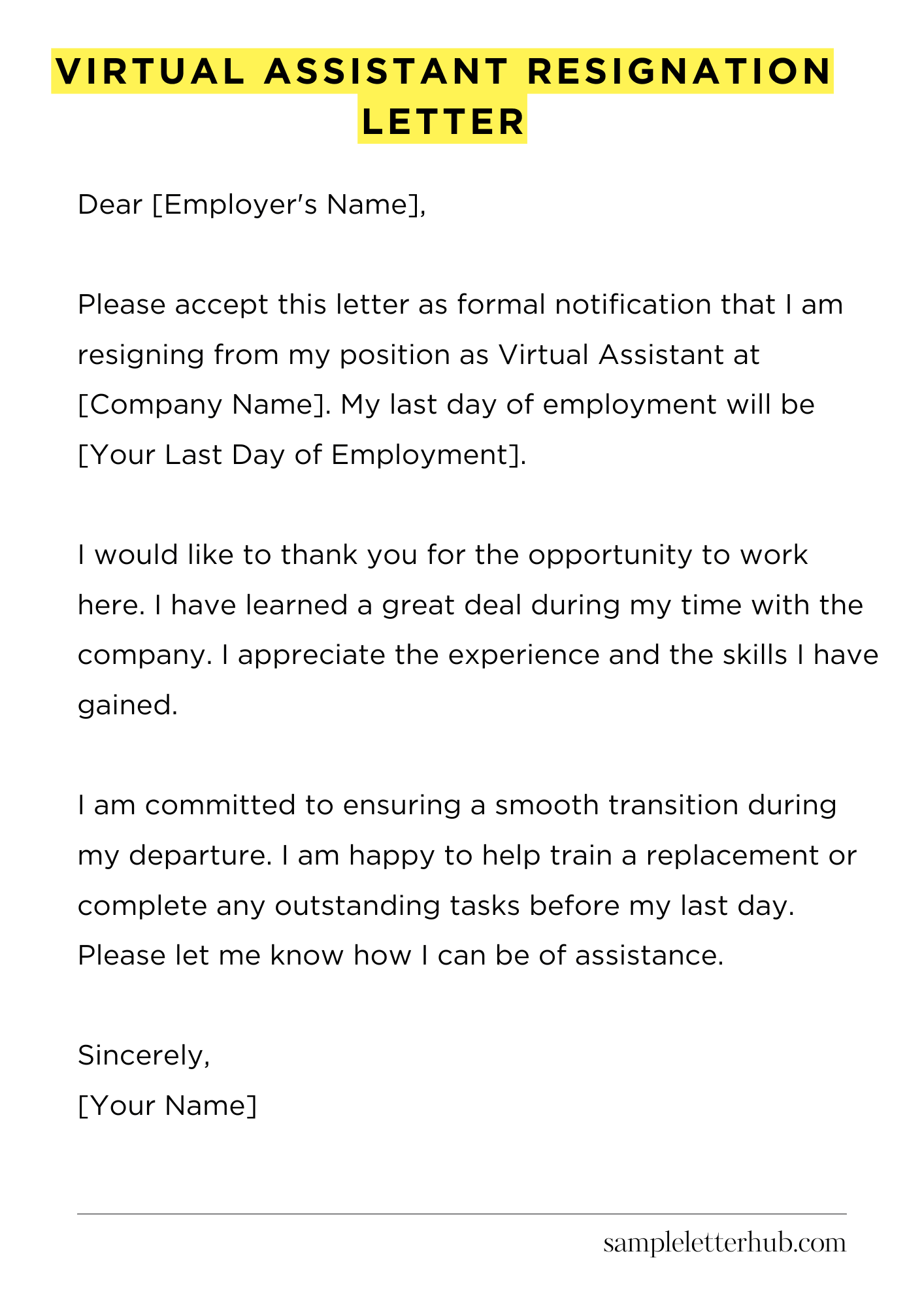
Dear [Employer’s Name],
Please accept this letter as formal notification that I am resigning from my position as Virtual Assistant at [Company Name]. My last day of employment will be [Your Last Day of Employment].
I would like to thank you for the opportunity to work here. I have learned a great deal during my time with the company. I appreciate the experience and the skills I have gained.
I am committed to ensuring a smooth transition during my departure. I am happy to help train a replacement or complete any outstanding tasks before my last day. Please let me know how I can be of assistance.
I wish you and [Company Name] all the best in the future.
Sincerely,
[Your Name]
How to Write a Virtual Assistant Resignation Letter
So, you’ve decided it’s time to move on from your virtual assistant gig. That’s totally understandable! Life changes, new opportunities pop up, and sometimes a change is just what you need. But before you simply vanish, you’ll need a solid resignation letter. Crafting a proper resignation letter is a professional courtesy.
It’s a way of saying goodbye respectfully. This document is a critical step in maintaining a positive relationship with your client, even as you leave their service. Let’s break down how to create a great one.
Step 1: Get the Format Right
First things first: the format matters. Keep it clean, concise, and easy to read. You’ll want a formal business letter style. Begin with your contact information (your name, address, and email) and the date. Below that, include your client’s information (their name or the company name, and their address). Following a clear format is important.
Then, the salutation! Use “Dear [Client’s Name],” or “Dear [Company Name],”. Never use a casual greeting. This is a professional document, remember?
Keep the body paragraphs short and to the point. No need for flowery language! Your client is busy, and so are you, now and in the future.
Step 2: State Your Intentions Clearly
The first paragraph is the most crucial. Here, you state your intention to resign. Be direct and clear. For example, “Please accept this letter as formal notification that I am resigning from my position as your Virtual Assistant, effective [Your Last Day of Employment].” Boom!
That is all that needs to be said. This immediately establishes your purpose. Don’t beat around the bush; get straight to the point. This prevents any confusion or misunderstandings.
Step 3: Show Gratitude and Professionalism
Even if things didn’t always go smoothly, this is the time to be gracious. Express your thanks for the opportunity to work with them. Mention any positive experiences or skills you’ve gained. For example, “I want to thank you for the opportunity to work as your Virtual Assistant. I have learned a great deal, especially regarding [mention a specific skill or experience].”.
It’s important to keep this paragraph brief and sincere. This is not the time to air grievances. Maintain a positive tone, even if you are not fully happy. It’s about preserving a good professional image.
Step 4: Offer Assistance with the Transition
A great resignation letter demonstrates your commitment to a smooth transition. Offer your assistance in training a replacement or completing ongoing tasks.
This shows responsibility and consideration. You could write something like, “I am happy to assist in the transition process. I am available to train a replacement or complete any pending tasks before my last day.” This is not an obligation, but a polite offer.
Be sure to be realistic about what you can do. Don’t over-promise. Be helpful, not overly involved.
Step 5: Wrap it Up Nicely and Get Out!
Close your letter with a professional closing, such as “Sincerely,” or “Respectfully,” followed by your full name. Proofread your letter carefully!
Ensure there are no typos or grammatical errors. Before you send it, double-check all the details: the date, the recipient’s information, and your own contact details. Consider sending the letter via email and keeping a copy for your records.
Finally, your work is done. You are finished. You’ve done it right and now you are ready for the next adventure. Good luck!
FAQs about Virtual Assistant Resignation Letter
What is the proper format for a Virtual Assistant resignation letter?
The standard format includes a clear subject line (e.g., “Resignation – [Your Name]”), a formal salutation (e.g., “Dear [Client’s Name]”), a concise statement of resignation with the effective date, a brief expression of gratitude for the opportunity, mention of any assistance in the transition (handover of tasks, documentation).
What key information should be included in a Virtual Assistant resignation letter?
Essential information includes the clear statement of your resignation, the specific effective date (your last day of work), a thank you to the client, details regarding any handover plans you have (if applicable), and your contact information for any final clarifications. Avoid negative language or lengthy explanations for leaving.
How much notice should I give my Virtual Assistant clients when resigning?
The notice period depends on your agreement with each client. Typically, a minimum of two weeks is standard, but some contracts might require more. Always review your contracts to determine the agreed-upon notice period. Providing ample notice allows clients time to find a replacement and ensures a smoother transition.
What if I am leaving a Virtual Assistant position due to a conflict with the client?
If you are resigning due to a conflict, it’s best to keep your resignation letter professional and concise. Avoid detailing the conflict within the letter. Simply state your resignation with the effective date. If you believe further communication is required, it is better to address the issue separately with the client. It’s important to maintain a professional tone, even if you are not satisfied.
How do I handle the transfer of tasks and client files when resigning?
Outline your handover plan within your resignation letter or a separate email. This includes listing tasks you are responsible for, providing necessary documentation (passwords, logins, templates), offering to train a replacement or answer any questions, and specifying the deadline for transferring the materials.
Ensure all crucial client information is securely and properly passed on to your client or their appointed successor before your last day.
Related:
Resignation letter due to rude boss
Resignation letter moving to another state
Resignation letter due to illness of family member
Resignation letter due to study