

A “Video Editor resignation letter” is a formal document. It informs your employer of your decision to leave your video editing job. The letter officially marks the end of your employment. It is a crucial step in the departure process.
Need to resign from your video editing role? This article provides you with templates. We have many examples to help you. These are adaptable for various situations. Consider these samples your starting point.
Writing this letter can seem daunting. We aim to simplify it. Use these to tailor your perfect resignation. Make your exit professional and clear. Good luck with your future endeavors!
Video Editor Resignation Letter
Below is a sample of a Video Editor Resignation Letter:
[Your Name]
[Your Address]
[Your Phone Number]
[Your Email Address]
[Date]
[Employer’s Name]
[Company Name]
[Company Address]
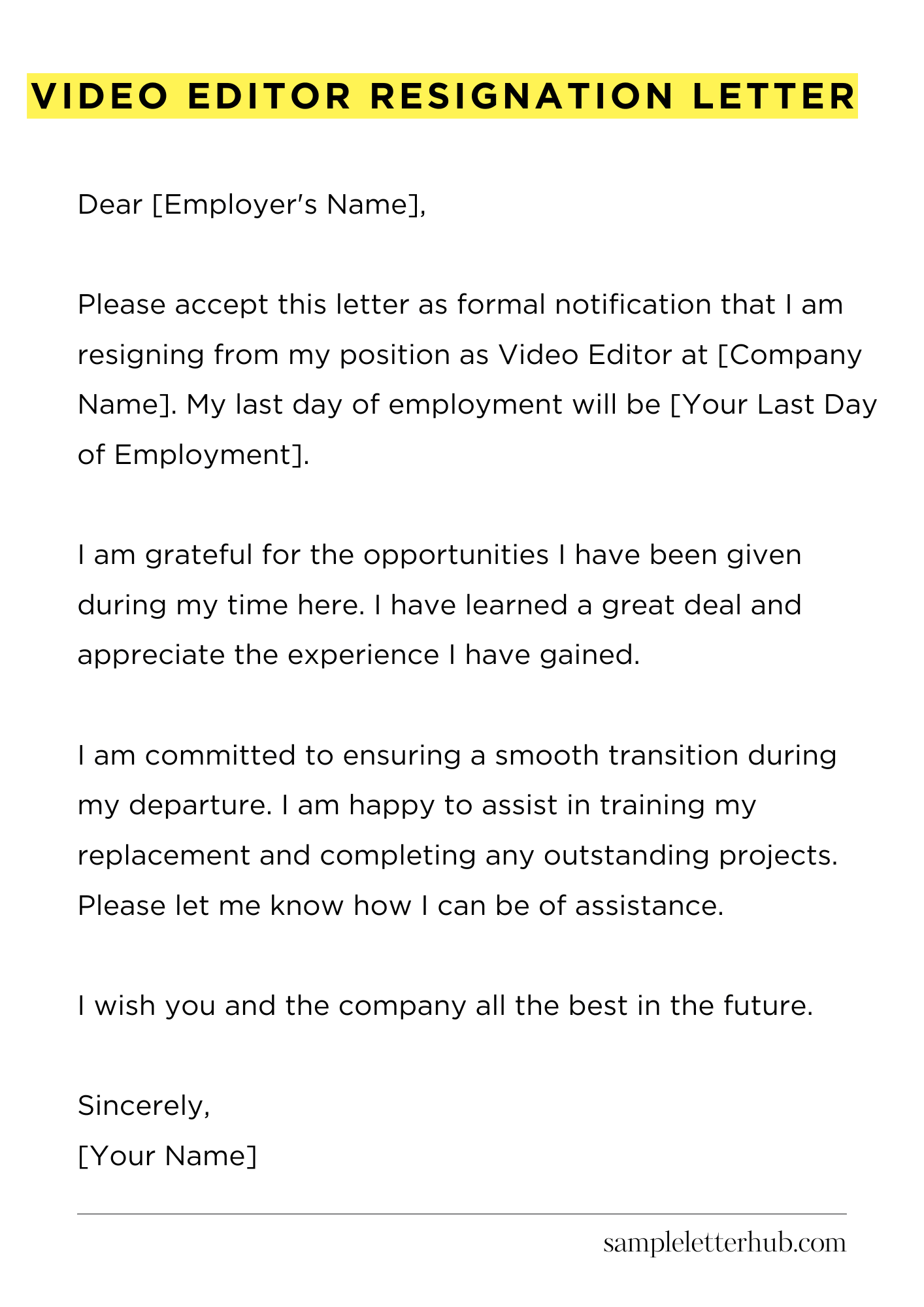
Dear [Employer’s Name],
Please accept this letter as formal notification that I am resigning from my position as Video Editor at [Company Name]. My last day of employment will be [Your Last Day of Employment].
I am grateful for the opportunities I have been given during my time here. I have learned a great deal and appreciate the experience I have gained.
I am committed to ensuring a smooth transition during my departure. I am happy to assist in training my replacement and completing any outstanding projects. Please let me know how I can be of assistance.
I wish you and the company all the best in the future.
Sincerely,
[Your Name]
How to Write a Video Editor Resignation Letter
So, you’re moving on! Being a video editor is a demanding job. Maybe you’ve found a better opportunity. Perhaps you’re pursuing a different career path.
Whatever the reason, you’re ready to submit your resignation. The resignation letter is more than just a formality; it’s a professional courtesy and a crucial step in ending your employment gracefully. Let’s delve into how to craft a resignation letter that leaves a positive impression, regardless of your reasons for leaving.
1. Formatting and Fundamentals
First things first: formatting. Your letter should be professional. Keep it concise. Use a standard business letter format. Include your contact information (name, address, phone number, and email address) at the top, followed by the date.
Address the letter to your direct supervisor or the appropriate HR representative. Keep the font simple and readable, like Times New Roman or Arial, and use a standard font size like 12 points. Avoid unnecessary jargon or slang.
Now, let’s look at the basic elements. Your letter must clearly state your intent to resign. Be direct. Include your official resignation date. This is critical.
The date allows your employer to prepare for your departure and initiate the transition process. Express your gratitude for the opportunity to work there. A simple “Thank you for the opportunity” goes a long way. It’s polite and shows respect.
2. The Body of Your Letter: Keep it Respectful
The body of your letter is where you expand upon your basic statement. Remember, less is often more. Avoid negative comments about your current job or colleagues.
Even if your experience wasn’t ideal, maintain a professional tone. This is not the place to air grievances. Instead, briefly mention the skills or experiences you gained while working in the role. Perhaps state that the role has helped you acquire essential knowledge.
If you’re willing to help with the transition, offer your assistance. This shows commitment. “I’m happy to assist in training my replacement” is a good example. Offer to answer any questions or help with handover documentation. This strengthens your professional reputation.
If you’ve been working on specific projects, list them if you have completed them. This could be useful for a handover or to express the impact you have created. It may be helpful to briefly mention your new role if you wish to.
3. The Tone: Maintaining Positivity
Your tone is crucial. Even if you’re not thrilled about leaving, stay positive. Focus on the future, not the past. Use language that is courteous and appreciative. Words like “grateful,” “appreciate,” and “thank you” should be prevalent. Avoid anything that could be perceived as bitter, angry, or critical. This reflects positively on your character.
For example, instead of saying, “I hated this job,” consider: “I’ve learned a great deal, and I’m grateful for the experiences I’ve gained.” The difference is subtle but significant. You want to leave on a good note.
4. Proofreading and Final Touches
Proofreading is paramount. Errors in your letter reflect poorly. Before sending your letter, carefully proofread it for any spelling or grammatical errors. Read it aloud to catch any awkward phrasing. Ask a friend or colleague to review it as a fresh pair of eyes can often catch mistakes you missed.
Consider the delivery method. Most employers prefer a physical or electronic copy. Determine the preferred method of your company before you send the letter. Following these steps helps make sure the letter is suitable.
5. After Submission: Handling the Response
Once you’ve submitted your letter, be prepared for a response. Your supervisor or HR might schedule an exit interview. This is a chance for them to ask questions and learn about your experience. Be prepared. Be honest, but still professional. They might ask for feedback, and you can provide it constructively.
During the transition period, be diligent. Complete your assigned tasks efficiently. Help with the handover of projects. Maintain a professional attitude until your last day.
This will reinforce a positive impression and leave a lasting mark. Remember, the way you leave is just as important as the work you’ve done while you were there. Your reputation and future opportunities can depend on this.
FAQs about Video Editor Resignation Letter
What is the most important information to include in a video editor resignation letter?
The most crucial elements to include are: a clear statement of your resignation, your last day of employment, a brief expression of gratitude for the opportunity, and any necessary information regarding the handover of your responsibilities. It is also wise to include your contact information for future communication.
How much notice should a video editor provide when resigning?
The standard notice period is typically two weeks, although this can vary based on your employment contract or company policy. Always refer to your employment agreement to confirm the required notice period. Providing ample notice allows for a smoother transition and demonstrates professionalism.
Should I state the reason for my resignation in the letter?
While not mandatory, you can briefly mention your reason for leaving. This can be as simple as stating you are pursuing a new opportunity or are seeking a career change. Keep it concise and avoid negativity. If you have a good relationship with your employer, you could briefly explain your decision, but it’s not a requirement.
How should I format the video editor resignation letter?
The letter should be professional and concise. Start with your contact information, followed by the date, and the recipient’s information. Use a formal salutation (e.g., Dear [Manager’s Name]), state your intention to resign, your last day, express gratitude, and close with a professional closing (e.g., Sincerely, or Best regards) and your typed name. Keep the tone positive.
What if I have uncompleted projects or ongoing responsibilities as a video editor?
Address ongoing projects in your letter or, if space is limited, in a separate email. Offer to assist in the transition by documenting your workflows, training a replacement, or providing any necessary support to ensure projects are completed successfully. This reflects a commitment to professionalism and a desire to leave on good terms.
Related:
Resignation letter due to rude boss
Resignation letter moving to another state
Resignation letter due to illness of family member
Resignation letter due to study