

A Vice President of Business Development resignation letter is a formal document. It announces your departure from the company. Its primary purpose is to officially inform your employer of your resignation. It also communicates your last day of employment.
Thinking of moving on? Drafting this letter can feel tricky. We’ve got you covered. This article offers sample resignation letters. These examples provide a helpful starting point. They are tailored for a Vice President of Business Development role.
Use these samples to personalize your own letter. Need a template for a specific situation? We will share different scenarios. This will make your resignation process smoother. Write your letter with confidence!
Vice President Of Business Development Resignation Letter
Below is a sample of a Vice President Of Business Development Resignation Letter:
[Your Name]
[Your Address]
[Your Phone Number]
[Your Email Address]
[Date]
[Hiring Manager Name] (If known, otherwise use title)
Vice President of Human Resources
[Company Name]
[Company Address]
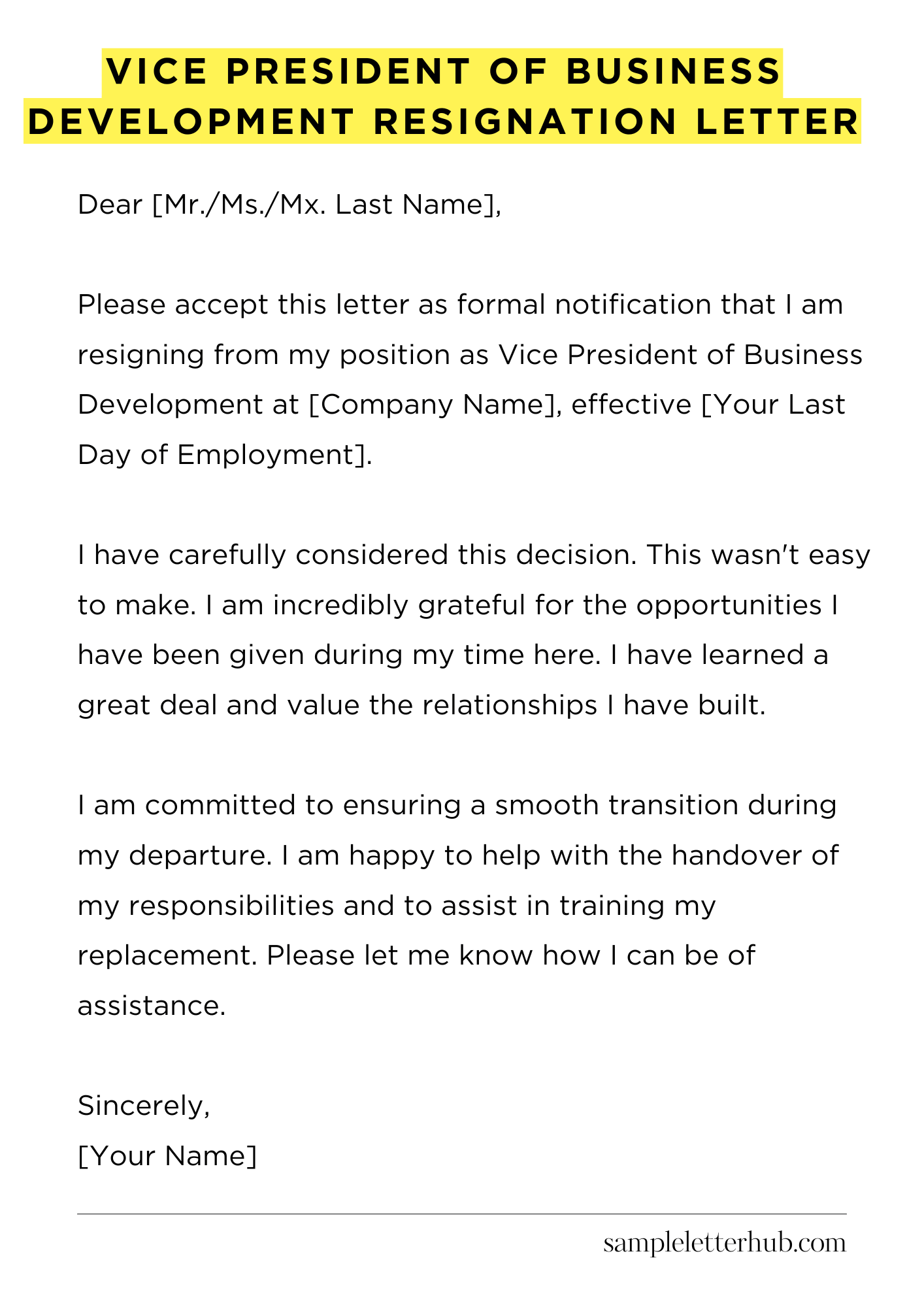
Dear [Mr./Ms./Mx. Last Name],
Please accept this letter as formal notification that I am resigning from my position as Vice President of Business Development at [Company Name], effective [Your Last Day of Employment].
I have carefully considered this decision. This wasn’t easy to make. I am incredibly grateful for the opportunities I have been given during my time here. I have learned a great deal and value the relationships I have built.
I am committed to ensuring a smooth transition during my departure. I am happy to help with the handover of my responsibilities and to assist in training my replacement. Please let me know how I can be of assistance.
I wish [Company Name] continued success in the future.
Sincerely,
[Your Name]
How to Write a Vice President of Business Development Resignation Letter
Resigning from a Vice President of Business Development role is a significant move. It’s a high-level position, and the way you handle your departure reflects on your professionalism.
This letter is your official notice; it’s not just paperwork. It’s a statement. It is essential to approach it strategically and with care. Here’s how to craft a resignation letter that leaves a positive impression, even as you move on.
1. Start with Clarity and Directness
First things first: Be clear and concise. State your intention to resign immediately and what your last working day will be. There is no room for ambiguity here. This is the core of your letter. It is vital to include the key information right at the top.
Here’s a basic structure: Begin with the date. Then address the letter to the appropriate person, usually your direct supervisor, CEO, or Head of HR. Use a professional salutation like “Dear [Name]”. Then, in the opening paragraph, explicitly state your resignation.
For instance, “Please accept this letter as formal notification that I am resigning from my position as Vice President of Business Development, effective [Your Last Day of Employment].” Simplicity is key. It shows you respect their time.
2. Briefly Express Gratitude (But Keep It Brief)
While you might have mixed feelings, a touch of gratitude goes a long way. This is not about being fake; it’s about maintaining a professional relationship. Briefly acknowledge your time with the company. Keep this section succinct; two or three sentences are ideal.
You could write something like, “I am grateful for the opportunities I have been given during my time here and for the experience I have gained. I appreciate the support I have received from my colleagues and the company leadership.” This acknowledges the positive aspects without getting overly sentimental or detailed. Remember, you want to leave on a good note.
3. Address the Transition (Offer Help!)
This is where you show your commitment to a smooth transition. Even though you are leaving, you can help make the departure seamless. Offer assistance with handing over your responsibilities. Provide a list of ongoing projects. Offer to help train your replacement. This is about showing that you are still reliable and professional, even as you leave.
Offer a suggestion like, “I am committed to ensuring a smooth transition during my departure. I am happy to assist in any way possible to find a successor and/or help in the transfer of my responsibilities, including training my replacement.”
4. Keep It Positive and Avoid Negativity
The tone of your letter should be positive and forward-looking. Avoid any negative comments about your reasons for leaving, the company, or specific individuals. Do not burn any bridges. Even if you’re leaving because of dissatisfaction, airing those grievances in a resignation letter is not advisable.
Maintain a positive tone and focus on the future. Remember, you might need a reference from this company. Avoid using words like “resentful” or phrases that indicate dissatisfaction.
Instead, focus on your next steps. For example, instead of saying, “I was unhappy with the lack of advancement,” say something like, “I am excited to pursue new opportunities that align with my long-term career goals.”
5. Finalize and Proofread (It Matters!)
Before you send your resignation letter, give it a thorough proofread. Check for any grammatical errors, spelling mistakes, or typos. Have someone else read it over for a second opinion. This helps make sure you haven’t missed anything. Ensure that all the important details, such as your last day, are correct.
Print it on good quality paper. Sign the letter, and then keep a copy for your records. This small step demonstrates your attention to detail and professionalism. The care you take reflects positively on you and can really make a difference.
Remember, your resignation letter is a reflection of your professional character. By following these guidelines, you can ensure a graceful departure and pave the way for future success.
FAQs about Vice President Of Business Development resignation letter
What is the typical format for a Vice President of Business Development resignation letter?
A typical resignation letter for a Vice President of Business Development should be professional and concise. It usually includes a clear statement of resignation, the effective date of resignation, a brief expression of gratitude for the opportunity, and may optionally include a reason for leaving (though this is not always necessary).
The format generally follows a business letter format: your contact information, the date, the recipient’s contact information, a salutation, the body of the letter, a closing, and your signature.
What key information should be included in a Vice President of Business Development resignation letter?
Crucially, the letter must state your intention to resign and the specific date your resignation takes effect. It should also include a brief thank you to the company or your manager for the opportunity. You may also include a willingness to assist with the transition of your duties during your remaining time at the company.
Be sure to include your name and title. Avoid negativity or complaints.
Should I provide a reason for resigning in my letter?
Providing a reason for your resignation is optional. It is more common for employees to keep the reason private. If you choose to include a reason, keep it brief and professional. Some common reasons include pursuing a new opportunity, seeking a different career path, or personal reasons.
Avoid going into excessive detail or including negative comments about the company or colleagues. However, some companies may want to know why so that they can prevent the same issue from happening again.
How much notice should I give when resigning as a Vice President of Business Development?
The standard notice period for a Vice President level position is usually between 30 and 60 days, depending on the company’s policy and your employment agreement. Check your employment contract or company handbook to determine the required notice period. Giving ample notice allows for a smooth transition and demonstrates professionalism.
What should I do after submitting my resignation letter?
After submitting your resignation letter, it’s crucial to follow up with your manager to discuss the transition plan. Offer to assist with training your replacement or transferring your responsibilities. Maintain a professional demeanor throughout your remaining time at the company. Begin any steps to get all personal belongings from the company.
Related:
Resignation letter due to rude boss
Resignation letter moving to another state
Resignation letter due to illness of family member
Resignation letter due to study