


A resignation letter is a formal document. It announces your departure from a job. “Usher resignation letter” refers to a specific type of this document. It’s written by someone who worked as an usher. The purpose is to officially inform the employer of the employee’s decision.
Are you leaving your usher position? This article is here to help. We’ll provide you with some great examples. You can use them to build your own letter. Need to resign for any reason? We’ve got you covered.
These samples will make it easy for you. You can tailor them to your situation. Find the perfect words to express yourself. Get ready to craft your resignation letter with confidence.
Usher Resignation Letter
Below is a sample of a Usher Resignation Letter:
[Your Name]
[Your Address]
[Your Phone Number]
[Your Email Address]
[Date]
[Usher’s Supervisor’s Name]
[Usher’s Supervisor’s Title]
[Venue Name]
[Venue Address]
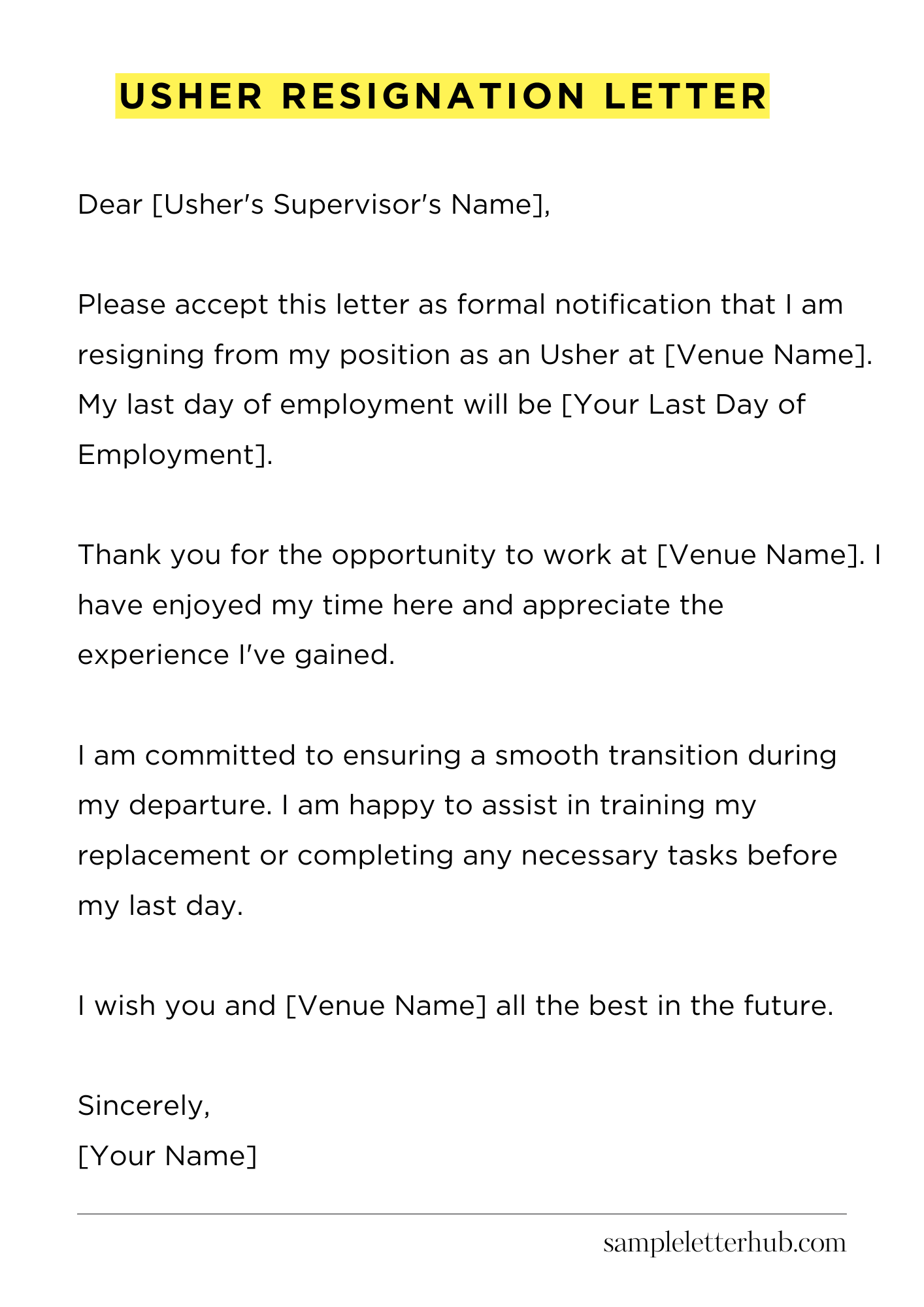
Dear [Usher’s Supervisor’s Name],
Please accept this letter as formal notification that I am resigning from my position as an Usher at [Venue Name]. My last day of employment will be [Your Last Day of Employment].
Thank you for the opportunity to work at [Venue Name]. I have enjoyed my time here and appreciate the experience I’ve gained.
I am committed to ensuring a smooth transition during my departure. I am happy to assist in training my replacement or completing any necessary tasks before my last day.
I wish you and [Venue Name] all the best in the future.
Sincerely,
[Your Name]
How to Write an Usher Resignation Letter
Know Your Audience and Purpose
Writing a resignation letter, even for a volunteer usher position, demands a level of professionalism. You need to understand who you are addressing and, most importantly, why you are writing.
This letter is your official notice. It formally communicates your intent to leave your role. Consider it a handshake on the way out the door.
The audience is likely the head usher, the theatre manager, or a supervisor in charge of volunteers. Be polite and respectful. Your objective is straightforward: to inform them of your departure, express appreciation (if genuine), and potentially offer assistance during the transition.
Crafting the Core Elements: A Step-by-Step Guide
Let’s break down the essential components. Begin with your contact information (your name, address, phone number, and email) and the date. Then, address the recipient professionally. Think: “Dear [Name or Title],” followed by a clear and concise opening sentence stating your intention to resign. Keep it simple. Avoid rambling introductions.
The second paragraph should include your last day of service. This clearly states when you will no longer be available. You could also offer a brief, positive explanation for your departure. Are you moving? Taking on new commitments? Or is it personal? Be respectful and avoid any negativity. Express gratitude for the experience you have had.
Finally, if possible, offer assistance with the transition. This shows consideration and professionalism. Provide your contact details for any possible assistance. End with a polite closing, like “Sincerely,” or “Respectfully,” followed by your full name and your signature.
The Language: Polished and Professional
The tone is vital. Maintain a courteous and respectful voice. Avoid sounding angry, bitter, or overly casual. Keep your language clear and easy to understand. Using formal language is okay. Proofread carefully! Ensure you correct typos and grammatical errors. It reflects your attention to detail.
Remember, you are leaving a role, and you want to leave a positive lasting impression. Be sincere. Avoid unnecessary drama or gossip. Keep it succinct and to the point. Short sentences work.
Example Resignation Letter Templates
Here’s a template to guide you. Feel free to adjust it to fit your unique circumstances.
[Your Name]
[Your Address]
[Your Phone Number]
[Your Email Address]
[Date]
[Recipient’s Name/Title]
[Theatre Name/Organization]
[Theatre Address]
Dear [Mr./Ms./Mx. Last Name],
Please accept this letter as formal notification that I am resigning from my position as an usher at [Theatre Name], effective [Your Last Day of Service].
I would like to thank you for the opportunity to have served as an usher. I have truly enjoyed my time volunteering here.
I am happy to assist with the transition process in any way I can. Feel free to contact me at [Your Phone Number] or [Your Email Address].
Sincerely,
[Your Signature – type your name here if printed]
[Your Typed Name]
Final Check: Before You Hit Send
Before submitting your letter, double-check everything. Is the date correct? Is the recipient’s name and title spelled correctly? Have you clearly stated your last day?
Read it out loud. Does it sound professional and polite? It’s better to get a second pair of eyes to read it. Then, after you are satisfied, submit your letter by email or hand it in person. Your departure letter sets the stage for future references. Do it well.
FAQs about Usher resignation letter
Why did Usher resign?
Usher’s reasons for resigning are varied and can stem from a multitude of factors. These could include seeking new professional opportunities, personal reasons such as health or family matters, or perhaps disagreements with the company’s direction or management.
Without specific information from Usher himself or a formal statement, the exact cause remains speculative, though examining public statements or news reports at the time of the resignation may provide clarity.
What were the terms of Usher’s resignation?
The terms of a resignation typically cover elements like the effective date, any severance arrangements, non-compete clauses, and the transfer of any ongoing projects or responsibilities.
Unless the resignation was made public via an official statement, the details are usually between Usher and his employer. The specific details would be revealed depending on the employment agreement between the two parties.
What impact did Usher’s resignation have on the company/organization?
The impact of Usher’s departure could range widely. If Usher was a key employee, the company may have experienced some disruption, potentially impacting projects or workflow.
The company may need to find a replacement and redistribute responsibilities. The impact would depend on the position, duties, and importance of the employee to the company.
Was Usher’s resignation voluntary or involuntary?
Distinguishing between voluntary and involuntary resignations is essential. A voluntary resignation implies Usher initiated the departure.
An involuntary resignation suggests termination, either by the company (firing) or under circumstances that led Usher to leave. Understanding whether the resignation was voluntary or not will depend on the specifics around the resignation which is usually revealed in the resignation letter.
Where can I find a copy of Usher’s resignation letter?
Resignation letters are typically confidential documents. Unless Usher or his former employer chose to make the letter public, it will likely not be available to the general public. Additionally, the availability of these kinds of records depends on the legal jurisdiction and relevant privacy laws. As such, it’s unlikely a copy would be generally available.
Related:
Resignation letter due to rude boss
Resignation letter moving to another state
Resignation letter due to illness of family member
Resignation letter due to study