

Leaving a university lecturer position requires a formal letter. This is a resignation letter. The letter officially informs the university of your departure. It’s a crucial step in the resignation process.
Writing a good resignation letter can be tricky. It needs to be professional and concise. We understand this. So, we’ve got you covered.
Here, we will share some templates. We will provide different examples. These will help you craft your own letter. Get ready to find the perfect format for your situation.
University Lecturer Resignation Letter
Below is a sample of a University Lecturer Resignation Letter:
[Your Name]
[Your Address]
[Your Phone Number]
[Your Email Address]
[Date]
[Recipient Name] (e.g., Head of Department)
[Recipient Title]
[University Name]
[University Address]
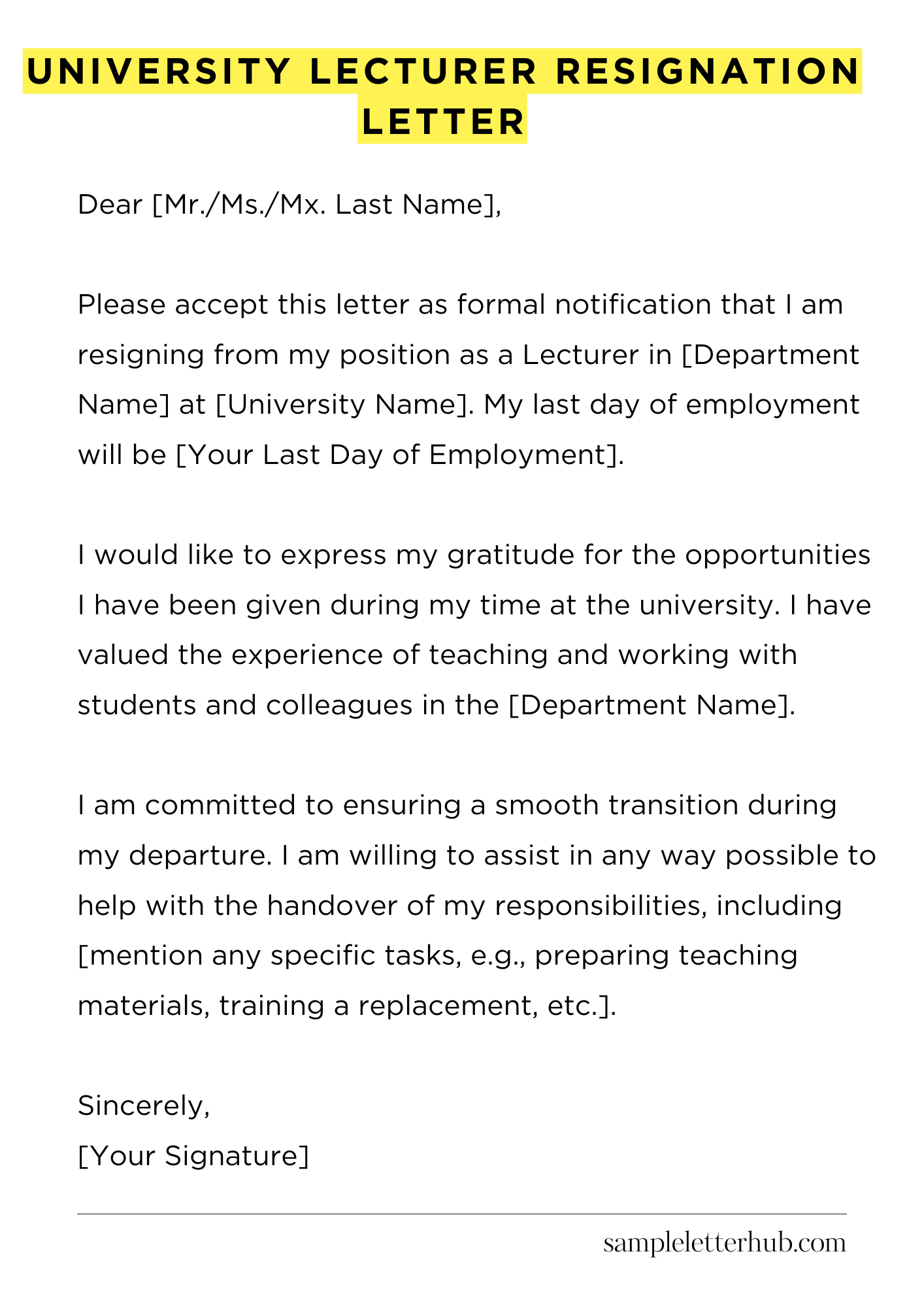
Dear [Mr./Ms./Mx. Last Name],
Please accept this letter as formal notification that I am resigning from my position as a Lecturer in [Department Name] at [University Name]. My last day of employment will be [Your Last Day of Employment].
I would like to express my gratitude for the opportunities I have been given during my time at the university. I have valued the experience of teaching and working with students and colleagues in the [Department Name].
I am committed to ensuring a smooth transition during my departure. I am willing to assist in any way possible to help with the handover of my responsibilities, including [mention any specific tasks, e.g., preparing teaching materials, training a replacement, etc.].
I wish the university and the [Department Name] all the best for the future.
Sincerely,
[Your Signature]
How to Write University Lecturer Resignation Letter
Leaving a university lecturer position can be a big step. A well-crafted resignation letter is your formal announcement. It’s not just a formality; it reflects your professionalism and leaves a lasting impression. Let’s break down how to write one that achieves its purpose.
1. Get the Basics Right: Format and Tone
The format matters. Your letter should be business-like and easy to read. Use a standard business letter format. Start with your name, address, and contact information. Then, include the date and the recipient’s information (usually the department head or dean). Choose a polite and professional tone throughout.
Avoid sounding angry or negative, even if you’re not thrilled about leaving. Keep it clear, concise, and to the point. This is not the place for lengthy explanations.
2. The Core Components: What to Include
Your letter needs key elements. Begin by stating your intention to resign and the effective date of your resignation. Next, formally state your position, such as “Lecturer in History.” Then, express your gratitude for the opportunity to have worked at the university. Briefly mention any specific positive experiences, projects, or collaborations you value.
A simple “I have greatly valued my time at [University Name] and appreciate the opportunities I’ve been given” works well. Finally, offer assistance with the transition. This shows consideration and professionalism. Mention that you’re willing to help with tasks like training your replacement or completing any unfinished work.
3. Specifics to Consider: Addressing the Details
Be precise with your departure date. This date starts the clock for your transition out of the job. Double-check your employment contract for any specific requirements regarding notice periods.
Clearly state any actions required from the university. This might include information about your final paycheck, benefits, or the return of university property. Consider requesting a formal acknowledgement of your resignation.
This gives you written confirmation of the date and other important information. If you have a strong relationship with your head of department, consider a brief conversation beforehand. This can provide context and make the written letter less of a surprise.
4. Polishing the Letter: Proofreading and Review
Proofreading is crucial! Before you send the letter, meticulously check for any grammatical errors, spelling mistakes, or typos. This helps demonstrate that you pay attention to detail.
Reading your letter aloud can help you spot any awkward phrasing or unclear statements. It is important to ask someone else to review your letter. Another set of eyes can often catch mistakes you might miss.
Consider whether your letter fully fulfills all of its intended objectives. You want to leave on a positive note, but still convey all necessary information.
5. Final Touches: Delivering the Letter
How you submit your letter matters, too. Deliver it formally. If your university has a policy about how to submit resignation letters, then follow it. Typically, you will submit a printed copy to your head of department or dean. A follow-up email is often a good idea, as well. Keep a copy of your resignation letter for your records.
This is especially useful for future reference or employment verification. Finally, maintain a positive attitude throughout the transition process. Your departure will reflect well on your professionalism.
FAQs about University Lecturer Resignation Letter
What is the essential information to include in a University Lecturer resignation letter?
A University Lecturer resignation letter should contain: your formal resignation, the date of your last day of employment (as agreed with the university), a clear and concise statement of your intent to resign, your formal name and title, your department, and a brief and professional expression of gratitude for the opportunity.
It may also include a reason for leaving, but this is optional and should remain professional.
How much notice should a University Lecturer give when resigning?
The notice period is typically specified in the employment contract. It’s usually between one to three months. It’s crucial to review your contract carefully. If the contract doesn’t specify a notice period, it’s advisable to check university policy or labor laws relevant to your location.
Can I include the reason for my resignation in the letter, and is it advisable?
While not mandatory, you can include the reason for your resignation. It’s important to keep it professional and brief. Common reasons include accepting a new position, pursuing further studies, or personal circumstances. Avoid negative comments about the university or colleagues. A concise and positive reason is preferable.
What is the proper format and tone for a University Lecturer resignation letter?
The format should be a formal business letter. Use a professional tone; be respectful and avoid negativity. Start with a formal salutation (e.g., “Dear [Recipient’s Name]”), followed by the body of the letter. End with a professional closing (e.g., “Sincerely,” or “Regards,”) and your full name and title. The letter should be typed, well-organized, and error-free.
Who should I address the resignation letter to, and how should I submit it?
The resignation letter should be addressed to your direct supervisor or the Head of Department. If you are unsure, consult your HR department for clarification. Submit the letter according to university protocol, usually via email and a hard copy.
Make sure you keep a copy of the letter for your records. Check the university’s specific policy on submitting official resignation documents.
Related:
Resignation letter due to rude boss
Resignation letter moving to another state
Resignation letter due to illness of family member
Resignation letter due to study