

A Unit Manager resignation letter is a formal document. It is written by a Unit Manager. The purpose is to officially inform the employer of their departure. This letter is a vital step in ending your employment professionally.
Are you a Unit Manager planning to move on? Writing a resignation letter can feel daunting. We’ve got you. We’ll be sharing several helpful templates. You can use these examples as a starting point.
Use these samples to craft your own perfect letter. Make your resignation smooth and stress-free. Let’s make this process simple for you.
Unit Manager Resignation Letter
Below is a sample of a Unit Manager Resignation Letter:
[Your Name]
[Your Address]
[Your Phone Number]
[Your Email Address]
[Date]
[Unit Manager’s Name]
[Unit Manager’s Title]
[Company Name]
[Company Address]
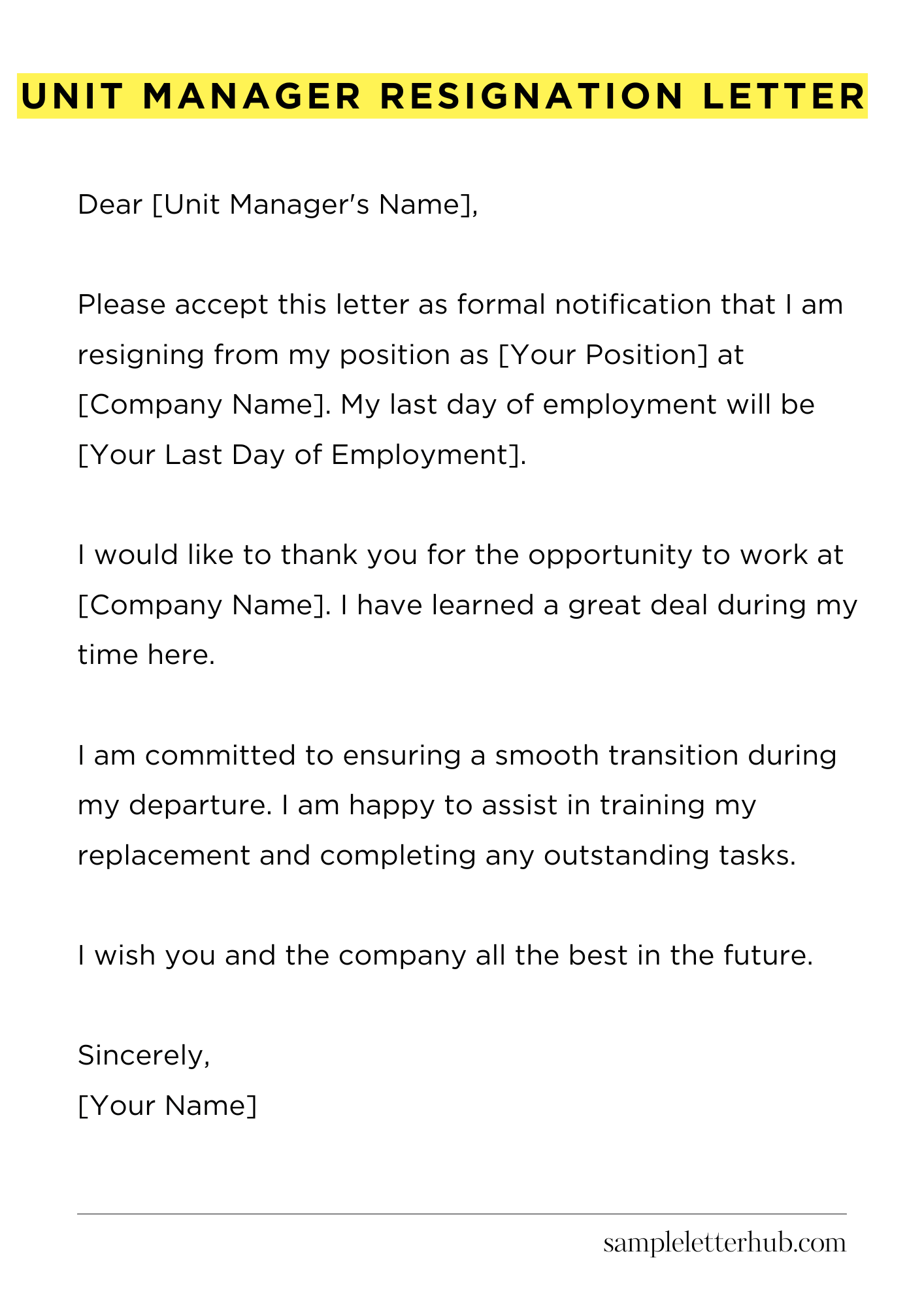
Dear [Unit Manager’s Name],
Please accept this letter as formal notification that I am resigning from my position as [Your Position] at [Company Name]. My last day of employment will be [Your Last Day of Employment].
I would like to thank you for the opportunity to work at [Company Name]. I have learned a great deal during my time here.
I am committed to ensuring a smooth transition during my departure. I am happy to assist in training my replacement and completing any outstanding tasks.
I wish you and the company all the best in the future.
Sincerely,
[Your Name]
How to Write a Unit Manager Resignation Letter
1. Getting Started: The Basics You Need
So, you’re moving on from your role as a Unit Manager. Congrats! This is a big step, and you’ll need to make sure you handle your exit professionally. First things first: a resignation letter is crucial. It’s a formal document that officially notifies your employer of your departure. You’ll want to have it done right.
Before you even think about putting pen to paper (or fingers to keyboard), know your company’s policy. Some companies require a specific format or time frame for notice. Double-check your employee handbook or HR resources. Failing to follow these guidelines could lead to unwanted complications. Make sure you know what’s expected of you, and follow the rules.
2. Essential Elements: What to Include
Now, let’s talk about what actually goes in the letter. Begin with a clear and concise statement of your resignation. State your name, your current position as Unit Manager, and the exact date of your last day of employment. This is the core of the whole thing.
Next, express your gratitude. Acknowledge the opportunities and experiences you’ve gained during your time in the role. Briefly mention anything positive you’ve learned or the relationships you’ve valued. This shows respect, and it’s always a good idea. However, be sincere; no one likes a forced thank-you.
Consider offering assistance with the transition. This is not always expected, but it shows professionalism and can make your departure smoother. You might offer to help train your replacement, complete any ongoing projects, or provide documentation. Remember this is completely optional, but often appreciated.
Finally, end the letter on a positive note. Reiterate your appreciation and wish the company and your colleagues well. Keep it brief and avoid anything negative or overly critical. Think of this as the final impression you are leaving. Make it a good one.
3. Format and Tone: Keeping it Professional
Your resignation letter needs to look professional. A well-formatted letter reflects well on you. Use a standard business letter format. Include your contact information (name, address, phone, email) at the top. Date the letter, and address it to your direct supervisor or the appropriate HR representative.
The tone should be formal and respectful. Avoid slang or overly casual language. Even if you’re leaving because of a bad experience, keep your tone polite and professional. Your goal here is to leave a good impression, not burn bridges. Also, be careful with your grammar and spelling.
Keep it brief! Resignation letters are not the place for lengthy explanations or elaborate details. Aim for one page maximum. Get to the point directly. You don’t want your manager to become tired.
4. What to Avoid: Common Mistakes
There are some things you absolutely should *not* include. Avoid negativity, complaints, or personal grievances. This isn’t the place to air your dirty laundry. Resist the temptation to list all the things you disliked about the job or the company.
Do not share confidential information. This includes details about company operations, customer data, or any proprietary information. Keep your departure clean and ethical.
Avoid burning bridges. No matter how you feel about your employer, refrain from making disparaging remarks about your colleagues or the company. Think carefully about your future in your field.
Finally, don’t just email your resignation. In most cases, a formal, printed letter is expected. It shows a higher level of respect and professionalism.
5. Putting it All Together: Example and Delivery
Here’s a basic template to get you started. Remember to customize it to your specific situation:
    [Your Name]
    [Your Address]
    [Your Phone Number]
    [Your Email Address]

    [Date]

    [Supervisor's Name]
    [Supervisor's Title]
    [Company Name]
    [Company Address]

    Dear [Supervisor's Name],

    Please accept this letter as formal notification that I am resigning from my position as Unit Manager at [Company Name], effective [Your Last Day of Employment].

    Thank you for the opportunities I have been given during my time at [Company Name]. I have valued my time here and have learned a great deal.

    [Optional: Offer assistance with transition]

    I wish you and [Company Name] all the best in the future.

    Sincerely,
    [Your Signature]
    [Your Typed Name]
Once you’ve written your letter, proofread it carefully. Double-check all dates and names. Print it out, sign it, and deliver it in person (if possible) to your supervisor. Make sure you keep a copy for your records. The whole process, from the first thought to the last, should be as simple as possible.
FAQs about Unit Manager resignation letter
How do I format a Unit Manager resignation letter?
A Unit Manager resignation letter should follow a professional business letter format. Include your contact information, the date, the recipient’s contact information (typically your supervisor or HR), a formal salutation (e.g., “Dear [Manager’s Name]”), a clear statement of your resignation and effective date, a brief expression of gratitude for the opportunity.
What should I include in my Unit Manager resignation letter?
Your letter should include your intent to resign, the effective date of your resignation (which aligns with your employment contract or company policy), a brief and polite statement of gratitude for your employment, and optionally, a very general reason for leaving.
You may also offer assistance with the transition process. It’s best to keep it concise and positive, focusing on the facts of your departure.
Do I need to give a reason for resigning in my Unit Manager resignation letter?
While not mandatory, it’s often customary to briefly state your reason for leaving. You can keep it vague and positive, such as “pursuing other opportunities” or “seeking a new challenge.” Avoid negative comments about your employer or colleagues. If you prefer to keep the reason private, you can simply state your resignation with the effective date.
How much notice should I give when resigning as a Unit Manager?
The amount of notice required is typically outlined in your employment contract or company policy. Common notice periods are two to four weeks. Always adhere to the terms of your contract. Providing more notice than required is always appreciated and can help maintain a positive relationship with your employer.
Can I use a template for my Unit Manager resignation letter?
Yes, using a template is perfectly acceptable and can be a good starting point. However, always personalize the template to reflect your specific situation, company details, and the recipient’s name. Review the template carefully to ensure it aligns with your intent and professionalism. You can find many reputable online resources that offer suitable templates for customization.
Related:
Resignation letter due to rude boss
Resignation letter moving to another state
Resignation letter due to illness of family member
Resignation letter due to study