

You’re between jobs. You need to resign from your current role. An “unemployed resignation letter” helps. It formally ends your employment. The purpose is to create a clean break. It helps to maintain a professional image.
Need help crafting your own letter? You’re in the right place. We’ve got you covered. We’ll share some templates. We’ll also provide examples. These samples make it simple. Adapt these to fit your unique situation.
We aim to make things easy. Writing a resignation letter shouldn’t be hard. Let’s get started. Find the perfect words now.
Unemployed Resignation Letter
Below is a sample of a Unemployed Resignation Letter:
[Your Name]
[Your Address]
[Your Phone Number]
[Your Email Address]
[Date]
[Employer’s Name]
[Company Name]
[Company Address]
Dear [Employer’s Name],
Please accept this letter as formal notification that I am resigning from my position as [Your Job Title] at [Company Name], effective immediately.
I am resigning from my position because I am currently unemployed and actively seeking new opportunities. This decision allows me to dedicate my time and energy to securing a new position.
I want to thank you for the opportunity to have worked here. I have learned a lot during my time here, and I appreciate the experiences I have gained.
I am available to assist with the transition of my duties during the next few days. Please let me know how I can be of help.
I wish you and the company all the best in the future.
Sincerely,
[Your Name]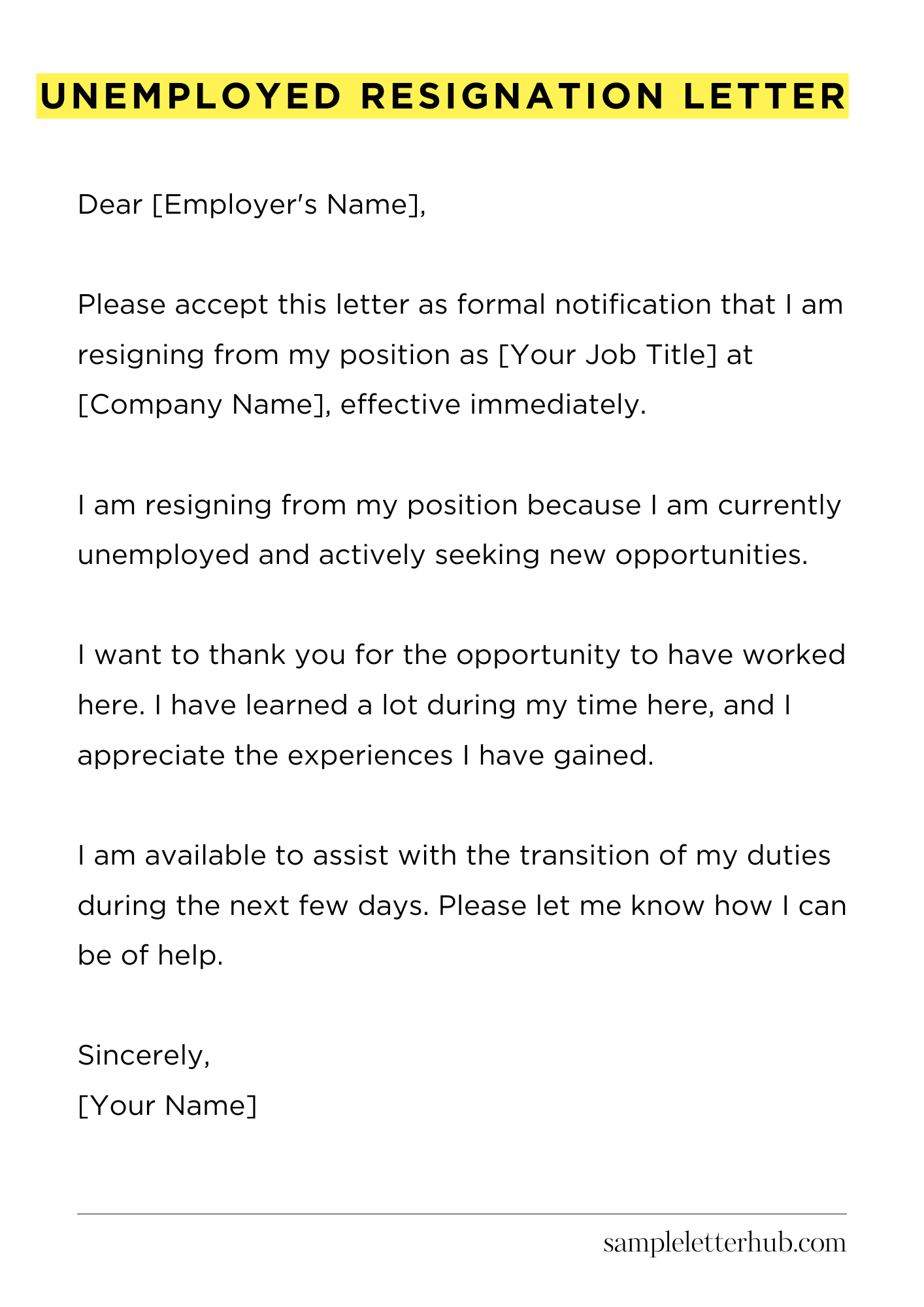
How to Write an Unemployed Resignation Letter
Why Resign When You Don’t Have a Job?
So, you’re wondering why you need to write a resignation letter when you’re unemployed. Makes sense, right? Well, there are a few key reasons. First, you might be exiting a temporary position, like a contract role, and need to officially end the agreement. You also want to maintain professionalism, which is critical for future job prospects.
Leaving a positive impression, even in a temporary or part-time job, can lead to good references and networking opportunities down the line. Finally, it can simply offer closure. It’s an official record of your departure, something you might need for your own records or potential unemployment benefits documentation.
Formatting is Key: Structure for Success
Formatting matters a lot! Your letter needs to look professional. Begin with your contact information (name, address, phone number, email) at the top, followed by the date. Then, add the employer’s information – their name, job title, and company address. Next comes the salutation: “Dear [Manager’s Name],” is standard.
If you don’t know the manager’s name, use “Dear Hiring Manager” or “To Whom It May Concern,”. Keep the letter concise and to the point. Aim for one page maximum. A well-formatted letter demonstrates attention to detail. This can also show how you communicate which is a key skill employers look for. Always proofread before sending!
The Core Content: What to Include
Now, let’s look at the body of the letter. First, state your intention clearly: “I am writing to formally resign from my position as [Your Job Title] at [Company Name].” Next, mention your last day of employment. Be sure to align this with your contract, if there is one. Include the date of your last day.
You might add a brief expression of gratitude for the opportunity. You can mention any positive experiences or skills you gained, but keep it brief. Finally, finish with a professional closing: “Sincerely,” or “Respectfully,” followed by your full name. Make sure you sign the letter after printing it!
Handling Sensitive Situations and Contractual Obligations
If you’re resigning from a situation with specific contractual obligations, be extra cautious. Check your employment contract carefully for notice periods, non-compete clauses, or other stipulations. Always adhere to these terms. If you have any concerns about these terms or are unsure how to proceed, consider consulting an employment lawyer.
Even if you’re unemployed, certain agreements might still apply. You want to avoid any potential legal issues. Consider providing additional information if needed, depending on company policy.
The Finishing Touches: Proofreading and Delivery
Proofreading is essential. Read your letter multiple times! Check for any typos, grammatical errors, and ensure the tone is professional and respectful. Ask a friend or family member to review it as well. Once you’re satisfied, choose the appropriate delivery method. If you can, deliver a hard copy and an email version to the necessary people.
In some cases, an email alone might suffice, but always confirm the preferred method with your employer. Keep a copy of your letter for your records. After you have submitted the letter, you can move on to your next opportunity.
FAQs about Unemployed Resignation Letter
What is the purpose of an unemployed resignation letter?
An unemployed resignation letter serves as a formal written notice to a previous employer, officially stating your departure from the company, even if you were unemployed at the time of the letter.
It typically confirms your intent to leave, specifies the effective date of your resignation, and may also express gratitude or offer a reason for leaving. It is a courteous way to close out your employment and could be important for background checks or future opportunities.
What information should be included in an unemployed resignation letter?
An effective unemployed resignation letter should include your full name, the date, the name of your former employer, and the date you are resigning.
It should also specify your job title if you held one, and a clear and concise statement of your resignation. Furthermore, it is common to include a brief expression of gratitude for the opportunity to have worked there. Finally, include your signature.
How should I format an unemployed resignation letter?
The format of the letter should be professional. Begin with a formal salutation (e.g., “Dear [Manager’s Name]”), followed by the body of the letter. The body should clearly state your resignation, effective date, and any other relevant information. Keep the tone polite, and concise.
End with a professional closing (e.g., “Sincerely,” or “Respectfully,”), followed by your typed name and signature. Use a standard business letter format (e.g., block format).
Is it necessary to provide a reason for resigning in the letter?
While not strictly required, providing a reason for your resignation can be helpful, especially if you wish to maintain a positive relationship with your former employer. A brief, neutral explanation (e.g., “pursuing new opportunities” or “focusing on personal goals”) is often sufficient.
If you do not wish to provide a reason, you are not obligated to do so, and you can simply state your resignation. However, keeping the letter professional and concise is of utmost importance.
Should I send an unemployed resignation letter via email or postal mail?
The method of delivery depends on the company’s policy and your previous communication with the employer. Generally, email is the most efficient and common method, especially if it was the primary way you communicated during your employment. If you are unsure, you can inquire with the company or HR department. Always retain a copy for your records.
Related:
Resignation letter due to rude boss
Resignation letter moving to another state
Resignation letter due to illness of family member
Resignation letter due to study