

Ever been asked to provide extra information to your travel insurance company? That’s where the Travel Insurance Additional Documents Submission Letter comes in. It’s a formal letter you write. Its purpose is to submit any requested documentation.
This could include things like medical records, receipts, or police reports. It ensures your travel insurance claim is processed correctly.
Navigating the process can feel tricky. Luckily, we’re here to help. We’ve got you covered with Travel Insurance Additional Documents Submission Letter samples! We’ll share templates and examples. This will help you easily create your own letter. Need a quick solution for your travel insurance claim? We make it easy.
Crafting the perfect letter is simple with our guide. We offer various sample letters. You can customize them for your specific situation. Whether it’s a flight cancellation or a medical emergency, these templates are ready to use. Save time and get your claim moving with our expert help.
[Your Name/Company Name]
[Your Address]
[Your Phone Number]
[Your Email Address]
[Date]
[Insurance Company Name]
[Insurance Company Address]
Subject: Submission of Additional Documents for Travel Insurance Claim – Policy Number [Your Policy Number]
Dear Sir/Madam,
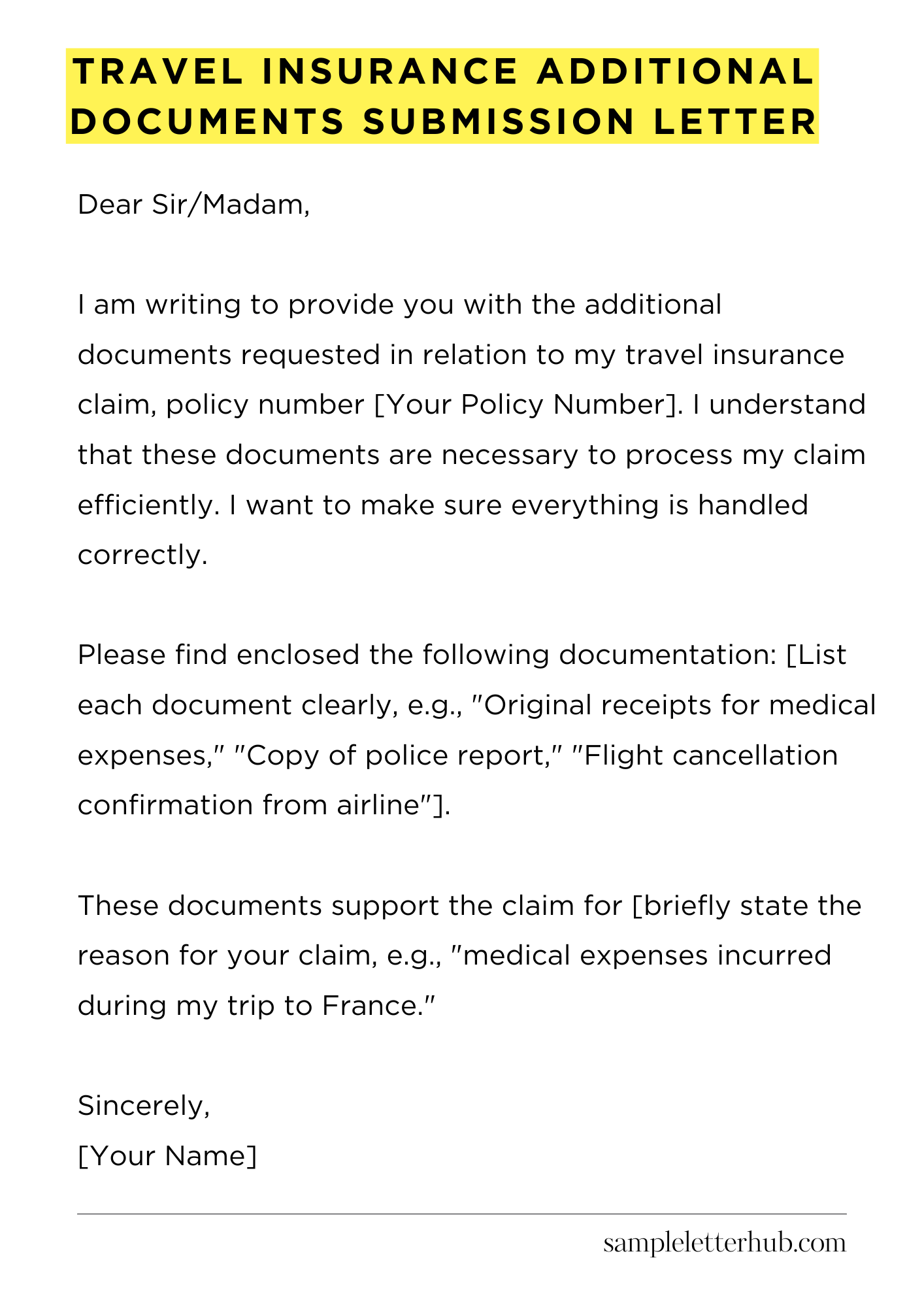
I am writing to provide you with the additional documents requested in relation to my travel insurance claim, policy number [Your Policy Number]. I understand that these documents are necessary to process my claim efficiently. I want to make sure everything is handled correctly.
Please find enclosed the following documentation: [List each document clearly, e.g., “Original receipts for medical expenses,” “Copy of police report,” “Flight cancellation confirmation from airline”]. Each document is carefully organized. I have also included a brief description beside each.
These documents support the claim for [briefly state the reason for your claim, e.g., “medical expenses incurred during my trip to France,” or “cancellation of my flight to Italy due to illness”]. This information should further assist with the resolution. I hope it helps to speed things up.
I have taken the utmost care to ensure the accuracy and completeness of these submissions. If you require any further information or clarification, please do not hesitate to contact me at your earliest convenience. I am readily available.
Thank you for your time and attention to this matter. I appreciate your assistance in processing my claim. I eagerly await your response regarding the status of my claim.
Sincerely,
[Your Name]
How to Write Travel Insurance Additional Documents Submission Letter
Submitting additional documentation for your travel insurance claim can seem daunting, but it doesn’t have to be. Crafting a concise and persuasive letter is key to a smooth and efficient claims process.
This guide provides you with a clear roadmap to navigate this often-necessary endeavor, ensuring your documents are properly presented for a swift resolution. Let’s delve into the nuances of composing an effective submission letter.
1. Subject Line: The Initial Salvo
Your subject line is your initial opportunity to capture attention. It should be succinct, explicit, and instantly informative. Avoid ambiguity.
Use a subject line such as “Travel Insurance Claim – Document Submission – [Your Policy Number]” or “Additional Documentation for Claim [Claim Number] – [Your Name]”. This clarity immediately informs the recipient of the letter’s purpose and allows for expeditious categorization.
2. The Salutation: A Formal Beginning
Start with a professional salutation. Use “Dear [Insurance Company Name] Claims Department,” or “To Whom It May Concern,” depending on the specific instructions provided by your insurer. Avoid casual greetings; a formal tone sets the right precedent and demonstrates respect for the process.
3. Contextual Cadence: State Your Case
The first paragraph should provide essential context. Briefly reiterate your claim details, including the policy number, claim number, and the date the claim was initially filed.
Briefly mention the nature of the claim (e.g., medical expenses, lost baggage) and the date the event occurred. This immediate recap aids in swift retrieval of your existing claim records.
4. Itemized Inventory: Presenting Your Exhibits
This is where you showcase the documentation. Create a clear, numbered list of each document you are submitting. Be specific. For instance:
- Original medical report from Dr. Smith, dated October 26, 2024.
- Receipt for medication purchased at CVS Pharmacy, dated October 27, 2024.
- Police report reference number ABC123, filed October 28, 2024.
This meticulous listing ensures each document is easily identifiable. This organized approach minimizes the chances of oversight or delay, expediting the adjudication procedure.
5. The Core Argument: Substantiating Your Claim
In this section, briefly explain the significance of each document, relating it directly to your claim. You do not need to rewrite the entire scenario, instead, offer concise explanations.
For example, “The medical report substantiates the injury sustained during the incident,” or “The receipt serves as proof of the expenses incurred for the prescribed medication.” These brief statements demonstrate the evidential value of your submission.
6. The Call to Action and Closure: Ensuring Follow-Up
End your letter with a clear call to action. State what you expect to happen next. For example, “I kindly request that you review the attached documents and process my claim accordingly,” or “Please let me know if any further information is required.”
Include your contact information (phone number, email address) for quick communication. Conclude with a professional closing, such as “Sincerely,” or “Respectfully,” followed by your full name and signature (if sending a physical letter). This ensures efficient and transparent follow-up if needed.
7. Document Delivery and Format: The Final Touches
Adhere to the insurance company’s preferred method of submission (e.g., email, postal mail). If submitting electronically, ensure all documents are scanned clearly and legibly. Utilize a format such as PDF for archival and compatibility. If mailing, consider using certified mail with return receipt requested to confirm receipt.
Proofread your letter meticulously before submitting; grammatical errors and typos can detract from your credibility. A well-formatted, error-free letter is a testament to your professionalism, improving the odds of a favorable outcome in the claim’s evaluation.
FAQs about Travel Insurance Additional Documents Submission Letter
What types of documents are typically requested in a travel insurance additional documents submission letter?
Travel insurance companies commonly request documentation to support a claim, verify eligibility, or assess the nature of a reported incident. These documents can include but are not limited to: medical reports (doctor’s notes, medical bills, diagnostic results), police reports (for theft, accidents).
What is the purpose of submitting additional documents for a travel insurance claim?
The submission of additional documents serves several crucial purposes in the claims process. Primarily, it allows the insurance company to validate the legitimacy of a claim by verifying the facts of the incident and the expenses incurred.
These documents are also used to determine coverage based on the policy terms, assess the extent of the loss or damage, and calculate the appropriate payout amount. The review of supporting documentation ensures fairness and accuracy in the claim settlement process.
How should I submit the additional documents requested in the letter?
The travel insurance company’s additional documents submission letter typically specifies the accepted methods for submission. These methods often include secure online portals, email attachments (ensuring the attachment size and file format meet the requirements), mail, or, in some cases, fax.
It’s crucial to carefully follow the instructions provided in the letter regarding the preferred submission method, the required file formats (e.g., PDF, JPEG), and any deadlines. Always retain copies of all submitted documents and maintain communication records with the insurer.
What happens if I fail to submit the requested documents by the deadline specified in the letter?
Failure to submit the requested documents by the deadline outlined in the additional documents submission letter can have significant consequences.
The insurance company may delay the processing of the claim, potentially leading to a denial of coverage. Many policies have clauses stating that claims may be rejected if the required information is not provided within the specified timeframe.
Contacting the insurer immediately if you foresee any difficulty in meeting the deadline is crucial to potentially arranging an extension.
How can I ensure that the submitted documents are accepted and processed correctly?
To ensure your documents are accepted and processed correctly, begin by carefully reviewing the requirements specified in the letter. Make sure all documents are legible and complete, including all pages if a multi-page document is required.
Clearly label each document with the claim number and the type of document. If submitting electronically, use the proper file format and ensure the file size is within the allowed limits. It’s advisable to make a copy of all documents before submission, and if you are submitting by mail or fax, consider sending them using a trackable method to confirm receipt.
Related:
Resignation letter due to rude boss
Resignation letter moving to another state
Resignation letter due to illness of family member
Resignation letter due to study