

Facing a loss due to theft? A Theft Claim Request Letter is your official way of seeking compensation. Its purpose is to inform an insurance company or relevant party about the theft. You are basically requesting them to cover your financial losses. This helps you get reimbursed for stolen property.
We understand writing these letters can be tricky. That’s why we’re here to help! We’ll provide you with various Theft Claim Request Letter templates. You’ll find different examples, samples, and guides. This makes it easy for you to tailor a letter for your specific situation.
Need to file a theft claim? We have got you covered. This article simplifies the process. Access ready-to-use theft claim letter samples. Get started writing your request letter today.
[Your Name]
[Your Address]
[Your Phone Number]
[Your Email Address]
[Date]
[Name of Insurance Company/Recipient]
[Address of Insurance Company/Recipient]
Subject: Theft Claim Request – Policy Number [Your Policy Number]
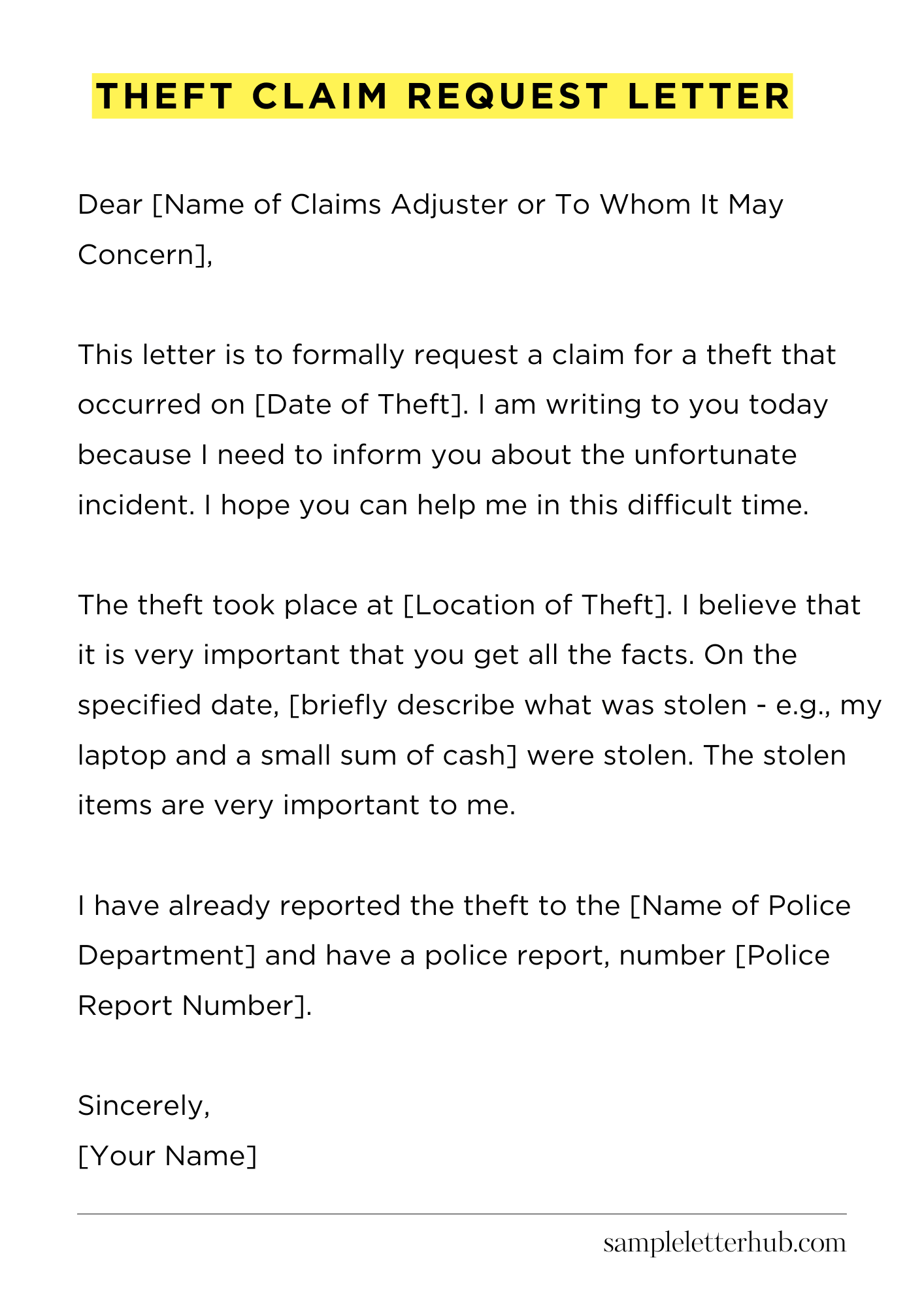
Dear [Name of Claims Adjuster or To Whom It May Concern],
This letter is to formally request a claim for a theft that occurred on [Date of Theft]. I am writing to you today because I need to inform you about the unfortunate incident. I hope you can help me in this difficult time.
The theft took place at [Location of Theft]. I believe that it is very important that you get all the facts. On the specified date, [briefly describe what was stolen – e.g., my laptop and a small sum of cash] were stolen. The stolen items are very important to me.
I have already reported the theft to the [Name of Police Department] and have a police report, number [Police Report Number]. I will provide a copy of this report with this letter. The police are investigating the theft. This should prove helpful to your investigation as well.
I am including supporting documentation with this claim. This should assist with the claim process. This includes [List of documents you are including – e.g., photos of the damaged property, receipts for the stolen items, etc.]. These documents will help to verify my claim.
I would appreciate it if you could start processing this claim as soon as possible. I would like to know the next steps in this process. Please let me know what further information you might need from me. You can reach me at the phone number or email address listed above.
Thank you for your time and consideration. I look forward to hearing from you soon.
Sincerely,
[Your Name]
How to Write a Theft Claim Request Letter
A theft claim request letter is your formal plea for recompense after a loss due to pilferage. It’s a crucial document that needs to be crafted with precision. Failing to do so can result in the nullification of your claim. Let’s look at the crucial elements of composing an effective theft claim request.
1. Initiate with Your Salutation and Personal Information
Begin your letter with a formal salutation. Address the recipient appropriately; usually, it’s the insurance adjuster, or loss adjusting company.
Follow this with your full name, current address, phone number, and email address. You must provide all this information at the onset. This clarifies the identity of the claimant and facilitates communication. Ensure the information is current and accurate.
2. State the Incident and the Pertinent Details
The core of your letter should unambiguously describe the theft incident. Be precise. Detail the date, time, and exact location where the theft transpired. Elaborate on the specifics of what was stolen.
This involves item descriptions, including brand names, model numbers, serial numbers, and any unique identifiers. If possible, include where the items were stored or kept. The more comprehensive your description, the better.
3. Provide Documentation and Supporting Evidence
Attach all relevant documentation to bolster your claim. This includes police reports, invoices, receipts, photographs, and any other evidence that substantiates your loss.
Police reports corroborate the occurrence of the theft. Invoices demonstrate the value of the stolen goods. Photographs offer visual proof of ownership and the condition of the items before the incident. Ensure each document is clearly labeled and referenced within your letter. This step is pivotal; a claim is only as solid as its supporting evidence.
4. Specify the Claimed Value and Desired Relief
Clearly state the monetary value of your claimed loss. List the value of each item stolen, providing a grand total. If you have insurance, reference the policy number.
Explicitly state the type of reimbursement you are seeking. Are you pursuing compensation for replacement, repair, or the monetary equivalent of the stolen items? Be succinct and direct in your request.
5. Review Policy Terms and Stipulations
Thoroughly scrutinize your insurance policy or any relevant agreements. Understand the terms, conditions, and exclusions. Confirm your claim falls within the purview of the policy. Familiarize yourself with the deductible. Know what the policy covers and what it does not. This exercise prevents misunderstandings and potential claim denials.
6. Compose a Professional Closing and Signature
Conclude your letter with a professional closing. Use a formal sign-off, such as “Sincerely” or “Respectfully.” Sign your full name, and if applicable, type your name beneath your signature for clarity. Include your contact information again, just to eliminate any chance of miscommunication. This reaffirms your intent and completes the formality of the letter.
7. Proofread and Deliver Your Letter
Before dispatching your letter, meticulously proofread it for any grammatical errors, spelling mistakes, or inconsistencies. Ensure the tone is professional, and the language is clear and concise.
Make copies of the letter and all attached documents for your records. Send the letter via certified mail with return receipt requested. This provides proof of delivery and ensures a record of your communication. Doing this will save you a lot of hassle in the long run.
FAQs about Theft Claim Request Letter
What is a theft claim request letter?
A theft claim request letter is a formal document submitted to an insurance company or relevant authority to report a theft and initiate the process of claiming compensation for the stolen items or losses incurred.
This letter serves as the official notification of the incident and provides detailed information about the event, the stolen property, and the desired outcome, which is typically reimbursement or replacement of the lost items.
What information should be included in a theft claim request letter?
A comprehensive theft claim request letter should include the date of the theft, the location where it occurred, a detailed description of the stolen items (including make, model, serial numbers if available, and estimated value), a description of the circumstances surrounding the theft, a copy of the police report (if filed).
How do I write a theft claim request letter?
To write an effective theft claim request letter, start with your contact information, the date, and the recipient’s contact information (insurance company or relevant authority). Clearly state that you are reporting a theft. Provide the necessary details as mentioned previously, ensuring clarity and accuracy.
Keep the language professional and concise. Attach all supporting documentation. Conclude with a request for prompt processing of your claim and your contact details for further communication. It’s generally best to keep a copy of the letter and all attachments for your records.
When should I file a theft claim request letter?
You should file a theft claim request letter as soon as possible after discovering the theft. Most insurance policies and legal procedures have time limitations for reporting claims, often within a specific timeframe, such as a month or two. Prompt action increases the chances of a successful claim.
Delays could be construed as lack of evidence or potential fraudulent intent. Consult your insurance policy or local laws for precise deadlines.
What happens after I submit a theft claim request letter?
After submitting the letter and related documents, the insurance company or authority will review your claim. They may conduct an investigation, which could involve contacting you for clarification, asking for additional information, or verifying the details with the police or other relevant parties.
They will then assess the claim based on the provided information, your policy terms, and their internal procedures. You will be notified of their decision, which could include approval, denial, or a request for more information. If approved, the company will process the reimbursement or replacement as per the policy.
Related:
Resignation letter due to rude boss
Resignation letter moving to another state
Resignation letter due to illness of family member
Resignation letter due to study