

A “Test resignation letter” isn’t a real resignation. It’s a practice letter. The purpose? To help you prepare. It lets you rehearse what you’ll say. It can help you feel more confident.
We understand that crafting the perfect words is hard. That’s why we’re here. We’ll give you plenty of examples. They are templates to inspire you. You can use these to help write any letter.
Consider this your creative launchpad. Need to announce a new job? Thinking about a career change? These samples will make it easier. Get ready to write with clarity and ease.
Test Resignation Letter
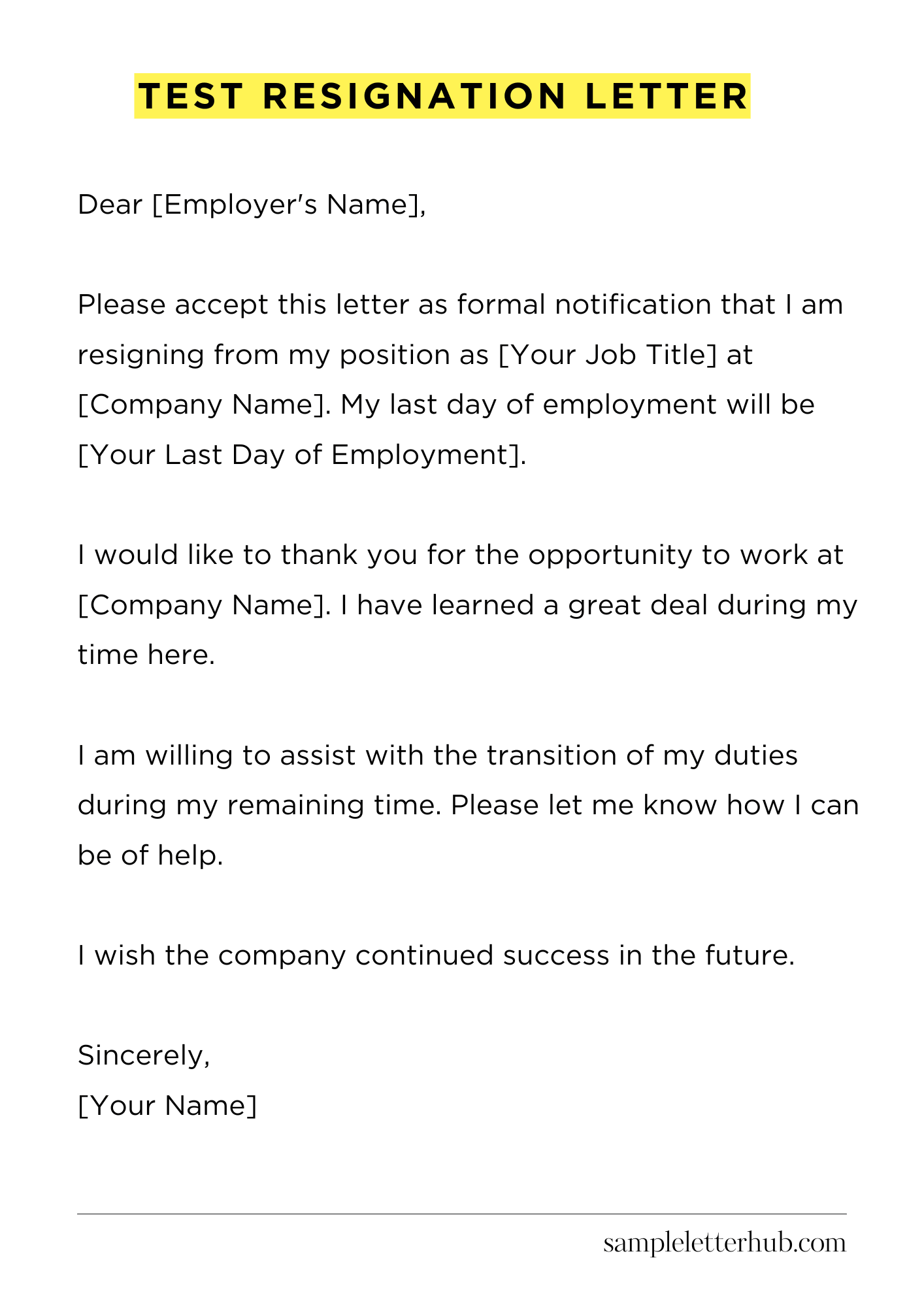
Below is a sample of a Test Resignation Letter:
[Your Name]
[Your Address]
[Your Phone Number]
[Your Email Address]
[Date]
[Employer’s Name]
[Employer’s Title]
[Company Name]
[Company Address]
Dear [Employer’s Name],
Please accept this letter as formal notification that I am resigning from my position as [Your Job Title] at [Company Name]. My last day of employment will be [Your Last Day of Employment].
I would like to thank you for the opportunity to work at [Company Name]. I have learned a great deal during my time here.
I am willing to assist with the transition of my duties during my remaining time. Please let me know how I can be of help.
I wish the company continued success in the future.
Sincerely,
[Your Name]
How to Write a Test Resignation Letter
1. Why Bother with a Test Run?
Before you send that resignation letter, you might want to consider a “test run.” Think of it as a dress rehearsal before the big show. This is particularly useful if you’re unsure about the wording, tone, or even the date you want to leave. A test resignation letter gives you the chance to refine your approach.
This allows you to avoid any potential awkwardness or regret later on. It’s a low-risk way to practice delivering potentially difficult news. Plus, you can make sure everything is perfect before hitting “send.”
2. What to Include (and Exclude)
A test resignation letter, like the real thing, should include key elements. First, your full name, the date, and your manager’s name. You then need a clear and concise statement of your intention to resign. The date of your last day of employment is also crucial, unless you haven’t yet decided.
Keep your reasons for leaving brief and professional. While you might want to vent, resist the urge. You can express gratitude for the opportunity to work there. Do not include excessive details about why you are leaving. A quick “for new opportunities” or something similar works perfectly. You do not need to list any specifics unless you want to.
3. The Tone: Professional and Positive
The tone of your letter is incredibly important. You want to maintain a professional demeanor, even if you are unhappy. Even when it is a test letter. Stick to formal language. Avoid slang or overly casual expressions. This shows respect for your employer, even if this is just a practice run.
Focus on the positives of your time at the company, if applicable. Acknowledging what you’ve learned or the relationships you’ve built can leave a positive impression. You can also express your willingness to assist with the transition. But you do not have to, particularly in a test letter.
4. Practicing Your Delivery and Timing
Once you’ve written your test letter, practice reading it aloud. This will help you identify any awkward phrasing or areas where you stumble. This also helps with the real letter, and helps you practice the actual delivery. Consider the timing of your resignation. Think about when you want to leave, and make sure your proposed last day reflects that.
Try sending the test letter to yourself or a trusted friend for feedback. They can offer an objective perspective on the tone and content. This will help you prepare the real letter.
5. Refining and Finalizing for the Real Thing
After reviewing the test letter and incorporating any feedback, it’s time to refine it for the actual resignation. Make any necessary edits to the wording, dates, or other details. Double-check your contact information, the recipient’s name, and company’s name.
Once you are satisfied, it is time to say goodbye to your workplace, if you choose. Remember to keep a copy of your letter for your records. Then you can send the letter with confidence, knowing you’ve prepared thoroughly.
FAQs about Test Resignation Letter
What is a test resignation letter and why would I need one?
A test resignation letter, also known as a sample or template resignation letter, is a document used to practice or experiment with the format and content of a resignation letter.
You might need one to understand the proper structure, wording, and tone for officially informing your employer of your intention to leave your job. It’s a risk-free way to familiarize yourself with the process before writing your actual resignation.
What should be included in a test resignation letter?
A test resignation letter should generally include the following elements: your intention to resign, the date of resignation, your official job title, a brief expression of gratitude (optional), and your signature. It’s crucial to tailor the content to reflect your specific situation while adhering to professional standards.
Can I use a test resignation letter as a real resignation?
No, a test resignation letter is not intended for use as an official notification of your departure. It is solely meant for practice and understanding the structure. If you submit a test letter without understanding its purpose, you will not receive your pay and benefits.
Where can I find sample test resignation letters?
Numerous online resources offer sample resignation letters. You can find templates on websites specializing in career advice, human resources, or job searching. These samples can serve as a starting point for crafting your practice letter.
What are some common mistakes to avoid when writing any resignation letter?
When composing any resignation letter, whether a test or real one, avoid the following: including negative comments about your employer or colleagues, being overly emotional, providing excessive explanations for your departure, and failing to proofread the document for errors in grammar, spelling, and punctuation. Maintaining a professional and respectful tone is crucial.
Related:
Resignation letter due to rude boss
Resignation letter moving to another state
Resignation letter due to illness of family member
Resignation letter due to study