

So, you’re a Test Engineer looking to move on? A resignation letter is your official goodbye. It’s a formal document. It informs your employer of your departure. It also states your last day of employment.
Writing this letter can feel tricky. Don’t worry, we’ve got you covered. We’ve compiled various templates. We’ll share some examples for Test Engineer resignation letters.
We provide a range of samples. You can adapt them to your specific situation. This article will help you craft a professional letter. It will make your resignation process smoother.
Test Engineer Resignation Letter
Below is a sample of a Test Engineer Resignation Letter:
[Your Name]
[Your Address]
[Your Phone Number]
[Your Email Address]
[Date]
[Employer’s Name]
[Company Name]
[Company Address]
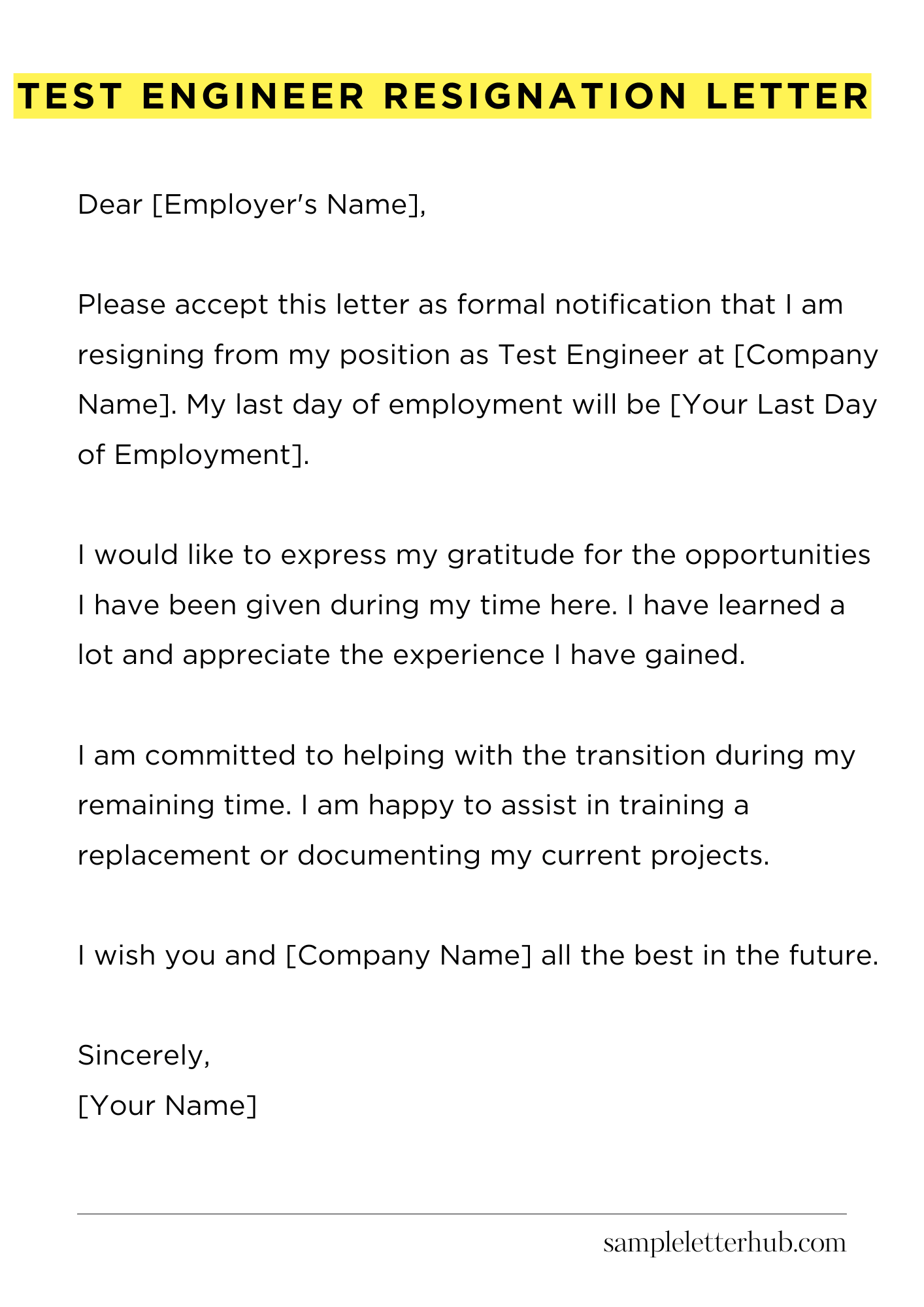
Dear [Employer’s Name],
Please accept this letter as formal notification that I am resigning from my position as Test Engineer at [Company Name]. My last day of employment will be [Your Last Day of Employment].
I would like to express my gratitude for the opportunities I have been given during my time here. I have learned a lot and appreciate the experience I have gained.
I am committed to helping with the transition during my remaining time. I am happy to assist in training a replacement or documenting my current projects.
I wish you and [Company Name] all the best in the future.
Sincerely,
[Your Name]
How to Write Test Engineer Resignation Letter
Leaving a job is never the easiest thing. But sometimes, it’s necessary. If you’re a Test Engineer and you’ve decided to move on, you’ll need to write a resignation letter. This isn’t just a formality; it’s a critical document. Here’s how to write a resignation letter that’s professional, clear, and leaves a good impression.
1. Keep it Concise and Direct
Get straight to the point. Your resignation letter should be brief and to the point. Start by clearly stating your intention to resign from your position as Test Engineer. Avoid rambling or providing unnecessary details. Keep it focused.
For example, you could start with something like this:
“Dear [Manager’s Name],
Please accept this letter as formal notification that I am resigning from my position as Test Engineer at [Company Name], effective [Your Last Day of Employment].”
Simple, right? Remember, clarity is key. It sets a professional tone from the start.
2. Express Gratitude (Always a Good Idea)
Even if you’re leaving for a challenging reason, it’s always a good idea to express gratitude. This is part of maintaining a positive professional relationship. You can simply thank your employer for the opportunity to work there. A brief sentence acknowledging your experiences and the skills you gained is more than enough.
Consider this example:
“I am grateful for the opportunities I have been given during my time here at [Company Name].”
This shows respect and leaves the door open for future possibilities.
3. State Your Last Day Clearly
Make sure you provide the exact date of your last day of employment. This is essential information that needs to be perfectly clear. Typically, you’ll work a standard two-week notice, but check your employment contract for the specifics.
The date ensures a smooth transition. Also, confirm you understand all the company’s policies regarding your exit.
4. Offer Assistance with Transition
Show your professionalism by offering to help with the transition. This may include training your replacement, documenting procedures, or completing any outstanding tasks. This demonstrates your commitment and willingness to ensure a smooth handover.
For instance, you might write:
“I am available to assist in the transition process to ensure a seamless handover of my responsibilities.”
This shows that you are a team player.
5. Proofread and Proofread Again
Before submitting your resignation letter, proofread it thoroughly. Check for any grammatical errors, typos, or inconsistencies. This demonstrates your attention to detail and reinforces your professionalism. Ensure the tone is appropriate.
Ask a friend or colleague to review your letter as well. A fresh set of eyes can often catch errors that you might have missed. Also, it is extremely important to ensure all the relevant information such as the name of the recipient (manager) and the company’s name is all correct.
Follow these steps, and you’ll create a Test Engineer resignation letter that leaves a positive lasting impression. Good luck with your future endeavors!
“`
“`html
FAQs about Test Engineer Resignation Letter
What is the primary purpose of a Test Engineer resignation letter?
The primary purpose of a Test Engineer resignation letter is to formally notify your employer of your intention to leave your position. It serves as an official record of your resignation and clarifies your last day of employment. This letter initiates the official departure process, allowing your employer to make necessary arrangements for your replacement and the handover of your responsibilities.
What essential information should be included in a Test Engineer resignation letter?
A well-crafted Test Engineer resignation letter should include your formal announcement of resignation, the date of your resignation, the effective last day of your employment (as per your contract or agreement), a brief expression of gratitude to your employer or specific individuals, and a clear indication of your willingness to assist in the transition process, such as offering to train your replacement or documenting your work. It’s also wise to include your contact information for future correspondence.
How much notice should a Test Engineer give in their resignation letter?
The amount of notice a Test Engineer should give in their resignation letter depends on the terms outlined in their employment contract or local labor laws. Typically, a minimum of two weeks’ notice is standard practice. However, the contract may specify a longer notice period. It’s important to review your contract before writing your letter to ensure you meet the required notice period. If no period is specified, two weeks is generally acceptable, but it’s best to confirm this with your company’s HR department.
Should a Test Engineer include a reason for leaving in their resignation letter?
Including a reason for leaving in a Test Engineer resignation letter is generally optional. While not required, you may choose to briefly state your reason, such as “to pursue another opportunity” or “for personal reasons.” However, it’s not necessary to go into great detail. Keeping it concise and professional is recommended. Focus on expressing your resignation and your commitment to a smooth handover.
How should a Test Engineer format their resignation letter?
A Test Engineer should format their resignation letter professionally. Begin with a formal salutation to your manager or the appropriate HR representative. Clearly state your intent to resign, followed by the effective date. Express gratitude for the opportunity to work at the company, and briefly mention your willingness to assist with the transition. Keep the tone professional, concise, and respectful. Use a formal closing, like “Sincerely” or “Best regards,” followed by your name and signature.
“`