


A “Teller Resignation Letter” is a formal document. It is written by a bank teller. The purpose is to officially inform their employer of their decision to leave their job. This letter is a crucial step in the resignation process. It ensures a smooth transition.
We understand that writing this type of letter can feel daunting. That’s why we’re here to help. We’ll share several templates. You will find different examples. These samples cover various situations.
Our goal is to make your task easier. Each sample offers a clear framework. You can adapt them to your specific circumstances. Craft a professional and polished resignation letter with ease.
Teller Resignation Letter
Below is a sample of a Teller Resignation Letter:
[Your Name]
[Your Address]
[Your Phone Number]
[Your Email Address]
[Date]
[Bank Manager’s Name] (or relevant person)
[Bank Name]
[Bank Address]
Dear [Bank Manager’s Name],
Please accept this letter as formal notification that I am resigning from my position as Teller at [Bank Name]. My last day of employment will be [Your Last Day of Employment].
I would like to thank you for the opportunity to work at [Bank Name]. I have enjoyed my time here and have learned a lot.
I am committed to ensuring a smooth transition during my departure. I am happy to assist in training my replacement and completing any necessary handover tasks.
Thank you for your understanding. I wish you and the bank all the best in the future.
Sincerely,
[Your Signature]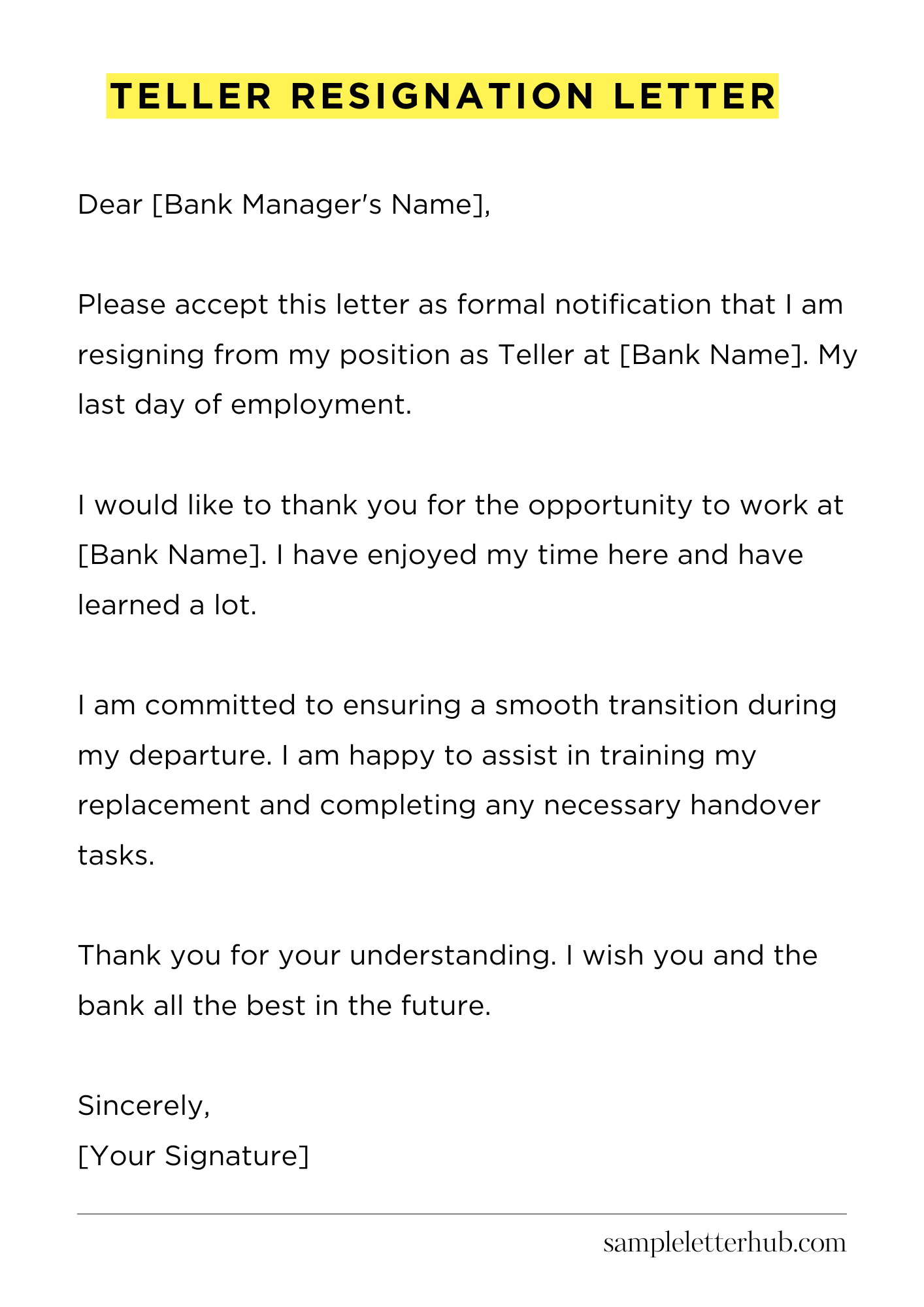
How to Write a Teller Resignation Letter
Know the Basics First
Resigning from any job can be tough, even when you are excited about what’s next. You want to leave on a good note. It’s important to do it professionally. The teller position is no different. A well-crafted resignation letter is your key to a smooth exit. First things first, it must be formal. This means using proper business letter format.
Your letter should be typed, not handwritten. The tone is very important too. Keep it positive and professional. No matter how you feel about your job, refrain from emotional outbursts.
Formatting is Key
Your letter needs to look professional. Begin with your full name and address. Then add the date. Next, include the employer’s name, title, and address. Start with a clear and concise salutation. “Dear Mr./Ms. [Last Name]” is the standard.
Use a professional and easy to understand font like Times New Roman, Arial, or Calibri, and use a 12-point font size. Indent each paragraph. The body of the letter is where you communicate your intention and should be straightforward and to the point.
State Your Intentions Clearly
The first paragraph is the most important. This is where you state your intention to resign. State the effective date of your resignation. For instance, “Please accept this letter as formal notification that I am resigning from my position as Teller, effective November 15, 2024.” Be direct and unambiguous.
This prevents any confusion. Always confirm your last day. This helps clarify when your employment officially ends. Clarity is paramount.
Express Gratitude and Offer Assistance
Always show your appreciation. Briefly thank your employer for the opportunity to work there. Mention anything you gained or the good experiences. This demonstrates professionalism and shows you are grateful for the experience. Offer assistance during the transition period.
“I am happy to assist in training my replacement or completing any outstanding tasks before my departure.” This makes the transition easier for your employer and shows your willingness to help. This kind of wording leaves a positive lasting impression.
Proofread and Submit
Before you send your letter, proofread it carefully. Check for any grammatical errors or typos. Always ask someone else to read it. Having another set of eyes can catch mistakes that you may have missed. Make sure you use formal language. Then, deliver the letter in person.
Give it to your manager or supervisor directly. Keep a copy for your records. This ensures you have a record of your resignation. Following these steps will help you leave your job professionally and maintain a good relationship with your previous employer.
FAQs about Teller resignation letter
How do I write a teller resignation letter?
A teller resignation letter should be concise and professional. Begin by stating your intention to resign, specify your last day of employment, express gratitude for the opportunity, and offer assistance with the transition. Keep it positive and avoid any negative comments about your employer or colleagues. Proofread carefully for any errors.
What information should I include in my teller resignation letter?
Your resignation letter should include your name, the date, your official job title (Teller), a clear statement of resignation, your last day of employment, and a brief expression of gratitude. It’s also polite to offer assistance during the transition period. Include your contact information (optional) for any further communication if needed.
When should I submit my teller resignation letter?
Typically, a teller should submit their resignation letter at least two weeks before their intended last day of employment. Check your employment contract or company policy for specific requirements. Submitting it earlier is often appreciated by the employer, allowing ample time for the transition.
Can I use a template for my teller resignation letter?
Yes, using a template for your teller resignation letter is perfectly acceptable. Many templates are available online, but make sure to customize it to your specific situation. Ensure it includes the essential elements and is tailored to the context of your employment as a teller.
What should I do after submitting my teller resignation letter?
After submitting your resignation letter, inform your supervisor or HR representative about any remaining tasks or training needed during your remaining time. Cooperate fully with the transition process, assist in training your replacement (if any), and complete any necessary exit procedures. Be professional and maintain a positive attitude until your last day.
Related:
Resignation letter due to rude boss
Resignation letter moving to another state
Resignation letter due to illness of family member
Resignation letter due to study