

Technical Services resignation letters are formal documents. They signal your departure from a technical services role. The main purpose is to officially inform your employer of your resignation. It also confirms your last day of employment.
This article simplifies the process. We will show you different letter formats. You’ll find templates, examples, and samples. Use these as a guide. Craft your own letter with ease.
Preparing to leave is easier than it seems. The templates are customizable. Adapt them to fit your specific needs. Say goodbye to guesswork. Start composing your letter now.
Technical Services Resignation Letter
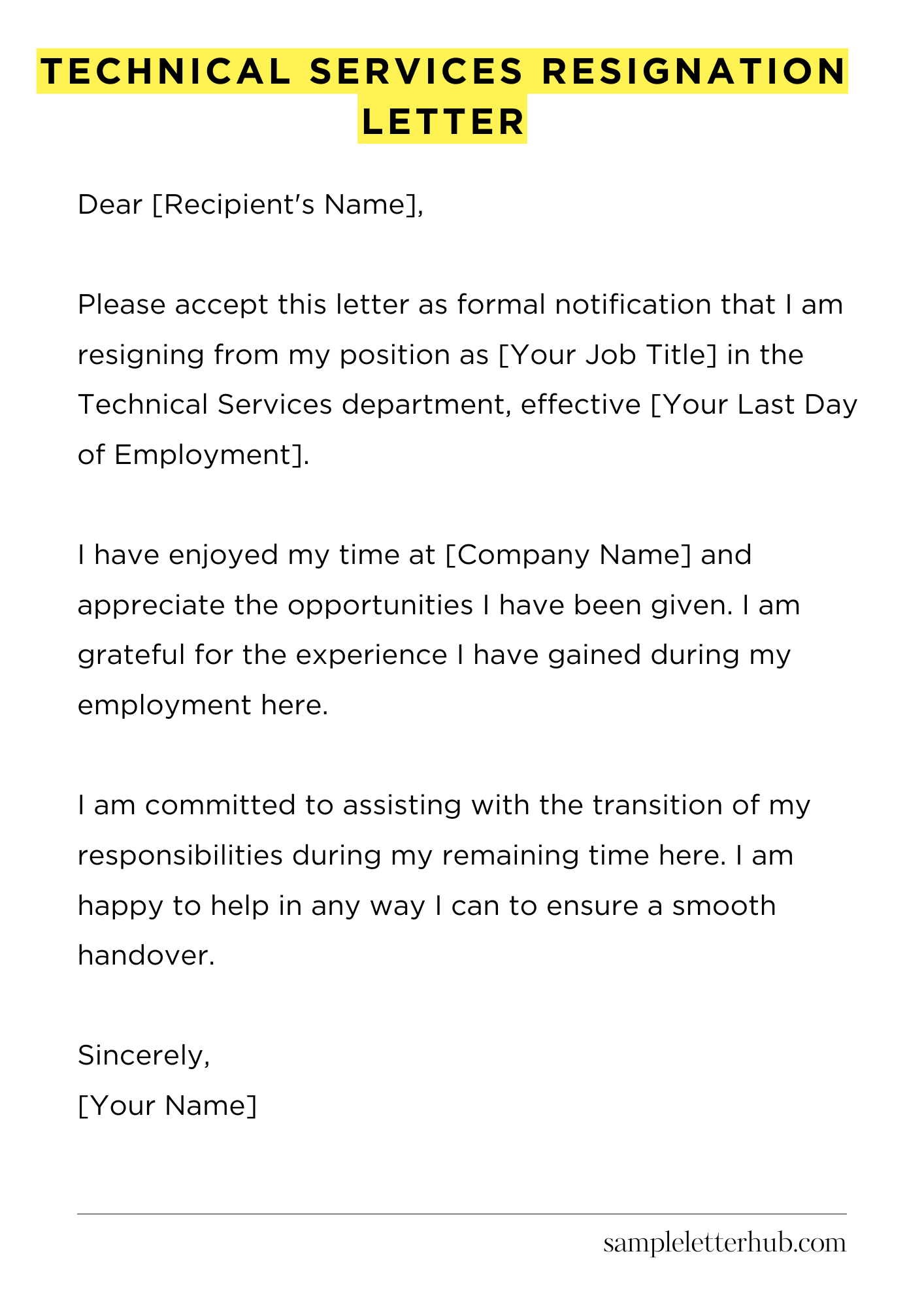
Below is a sample of a Technical Services Resignation Letter:
[Your Name]
[Your Address]
[Your Phone Number]
[Your Email Address]
[Date]
[Recipient’s Name]
[Recipient’s Title]
[Company Name]
[Company Address]
Dear [Recipient’s Name],
Please accept this letter as formal notification that I am resigning from my position as [Your Job Title] in the Technical Services department, effective [Your Last Day of Employment].
I have enjoyed my time at [Company Name] and appreciate the opportunities I have been given. I am grateful for the experience I have gained during my employment here.
I am committed to assisting with the transition of my responsibilities during my remaining time here. I am happy to help in any way I can to ensure a smooth handover.
Thank you for the support and guidance I have received. I wish you and [Company Name] all the best in the future.
Sincerely,
[Your Name]
How to Write a Technical Services Resignation Letter
Why You Need a Good Resignation Letter
Leaving a job is a big deal. You want to do it right. Especially when you’re in technical services. You need to provide a formal resignation letter. This is more than just a formality. It’s an important document. It officially starts the process of your departure. A well-written letter is crucial. It sets a positive tone.
This helps preserve your professional relationships. It also ensures a smooth transition. That’s a huge benefit for both you and your soon-to-be former employer. A good letter can prevent misunderstandings. And it can help you get a good reference down the line.
Key Elements to Include
Your resignation letter should contain specific information. First, clearly state your intent to resign. Say the words. Mention your job title. Next, include your last day of employment. This needs to be precise. Also, be sure to offer your gratitude to the company for the opportunity. Keep it simple. Avoid negativity.
Express your thanks for the experience. If you can, briefly acknowledge your contributions and the skills you’ve developed. A little bit of appreciation goes a long way. Some letters include an offer to assist with the transition. It can be helpful to offer support. Be prepared to provide any assistance that’s needed.
Formatting for Professionalism
The format of your letter matters. Use a professional business letter format. Start with your contact information. Include your name, address, phone number, and email. Then, add the date.
Next, include the recipient’s information. That is, the manager’s name and title. Use a formal salutation like “Dear [Manager’s Name]”. Keep the language concise. Choose simple fonts such as Arial or Times New Roman.
Ensure the letter is well-spaced. Proofread the letter carefully. Check for any errors in grammar and spelling. A polished letter shows you pay attention to detail.
Crafting the Right Tone
The tone of your letter is critical. Keep it positive and professional. Avoid negativity, even if you had a negative experience. Focus on the positive aspects of your time at the company. Keep the language neutral. Express your gratitude for the opportunity. You are essentially burning no bridges. Avoid any complaints or grievances.
State your reasons for leaving briefly. If you want to, you can keep the explanation simple. The goal is to leave on good terms. You should always maintain a polite and respectful tone. This protects your reputation.
Final Steps and Considerations
Once you’ve written your letter, there are a few final steps. Proofread the letter again. Have a trusted friend or colleague review it. Then, submit the letter. Send it to your manager. Ensure you follow any internal procedures for submitting your resignation. Keep a copy for your records. Consider the timing of your resignation.
Give enough notice, typically two weeks. This helps with the transition. Be prepared to answer questions. Be professional throughout the process. A well-written letter can ensure a smooth departure. It’s a valuable part of your professional journey.
FAQs about Technical Services Resignation Letter
What is the primary purpose of a technical services resignation letter?
The primary purpose is to formally notify your employer of your intention to leave your technical services position. It serves as an official record of your departure and helps to initiate the handover process, ensuring a smooth transition of your responsibilities.
What key information should be included in a technical services resignation letter?
Essential components include a clear statement of your resignation, the effective date of your departure, a concise reason for leaving (optional but often included), and a thank you to your employer. It should also specify how you can be contacted for questions. Additionally, you may want to offer assistance with the transition.
How much notice should I give in my technical services resignation letter?
The standard notice period varies, typically ranging from two weeks to a month. This depends on your employment contract, company policy, and local labor laws. Be sure to review these before submitting your letter and adhere to the stipulated timeframe.
Should I provide a reason for resigning in my technical services resignation letter?
Providing a reason is often optional but can be helpful. It’s generally advisable to keep the reason brief and professional, focusing on opportunities or personal goals. Avoid negative comments about your employer or colleagues.
How should I format and deliver my technical services resignation letter?
The letter should be professionally formatted, using a formal tone. It’s usually best to submit the letter in writing, either as a physical document or as an email. It’s often best to provide a copy to your direct supervisor and possibly Human Resources. Always retain a copy for your records.
Related:
Resignation letter due to rude boss
Resignation letter moving to another state
Resignation letter due to illness of family member
Resignation letter due to study