

A Technical Service Engineer resignation letter is a formal document. It informs your employer of your decision to leave your job. The letter officially marks the end of your employment. It is a crucial step in the resignation process.
Finding the right words can be tough. We understand it’s not easy. That’s why we’re here to help you. We’ll give you ready-made templates. We’ll offer sample resignation letters. These examples will help you write your own.
Use our samples to craft your perfect letter. Adapt them to fit your specific situation. We’ve got you covered whether you want a short, sweet letter, or a detailed one. We have what you need.
Technical Service Engineer Resignation Letter
Below is a sample of a Technical Service Engineer Resignation Letter:
[Your Name]
[Your Address]
[Your Phone Number]
[Your Email Address]
[Date]
[Hiring Manager Name] (If known, otherwise use title)
[Hiring Manager Title]
[Company Name]
[Company Address]
Dear [Mr./Ms./Mx. Last Name],
Please accept this letter as formal notification that I am resigning from my position as Technical Service Engineer at [Company Name]. My last day of employment will be [Your Last Day of Employment].
I would like to thank you for the opportunity to work at [Company Name] over the past [Number] years/months. I have enjoyed my time here and have learned a great deal. I appreciate the experiences and the colleagues I have worked alongside.
I am committed to assisting with the transition during my remaining time here. I am happy to help train a replacement and complete any outstanding tasks to ensure a smooth handover. Please let me know how I can be of assistance.
I wish you and [Company Name] all the best in the future.
Sincerely,
[Your Signature]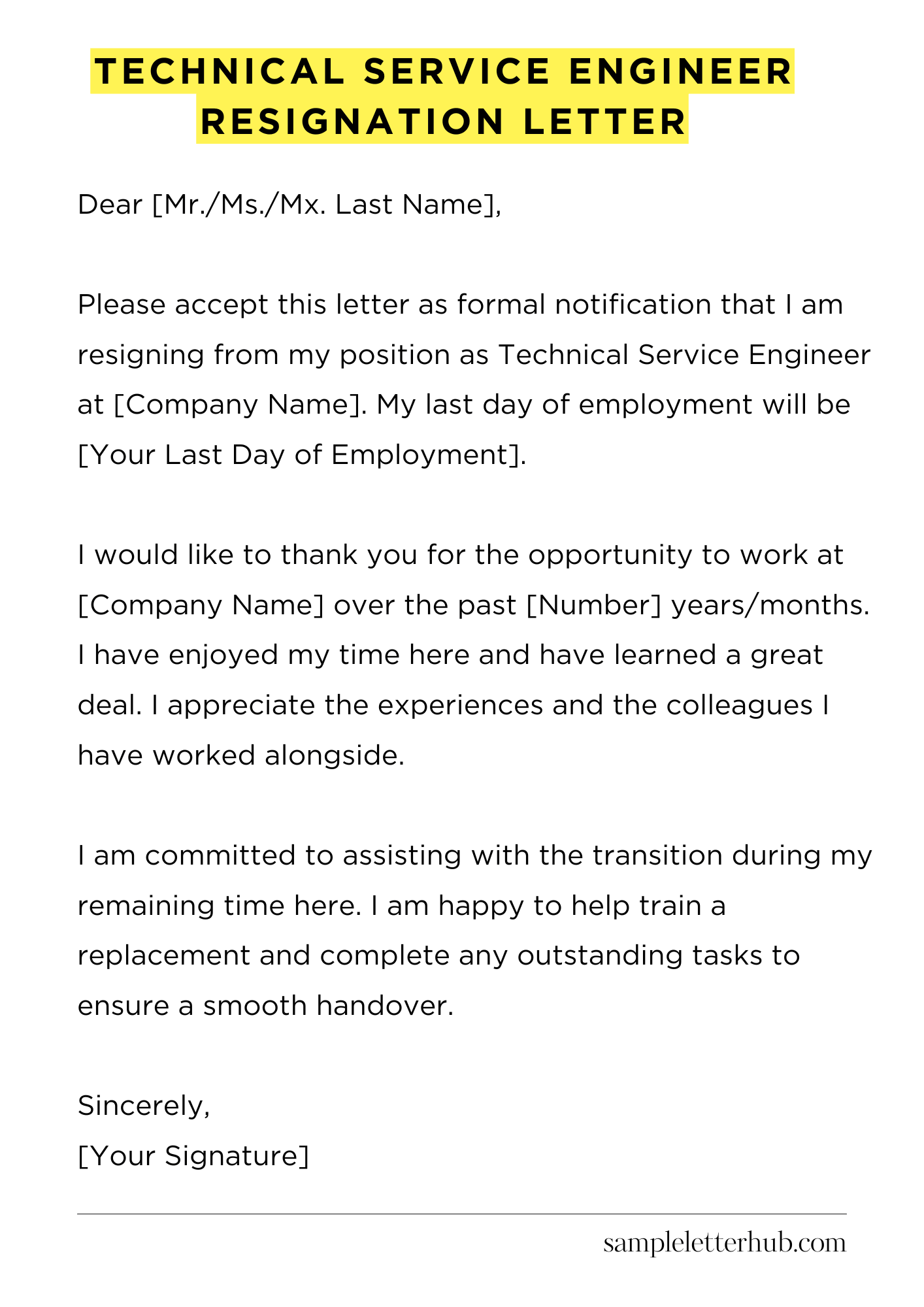
How to Write Technical Service Engineer Resignation Letter
Getting Started: Your Intentions Matter
Resigning from a job is a big step. You must make it clear that you want to leave. For a Technical Service Engineer, this often involves specialized equipment, client interaction, and project responsibilities.
This needs to be considered. Your resignation letter, therefore, acts as a formal declaration. Be direct and unambiguous from the get-go. Start by stating that you are resigning from your position. Mention the effective date, the last day you will be working for the company.
Don’t beat around the bush; clarity is key here.
Your goal is to convey your decision with professionalism and respect. It shows that you value the relationships you’ve built.
Structuring Your Letter: The Essential Elements
A well-structured letter is crucial. The layout matters. Begin with your name, address, and contact information. Below that, include the date and the recipient’s information. Next, begin with a professional salutation, such as “Dear [Manager’s Name]”. Then, the body of your letter is split into sections. First, clearly state your resignation.
Second, your effective date. You can add a brief and polite reason for leaving if you want. It’s not usually necessary, but it can be nice. Third, offer your assistance during the transition phase. Fourth, express gratitude. Fifth, offer a courteous closing. Sixth, include your signature.
Ensure each section is easy to read.
Make sure the email is formatted appropriately; it’s essential for readability.
What to Include: Content That Counts
What should you write? Keep it professional. Start with a clear statement of your resignation and the last day of employment. If you are leaving for a new job, avoid discussing the details. If you wish, briefly explain why you are leaving, but avoid negativity. Then, offer assistance during the transition period.
For example, you can offer to train your replacement or to complete ongoing projects. Always express gratitude for the opportunities you have received. Thank your manager and the company. End with a polite closing, such as “Sincerely” or “Best regards.”
Your tone here is important.
Remember that this letter is a reflection of you.
What to Avoid: Common Pitfalls
There are several things to avoid in a resignation letter. First, never badmouth your employer, colleagues, or company. Second, don’t burn bridges.
Third, avoid getting into lengthy or overly detailed explanations for your departure. A short and sweet reason is generally sufficient. Fourth, refrain from making demands or ultimatums. Finally, don’t send the letter without proofreading it carefully.
Carelessness can have consequences.
Keep your language professional.
Finalizing and Delivering: The Last Steps
Proofread your letter multiple times. Check for grammar and spelling errors. Make sure your tone is professional and respectful. Print the letter on high-quality paper.
Make a copy for yourself. Deliver the letter in person to your manager. This is standard procedure. Follow up the letter with a brief conversation, if appropriate. Ensure a smooth handover of your responsibilities, and make sure that all the necessary documents and company assets are handed over. Your goal is to leave a positive lasting impression.
Good luck!
Your final impression is everything.
FAQs about Technical Service Engineer resignation letter
How do I start my resignation letter as a Technical Service Engineer?
Begin your letter with a clear and concise statement of your intent to resign, including your name and the date. State your position, then move on to the effective date of your resignation. For instance, “I am writing to inform you that I am resigning from my position as Technical Service Engineer, effective [Date].”
What key information should be included in a Technical Service Engineer resignation letter?
Your letter should include: the formal announcement of your resignation, the date your resignation takes effect, a brief expression of gratitude to the company (if desired), and any necessary information regarding the handover of your responsibilities or ongoing projects. You may also include contact information if you’re open to questions.
Should I provide a reason for my resignation in the letter?
You are not obligated to provide a specific reason for your resignation. However, you might choose to briefly mention the reason if you are comfortable, particularly if it’s a positive one, such as pursuing a new opportunity.
Keep it professional and concise, for example, “I have accepted a position that aligns with my long-term career goals”. Avoid negative comments about your current employer or colleagues.
How should I handle the handover of my responsibilities in the resignation letter?
In your letter, acknowledge your responsibility to assist with the transition. Offer your willingness to cooperate during the handover period. You can state something like: “I am committed to ensuring a smooth transition during my remaining time here and am happy to assist in training my replacement or providing any necessary documentation.” Be prepared to offer the assistance they require.
Is it necessary to thank my employer in the resignation letter?
It is generally a good practice to express gratitude in your resignation letter, regardless of your reasons for leaving. Thank your employer for the opportunities, experiences, or support they have given you during your tenure. This leaves a positive lasting impression.
A simple sentence such as, “Thank you for the opportunities I have been given during my time here,” can be very effective.
Related:
Resignation letter due to rude boss
Resignation letter moving to another state
Resignation letter due to illness of family member
Resignation letter due to study