

Deciding to leave a summer analyst position? You’ll likely need a resignation letter. This formal document officially communicates your departure to your employer. It’s a crucial step in ending your employment professionally.
Crafting a resignation letter can feel daunting. We understand. That’s why we’re here to help. We’ve compiled several examples. You can use these templates to build your own letter.
These examples cover different situations. Find the one that best suits your needs. Feel free to modify them. Your perfect resignation letter is within reach. Let’s get started.
Summer Analyst Resignation Letter
Below is a sample of a Summer Analyst Resignation Letter:
[Your Name]
[Your Address]
[Your Phone Number]
[Your Email Address]
[Date]
[Hiring Manager Name] (If known, otherwise use title)
[Hiring Manager Title]
[Company Name]
[Company Address]
Dear [Mr./Ms./Mx. Last Name],
Please accept this letter as formal notification that I am resigning from my position as a Summer Analyst at [Company Name]. My last day of employment will be [Your Last Day of Employment].
Thank you for the opportunity to work at [Company Name] and for the experiences I have gained during my time here. I have learned a great deal, and I appreciate the support I have received from my colleagues.
I wish you and the company all the best in the future. I am available to help with the transition of my responsibilities, if needed.
Sincerely,
[Your Signature]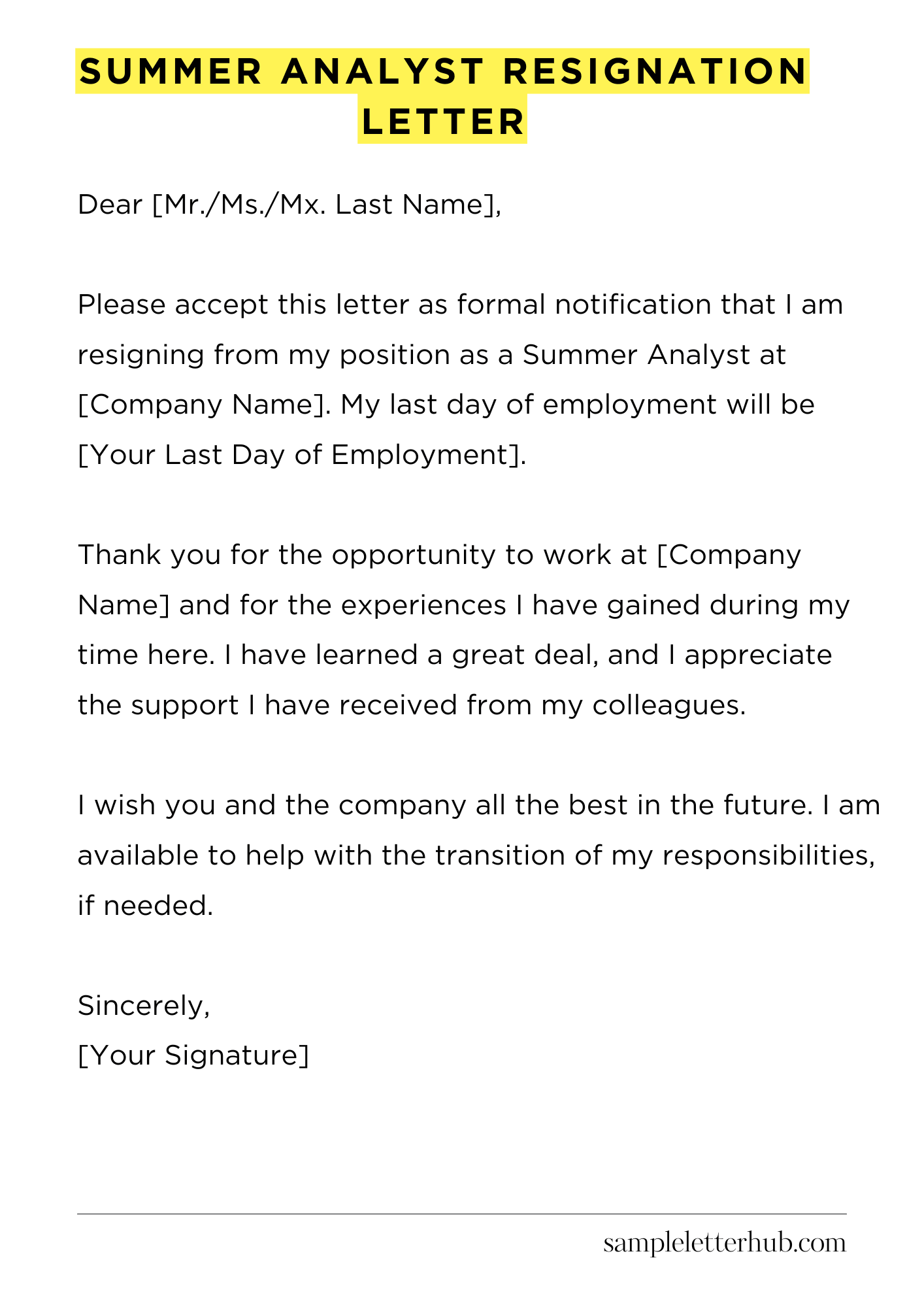
How to Write a Summer Analyst Resignation Letter
1. Preparing to Step Away
So, you’ve decided to move on from your summer analyst position. That’s a big decision! Before you even think about putting pen to paper (or fingers to keyboard), take a moment to reflect.
Think about the reasons for your departure. Are you returning to school? Did you receive a better offer? Understanding your motivations is key. This clarity will help you craft a sincere and professional letter.
Consider the timing. Ideally, you’ll want to give your employer sufficient notice, which is usually two weeks, or as per the guidelines of your offer letter. This shows respect for the company and allows them to find a replacement without too much disruption. Planning ahead is always a good idea.
2. Crafting the Core Components
A well-written resignation letter is straightforward. First, you need to clearly state your intention to resign. Start with a direct sentence, like, “Please accept this letter as formal notification that I am resigning from my position as a Summer Analyst, effective [Your Last Day of Employment].”
Next, express your gratitude. A simple “Thank you for the opportunity to have worked here this summer” goes a long way. Then, briefly mention any relevant context. You can state that you’re leaving to resume your studies or pursue another opportunity.
Keep it concise. Avoid excessive details about why you’re leaving unless you want to offer them. It’s perfectly fine to keep it brief and professional. Always double-check your dates and make sure they align with your agreement.
3. Adding the Professional Touches
Now that you have the basic structure, it’s time to refine it. Always use a formal business letter format. Include your name, address, the date, and the recipient’s name and title. Address the letter to your direct supervisor or the appropriate hiring manager. Proofread your letter meticulously for any grammatical errors or typos. Poor grammar can undermine your professionalism.
Expressing appreciation for the experience is crucial. Acknowledge what you have learned and the skills you’ve developed. For instance, “I have greatly valued the experience and the opportunity to contribute to the team.” This demonstrates that you haven’t forgotten the positive aspects of the internship.
4. Keeping it Positive and Forward-Looking
Even if your experience wasn’t entirely positive, focus on the future. Avoid negative comments or complaints. Your resignation letter should be a bridge to your next opportunity, not a burning of bridges. You want to leave a good impression, and a positive tone is essential for that.
Include a closing statement that offers assistance with the transition. You could write, “I am happy to assist with the handover of my responsibilities during my remaining time here.” This shows you’re willing to help your team. End with a professional closing, such as “Sincerely” or “Best Regards,” followed by your full name and signature (if submitting a hard copy).
5. Final Review and Delivery
Before sending your resignation letter, take a final look. Read it aloud. Does it sound clear and professional? Ask a friend or mentor to review it for feedback. Once you are satisfied, submit your letter according to your company’s policy. Usually, this means delivering it to your supervisor or the HR department. Don’t procrastinate! Doing it promptly is important.
Consider whether you’d like to deliver it in person or electronically. If possible, a face-to-face conversation to deliver your letter, followed by a digital copy, can be a great idea. Good luck with your future endeavors!
FAQs about Summer Analyst resignation letter
How much notice should a Summer Analyst give when resigning?
Typically, a Summer Analyst should provide at least two weeks’ notice when resigning. However, the specific requirements may vary depending on the firm’s policies outlined in the employment offer or handbook. Reviewing these documents is essential. If possible, providing more notice, especially if the resignation is during a critical project phase, is always a professional courtesy.
What should be the tone and format of a Summer Analyst resignation letter?
The tone of a Summer Analyst resignation letter should be professional and polite. The format should be a standard business letter, including your contact information, the date, the recipient’s contact information (usually your direct supervisor or HR), a clear statement of resignation.
Should a Summer Analyst provide a reason for resigning in their letter?
Providing a reason for resigning in a Summer Analyst resignation letter is generally not mandatory, but can be helpful. While not required, a brief, positive statement acknowledging a new opportunity, personal circumstances, or a change in career goals is often sufficient.
Avoid going into excessive detail or expressing dissatisfaction. If you are resigning due to negative experiences, it’s best to keep the reason vague and professional.
What should be avoided in a Summer Analyst resignation letter?
A Summer Analyst resignation letter should avoid negativity, criticism of the company or colleagues, and excessive detail about the reasons for leaving. It is also important to refrain from burning bridges or making demands. Avoid including information that could be considered unprofessional or that might jeopardize future opportunities with the firm or in the industry.
How should a Summer Analyst handle submitting the resignation letter?
A Summer Analyst should typically submit the resignation letter to their direct supervisor or HR representative. It’s often best to schedule a meeting to discuss the resignation in person, followed by a formal written letter. Always retain a copy of the letter for your records. Ensure all required company property, like laptop and ID, is returned on or before your last day.
Related:
Resignation letter due to rude boss
Resignation letter moving to another state
Resignation letter due to illness of family member
Resignation letter due to study