

A Subject Matter Expert (SME) resignation letter is a formal document. It informs an employer of your intent to leave your role. Its purpose is to officially communicate your departure. It also helps to maintain a professional relationship with your employer.
Leaving a job can be tricky. Writing the perfect resignation letter is essential. Don’t worry! We’ve got you covered. This article offers several templates. We’ll also include various examples and samples.
These templates will simplify the process. They’ll make writing your own letter much easier. Find the best format for your needs. Adapt them to fit your situation.
Subject Matter Expert Resignation Letter
Below is a sample of a Subject Matter Expert Resignation Letter:
[Your Name]
[Your Address]
[Your Phone Number]
[Your Email Address]
[Date]
[Hiring Manager Name] (If known, otherwise use title)
[Hiring Manager Title]
[Company Name]
[Company Address]
Dear [Mr./Ms./Mx. Last Name],
Please accept this letter as formal notification that I am resigning from my position as Subject Matter Expert at [Company Name], effective [Your Last Day of Employment].
I would like to thank you for the opportunity to work at [Company Name] for the past [Number] years/months. I have enjoyed my time here and learned a great deal.
During my employment, I have been involved in [briefly list key responsibilities or achievements]. I am grateful for the experience and the colleagues I have worked alongside.
I am committed to ensuring a smooth transition during my departure. I am happy to assist in training my replacement and completing any outstanding tasks. Please let me know how I can be of assistance during this period.
I wish you and [Company Name] all the best for the future.
Sincerely,
[Your Name]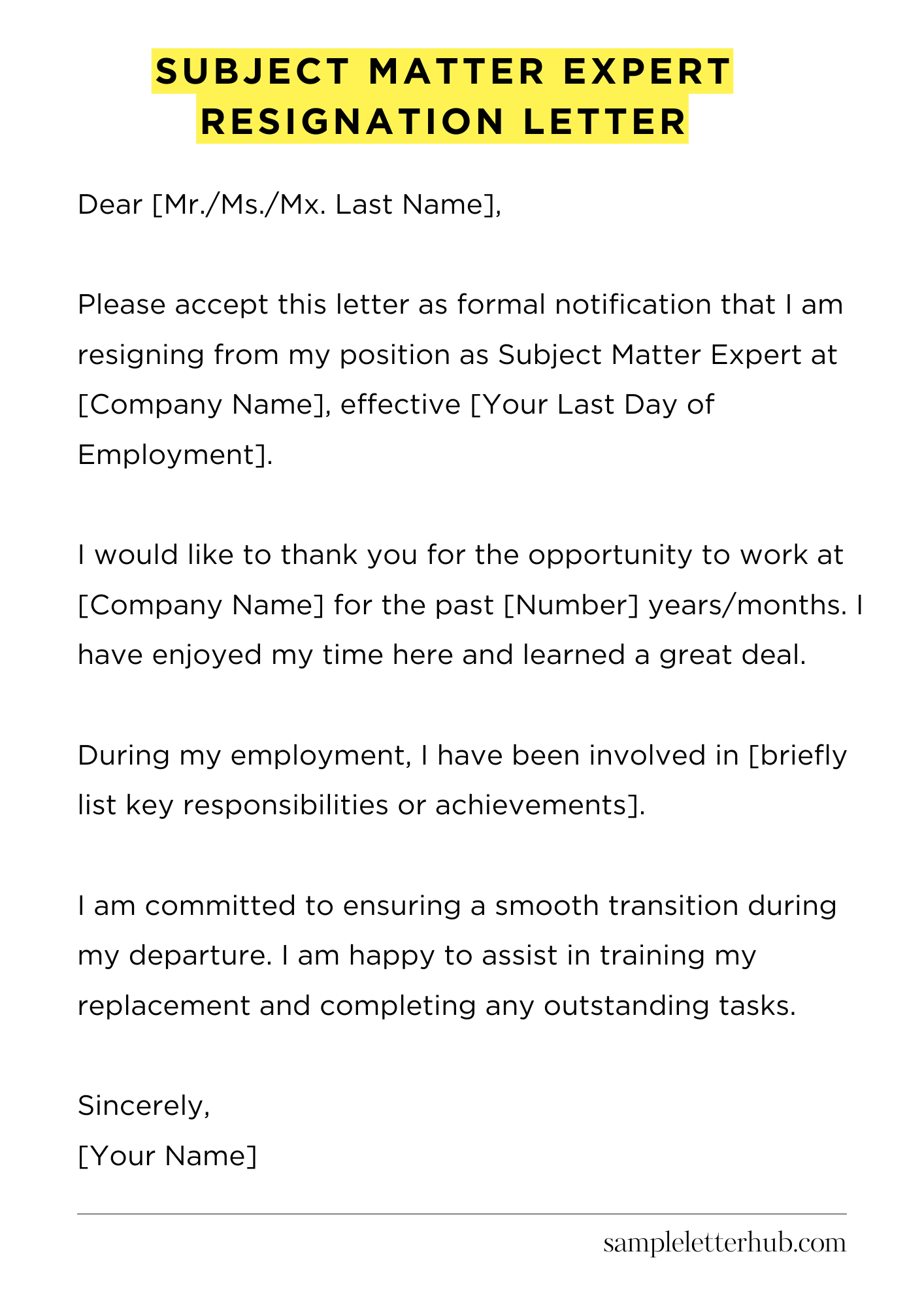
How to Write a Subject Matter Expert Resignation Letter
1. Why is a Good Resignation Letter Important?
Leaving a job, especially a role as crucial as a Subject Matter Expert (SME), requires tact and professionalism. Your resignation letter is more than just a formality. It’s a crucial document. It helps maintain a positive relationship with your employer. Remember that first impressions matter, and so do last ones!
A well-crafted letter helps ensure a smooth transition. You also want to protect your professional reputation. Think of it as a bridge. You want to avoid burning it. This letter will also serve as a written record of your departure.
2. What to Include in Your Resignation Letter
A good resignation letter for an SME contains several key components. It should be clear and concise. First, state your intention to resign. Explicitly mention your last day of employment.
This is crucial for clarity. Second, express your gratitude for the opportunity. A simple “Thank you for the opportunity to work here” goes a long way. Third, briefly mention your reason for leaving, if you choose to. Keep this brief and professional. It is not mandatory to go into extensive detail.
Finally, offer assistance with the transition. You could offer to help train your replacement. You can also offer to document processes or provide any other relevant information. Don’t forget to include your contact information.
3. Crafting the Perfect Tone
The tone of your letter is critical. Maintain a professional and respectful attitude throughout. Avoid negativity, even if your reasons for leaving are less than ideal.
Stick to the facts. Be polite. Avoid overly emotional language. Focus on the positive aspects of your employment, if possible. Remember, you want to leave a good impression. Your letter should reflect your expertise. It should also showcase your professionalism.
4. Template and Examples: Making it Easier
Let’s look at some templates. You can adapt these templates. Remember to customize them to fit your specific circumstances.
Template 1 (Basic)
[Your Name]
[Your Address]
[Your Email]
[Your Phone Number]
[Date]
[Employer’s Name]
[Employer’s Address]
Dear [Manager’s Name],
Please accept this letter as formal notification that I am resigning from my position as Subject Matter Expert at [Company Name]. My last day of employment will be [Your Last Day].
Thank you for the opportunity to work at [Company Name]. I wish you and the company all the best in the future.
Sincerely,
[Your Signature]
[Your Typed Name]
Template 2 (With Gratitude and Offer of Assistance)
[Your Name]
[Your Address]
[Your Email]
[Your Phone Number]
[Date]
[Employer’s Name]
[Employer’s Address]
Dear [Manager’s Name],
Please accept this letter as formal notification that I am resigning from my position as Subject Matter Expert at [Company Name], with my last day of employment being [Your Last Day].
I am grateful for the opportunities I have been given during my time here. I have learned a lot and appreciate the experiences I have gained.
I am happy to assist in the transition process in any way I can, including training my replacement and documenting key processes. Please let me know how I can be of assistance.
I wish you and the company all the best.
Sincerely,
[Your Signature]
[Your Typed Name]
You can modify these. These templates help get you started.
5. Before You Hit Send: Proofread and Review
Before submitting your letter, proofread it carefully. Check for any grammatical errors or typos. Ensure your tone is professional. Double-check all dates and contact information. Have a trusted colleague or friend review the letter. Fresh eyes can often catch mistakes you might have missed.
A polished letter reflects your professionalism. A poorly written letter can damage your reputation. Take the time to get it right.
FAQs about Subject Matter Expert resignation letter
How do I write a Subject Matter Expert (SME) resignation letter?
When drafting your resignation letter, it’s crucial to maintain a professional tone. Start by clearly stating your intention to resign from your position as a Subject Matter Expert, including your last day of employment. Briefly express gratitude for the opportunity and mention any significant contributions you made during your tenure.
Offer assistance with the transition process, such as training your replacement or completing ongoing projects. Keep the letter concise, positive, and focused on the necessary information. Include your contact information for any follow-ups.
What should I include in a Subject Matter Expert resignation letter?
A well-structured SME resignation letter should include: your official resignation, the date of your last day of employment, a brief expression of gratitude for the opportunity, mention of any major contributions, an offer to assist with the transition (e.g., training a replacement), a professional closing, and your signature.
It’s often helpful to provide contact information for any post-employment inquiries.
What’s the ideal notice period for an SME resignation?
The standard notice period is typically two to four weeks. However, the ideal notice period for a Subject Matter Expert depends on company policy, your contract terms, and the complexity of your role. Consider the scope of your responsibilities, ongoing projects, and the time needed to ensure a smooth handover.
Always review your employment contract to understand the specified notice period. Providing more notice is often appreciated and allows for a better transition.
How should I handle sensitive information in my resignation letter?
It is crucial to maintain confidentiality. Do not include any confidential information, trade secrets, or proprietary details about the company or its clients in your resignation letter.
Focus on your departure and the offer to assist with the handover process. If you have signed any confidentiality agreements, ensure that your actions comply with them, even after leaving the company.
How do I deal with counteroffers when resigning as an SME?
When you receive a counteroffer, carefully evaluate your reasons for resigning in the first place. Consider all aspects of the original decision, including career goals, work-life balance, and compensation. A counteroffer may address your immediate concerns but might not solve the underlying issues that led you to seek new opportunities.
If you are offered a counteroffer, take the time to consider it, review the terms and conditions in writing, and assess how it affects your career aspirations before making a final decision.
Related:
Resignation letter due to rude boss
Resignation letter moving to another state
Resignation letter due to illness of family member
Resignation letter due to study