

So, you’re a student worker and ready to move on. A student worker resignation letter is your official way of informing your employer that you’re leaving your job. It’s a formal document. Its purpose is to communicate your departure clearly and respectfully. This letter helps maintain a professional relationship.
We understand writing these letters can be tricky. That’s why we’re here to help. We’ve put together some great templates. They’re designed to make the process easier. You’ll find different examples.
Ready to craft your own letter? We’ll provide a variety of samples. Choose the one that fits your situation best. Customize them to fit your needs. Writing your resignation just got a whole lot simpler.
Student Worker Resignation Letter
Below is a sample of a Student Worker Resignation Letter:
[Your Name]
[Your Address]
[Your Phone Number]
[Your Email Address]
[Date]
[Employer’s Name]
[Employer’s Title]
[Company Name]
[Company Address]
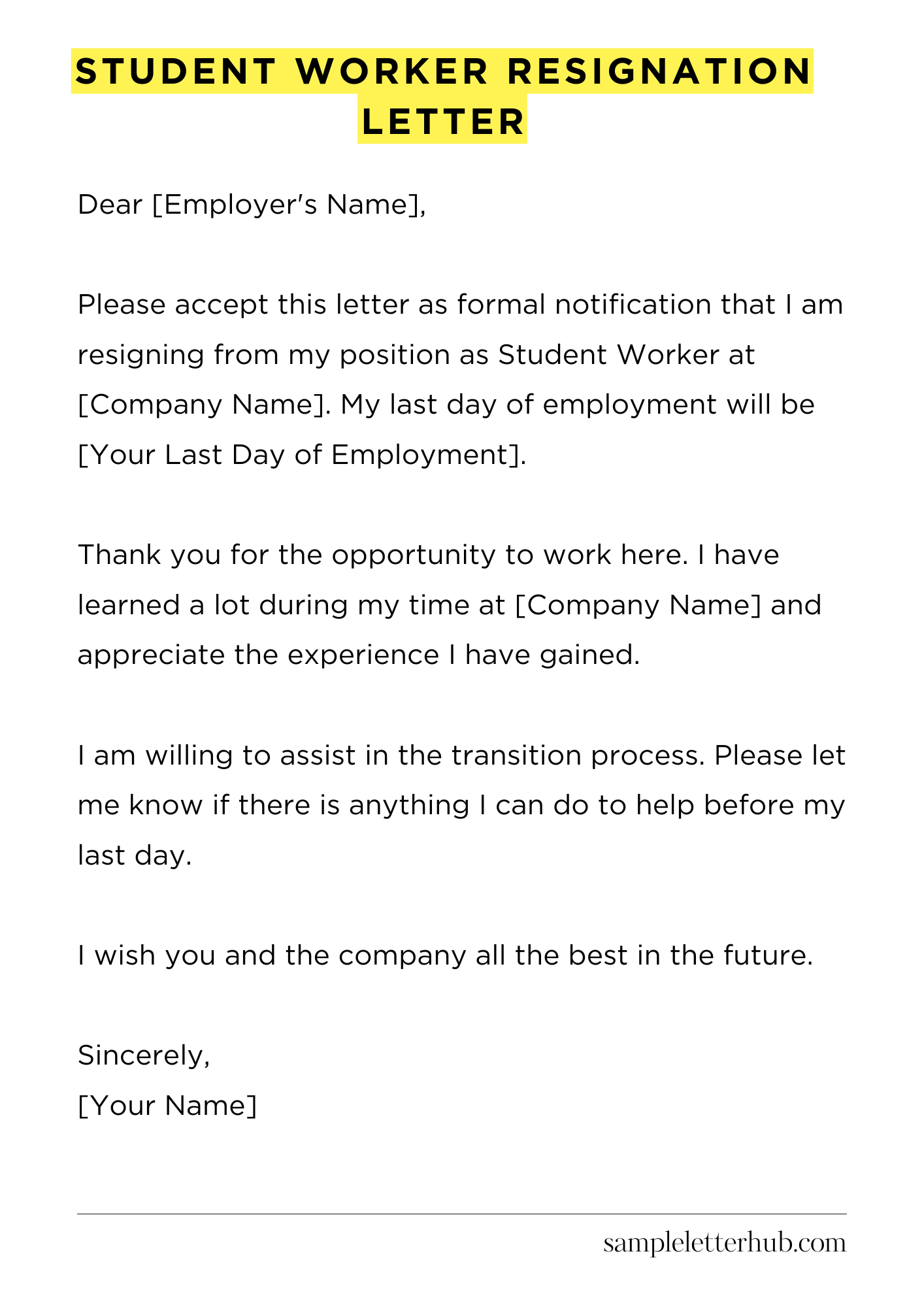
Dear [Employer’s Name],
Please accept this letter as formal notification that I am resigning from my position as Student Worker at [Company Name]. My last day of employment will be [Your Last Day of Employment].
Thank you for the opportunity to work here. I have learned a lot during my time at [Company Name] and appreciate the experience I have gained.
I am willing to assist in the transition process. Please let me know if there is anything I can do to help before my last day.
I wish you and the company all the best in the future.
Sincerely,
[Your Name]
How to Write a Student Worker Resignation Letter
Working while studying can be tough! But sometimes, you need to move on. Maybe you got a better opportunity, or perhaps the job just isn’t the right fit anymore. Whatever the reason, if you’re a student worker planning to leave your job, you’ll need to write a resignation letter. Don’t worry; it’s easier than you think.
1. Keep it Short and Sweet
Lengthy explanations aren’t usually needed. A good resignation letter is concise and to the point. State your intent clearly and quickly. Start with a straightforward sentence stating you’re resigning from your position. Remember your boss or supervisor will appreciate the clarity.
For example: “Please accept this letter as formal notification that I am resigning from my position as a [Your Job Title] at [Company Name], effective [Your Last Day of Employment].”
2. Be Professional and Polite
Even if you’re not thrilled with your job, maintain professionalism. Thank your employer for the opportunity. Expressing gratitude is a classy move and it leaves a positive lasting impression. Remember, you never know when your paths may cross again. Be mindful of your tone.
Here’s a sample sentence: “Thank you for the opportunity to work at [Company Name] over the past [duration]. I have learned a lot.”
3. Provide a Proper Timeline
Your letter must include the date of your last day of employment. This is crucial for your employer to plan for your departure and find a replacement. Standard practice is to give two weeks’ notice. However, check your employment contract or company policy for specific requirements. If your contract states a different notice period, abide by it.
For example: “My last day of employment will be [Date].”
4. Offer to Help with the Transition
Show your professionalism by offering assistance during your transition. This might involve training your replacement, finishing up ongoing projects, or creating documentation. This is a sign of respect and will also reflect positively on you.
Consider this phrasing: “I am happy to assist in training my replacement and ensuring a smooth handover of my responsibilities.”
5. Review and Proofread
Before sending your letter, carefully proofread it. Check for any typos, grammatical errors, and ensure the tone is appropriate. Having a second pair of eyes to read over the letter can often help catch mistakes you may have missed. Finally, print it out and hand it in in person or send it via email, as directed by your employer. A well-written resignation letter leaves a positive final impression.
FAQs about Student Worker Resignation Letter
What is the primary purpose of a student worker resignation letter?
The primary purpose of a student worker resignation letter is to formally notify your employer of your intention to leave your position. It serves as an official record of your departure and helps to ensure a smooth transition, allowing your employer to make necessary arrangements to fill your role.
It also offers a chance to express gratitude for the opportunity and, if desired, to offer assistance during the handover period.
What essential information should be included in a student worker resignation letter?
A well-crafted student worker resignation letter should include the following essential information: a clear statement of your intent to resign, the effective date of your resignation (your last day of employment), your name, the name of your supervisor or the person to whom you are reporting, and optionally, a brief and professional statement of gratitude.
Additional information like any specific reason for leaving is optional and depends on your comfort level. The letter must be dated and signed.
How much notice should a student worker give when resigning?
The amount of notice a student worker should give depends on the specific requirements of the employer and any employment contract or policy you may have.
However, a general standard is typically at least two weeks’ notice. This allows sufficient time for the employer to find a replacement and for you to assist with the handover of your responsibilities. Always check your employment agreement or consult with your supervisor for specific guidelines.
Should a student worker resignation letter include a reason for leaving?
While not mandatory, including a reason for leaving in your student worker resignation letter is a matter of personal choice. It’s often advisable to keep it brief and professional, focusing on opportunities or situations that require your time. Common reasons include graduation, a new academic schedule, or another job offer.
It is best to avoid going into excessive detail or including negative comments.
If you’re comfortable, you can state you are resigning because of a new opportunity or due to the increased academic workload. If you’d rather not say a specific reason, you can simply state “for personal reasons.”
How should a student worker format and submit their resignation letter?
A student worker resignation letter should be formatted professionally, typically using a standard business letter format. This includes your contact information, the date, your supervisor’s information, a formal salutation (e.g., “Dear [Supervisor’s Name]”), the body of the letter, a professional closing (e.g., “Sincerely”), and your signature.
The letter should be printed on appropriate paper if given physically, and the electronic submission should include the attachment in a PDF form. Submit your letter to your supervisor or the designated person according to your employer’s policy. Always retain a copy for your records.
Related:
Resignation letter due to rude boss
Resignation letter moving to another state
Resignation letter due to illness of family member
Resignation letter due to study