

A Strength and Conditioning Coach resignation letter is a formal document. It is used to inform an employer about leaving a job. The letter should state the coach’s intent to resign. It should also include the last day of employment.
Writing a resignation letter can be tricky. Don’t worry, we are here to help. We’ll share several templates. You can use them to create your own letter. This article will provide different examples for different situations.
These samples make the process simpler. You can tailor them to fit your needs. These templates are easy to modify. They help you express yourself clearly and professionally. Get ready to write a strong resignation letter with our guidance.
Strength And Conditioning Coach Resignation Letter
Below is a sample of a Strength And Conditioning Coach Resignation Letter:
[Your Name]
[Your Address]
[Your Phone Number]
[Your Email Address]
[Date]
[Hiring Manager Name] (If known, otherwise use title)
[Hiring Manager Title]
[Organization Name]
[Organization Address]
Dear [Mr./Ms./Mx. Last Name],
Please accept this letter as formal notification that I am resigning from my position as Strength and Conditioning Coach at [Organization Name], effective [Your Last Day of Employment].
I am grateful for the opportunity to have worked here for [Duration of Employment]. I have enjoyed my time contributing to [mention a specific achievement or responsibility].
I am committed to ensuring a smooth transition during my departure. I am happy to assist in training my replacement and completing any necessary handover tasks before my last day.
I wish [Organization Name] continued success in the future.
Sincerely,
[Your Signature]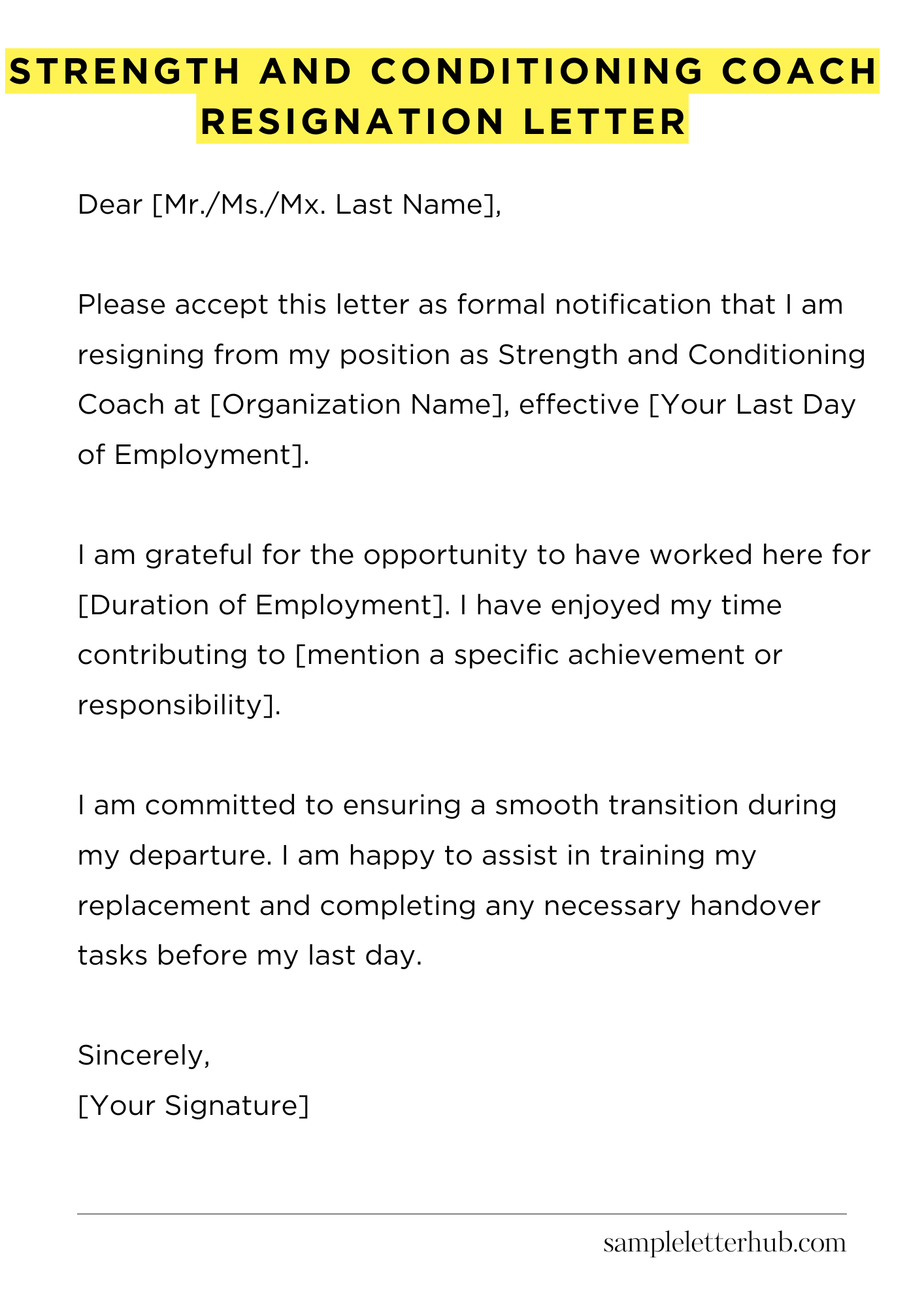
How to Write a Strength and Conditioning Coach Resignation Letter
1. Grasp the Basics: Why a Resignation Letter Matters
Leaving a job, especially in a professional field like strength and conditioning, demands a formal departure. A well-crafted resignation letter is more than just a formality; it’s a crucial step. It formally announces your intentions, sets a positive tone, and protects your professional reputation.
Think of it as your final, impactful act while employed. It creates a lasting impression. It documents your departure in writing, providing a clear record for both you and your employer. This is important for human resources, compliance, and future reference.
2. Essential Elements: What Your Letter Must Include
Several components are non-negotiable for a professional resignation letter. First, be sure to include the date. Always address the letter to your direct supervisor or the appropriate person within the organization. Clearly state your intention to resign. Specify your last day of employment.
This is crucial for avoiding any misunderstandings. Express your gratitude for the opportunity. Briefly mention any key accomplishments you’re proud of, if applicable.
Keep the tone positive and professional. Avoid negativity, even if your experience wasn’t ideal. Include your contact information. This ensures easy communication during the transition period. Proofread the letter carefully.
3. Crafting the Content: Tips for a Powerful Letter
Now, let’s look into the meat of your letter. Start with a straightforward, polite statement of your resignation. For instance, “Please accept this letter as formal notification that I am resigning from my position as Strength and Conditioning Coach, effective [Your Last Day of Employment].”
Next, show appreciation for the experience you’ve gained and the opportunities offered. If you have some good experiences it is a good idea to state those.
Consider saying something like, “I am grateful for the opportunities I have been given during my time here and for the experience I have gained working with your athletes.” Briefly mention your willingness to assist with the transition.
Offer to help train someone. If you are comfortable, you may add, “I am happy to assist in training my replacement during the transition phase, to ensure a smooth hand-off of responsibilities.” Finally, close with a professional sign-off, such as “Sincerely” or “Respectfully.”
4. Tailoring Your Letter: Adapting to Your Situation
Every job is different. Therefore, every letter should be tailored to fit. Consider the relationship you had with your employer. If you had a close working relationship, a slightly more personal touch may be acceptable, but still maintain professionalism. If you are leaving for a better opportunity, you do not have to detail the new opportunity in your letter.
However, if the opportunity is inside the same organization, you may state this if you wish to do so. If you have any remaining unused vacation time, it is important to check company policies or add a line, inquiring as to the payout policy. Be honest in your resignation. If possible, avoid burning bridges.
Consider how the letter will be perceived by others. Reflect on the tone. Remember, the letter is a reflection of you and your professionalism.
5. The Final Touches: Polishing and Delivering Your Letter
Before submitting your letter, always proofread it multiple times. Check for any grammatical errors or typos. Ensure the formatting is clean and easy to read. Print it on good quality paper. In a digital world, an official hard copy is still the best practice. Deliver the letter in person, if possible.
Schedule a meeting with your supervisor to hand it to them, or email it. Maintain a positive attitude during the handover period. Follow through on any offers to assist with the transition. Finally, keep a copy of your letter for your records. This is vital. Now, you’re ready to move forward. Your reputation matters!
FAQs about Strength And Conditioning Coach resignation letter
How do I start a Strength and Conditioning Coach resignation letter?
Begin your letter with a clear and professional salutation (e.g., “Dear [Supervisor’s Name]”). Immediately state your intention to resign from your position as a Strength and Conditioning Coach, including the effective date of your resignation. Keep the opening concise and direct.
What should I include in the body of a Strength and Conditioning Coach resignation letter?
The body of your letter should briefly express your gratitude for the opportunity and any positive experiences you’ve had. You can mention specific skills you’ve developed or contributions you’ve made.
While you don’t need to provide extensive reasons for leaving, you may briefly state your reasons if you wish, such as pursuing other career opportunities or personal reasons. Be positive and avoid negative comments about your current employer or colleagues.
If appropriate, offer assistance with the transition, such as training a replacement or completing ongoing projects.
What is the proper format for a Strength and Conditioning Coach resignation letter?
The letter should be professionally formatted. Use a standard business letter format, including your contact information, the date, your supervisor’s name and title, and the company’s address.
The letter should be single-spaced with a blank line between paragraphs. Ensure the tone is formal and polite throughout the document. It’s recommended to type the letter and either print it or send it digitally, according to your company’s protocol.
When should I submit my Strength and Conditioning Coach resignation letter?
Submit your resignation letter as soon as you have made your decision to leave. Most companies require at least two weeks’ notice, but this may vary based on your employment contract or local regulations.
Check your employment agreement or company policies to determine the required notice period. Deliver the letter in person if possible or send it via email if that is the accepted procedure within your workplace.
What information should I avoid including in a Strength and Conditioning Coach resignation letter?
Avoid including overly personal details or grievances about your job or employer. Refrain from making negative comments about colleagues, the management, or the company.
Keep the letter focused on the professional aspects of your departure. Do not list reasons for leaving that are overly negative or that could damage your professional reputation. Avoid sharing confidential information or trade secrets.
Related:
Resignation letter due to rude boss
Resignation letter moving to another state
Resignation letter due to illness of family member
Resignation letter due to study