

A Strategy Consultant resignation letter is a formal document. It informs your employer of your decision to leave. The letter officially ends your employment. It’s a crucial step in the process.
Feeling overwhelmed about writing your resignation? We get it. Leaving a consulting role is a big move. You want to make a professional impression. Don’t worry.
We’ve got you covered. Here are templates and samples. These will help you draft your own strategy consultant resignation letter. Choose the one that fits your situation. Make the process easier.
Strategy Consultant Resignation Letter
Below is a sample of a Strategy Consultant Resignation Letter:
[Your Name]
[Your Address]
[Your Phone Number]
[Your Email Address]
[Date]
[Hiring Manager Name] (If known, otherwise use title)
[Hiring Manager Title]
[Company Name]
[Company Address]
Dear [Mr./Ms./Mx. Last Name],
Please accept this letter as formal notification that I am resigning from my position as Strategy Consultant at [Company Name]. My last day of employment will be [Your Last Day of Employment].
I would like to thank you and the company for the opportunity to work here. I have learned a great deal during my time here and appreciate the experiences I have gained.
I am committed to ensuring a smooth transition during my departure. I am happy to assist in training my replacement and completing any outstanding tasks. Please let me know how I can be of assistance.
I wish you and [Company Name] all the best in the future.
Sincerely,
[Your Signature]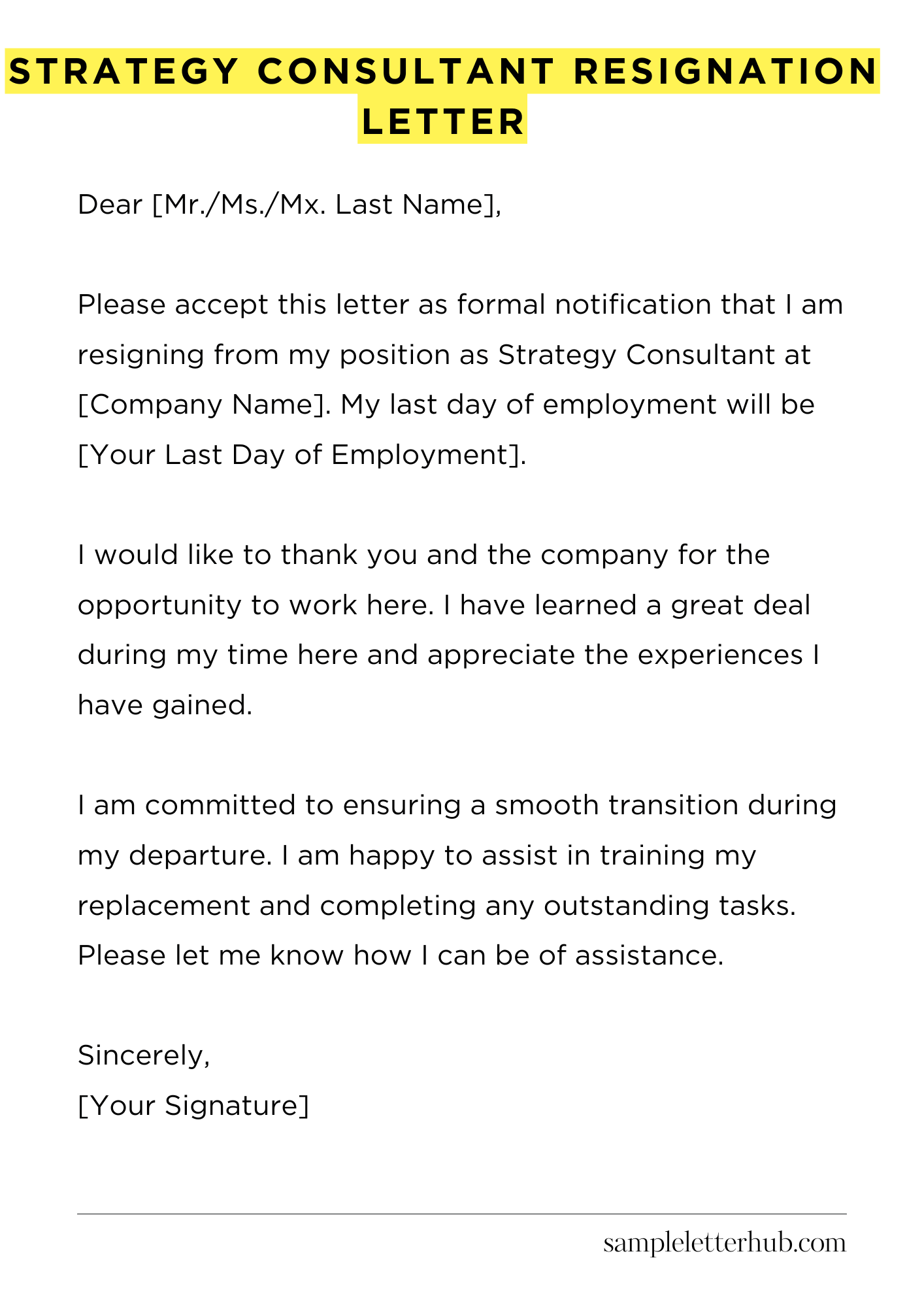
How to Write Strategy Consultant Resignation Letter
Leaving a strategy consulting role is a big step. You’ve likely put in long hours, traveled extensively, and honed your analytical skills. So, your resignation letter needs to reflect that professionalism. But, what exactly should you include to make it effective? Let’s break it down.
1. Formalities: Keep it Clear and Concise
First things first. Your resignation letter is a formal document. Therefore, it needs to be written with a professional tone. Start with your full name, current title, and the date. Next, directly state your intention to resign from your position. Always mention the specific date your resignation takes effect. This is super important.
Consider using a standard business letter format. Address the letter to your direct supervisor or the appropriate HR contact. Keep sentences relatively short and get straight to the point. No fluff allowed!
2. Express Gratitude: Showing Appreciation
While you’re moving on, it’s wise to express gratitude. You don’t have to write a novel, but a sincere acknowledgement of your experience is important. Acknowledge the opportunities you’ve been given. Briefly mention any key learnings or positive experiences you had during your time with the firm. Show appreciation for the company and its leadership.
Think about saying something like: “I am grateful for the opportunities I have been provided during my time at [Company Name], and I appreciate the support I have received from my colleagues.” This shows respect. It also leaves a positive impression, regardless of your reasons for leaving.
3. Provide Context (But Keep it Brief)
You’re not obligated to give a detailed explanation for why you’re leaving. However, it’s usually considered polite to provide a brief and general reason. Keep it vague, if needed. For example, stating that you’re pursuing another opportunity is perfectly acceptable. Or, you can say you are seeking a career change. This helps them understand, without needing all the gritty details.
Avoid any negative comments about the company, your colleagues, or your clients. This is not the time to air grievances. Maintain a positive and professional demeanor throughout the entire letter.
4. Offer Support: Facilitate a Smooth Transition
Demonstrate your commitment to a smooth handover. Offer to assist in the transition of your responsibilities. You can offer to train your replacement or to document your projects. This action highlights your professionalism and your dedication. This will leave a lasting positive impact.
Consider phrases like: “I am committed to ensuring a smooth transition during my departure. I am happy to assist in any way possible to train my successor and to complete ongoing projects before my last day.” This is great for your reputation.
5. Conclusion and Closing: Sign Off with Class
End your letter with a professional closing. Use a formal sign-off like “Sincerely,” or “Best Regards.” Type your full name, and then leave space for your signature above it. This completes the formal nature of the document. Keep your tone polite and respectful right until the end.
Proofread the letter carefully. Double-check for any spelling or grammatical errors before sending it. Make a copy for your records. This is vital.
FAQs about Strategy Consultant Resignation Letter
What is the recommended format for a Strategy Consultant resignation letter?
The standard format for a strategy consultant resignation letter should be professional and concise. Start with your name, address, and contact information, followed by the date. Then, address the letter to your direct supervisor or HR department. Clearly state your intention to resign, including your last day of employment.
Express gratitude for the opportunities you’ve been given, and briefly mention your willingness to assist with the transition. Keep it to one page, and maintain a formal tone.
What key information should be included in a Strategy Consultant resignation letter?
Your resignation letter must include your explicit intent to resign, stating your last day of employment with precision. It should also include your name, the name of your company, and the date. You must maintain professional etiquette and maintain a tone of gratitude toward your employer.
In addition, it should include your availability to assist with the transition process, such as training your replacement, or completing projects. Consider including your contact information for future communications, if you choose.
How much notice should a Strategy Consultant give when resigning?
Typically, strategy consultants are expected to provide at least two weeks’ notice, which is the standard professional courtesy. However, the exact notice period might be outlined in your employment contract, so it’s critical to review it.
Some senior-level consultants or those in leadership roles might be expected to give more notice, perhaps a month or more, depending on the firm’s policy and the complexity of their projects. Always adhere to the terms agreed upon in your employment agreement to avoid any potential issues.
Is it necessary to state the reason for resigning in a Strategy Consultant’s letter?
While not mandatory, it’s often acceptable to briefly state your reason for resigning. You could, for instance, say you’re pursuing another opportunity or that you’re seeking a career change.
However, you are not required to give the exact specifics of your reason. Keep it brief and positive, focusing on your future plans rather than any dissatisfaction with your current role. A simple statement such as “I am pursuing a new opportunity” is often sufficient.
How should a Strategy Consultant handle the transition process after submitting their resignation?
After submitting your resignation letter, it’s essential to cooperate with your employer to ensure a smooth transition. This involves collaborating with your team, and completing outstanding tasks.
Be prepared to train your replacement and transfer your knowledge and responsibilities effectively. Maintain professionalism throughout the transition period, attending meetings, responding to questions, and keeping up the quality of your work until your last day. This will leave a positive impression on your employer.
Related:
Resignation letter due to rude boss
Resignation letter moving to another state
Resignation letter due to illness of family member
Resignation letter due to study