

A staff writer resignation letter is a formal document. It is written by a staff writer. The purpose? To officially inform their employer of their departure. This signals the end of their employment.
Crafting the perfect resignation can be tricky. Don’t worry, we’ve got you covered. We’ll explore various examples and templates. These will guide you through the process.
Think of this article as your personal resignation letter toolkit. Find the right words and format with ease. Make your transition smoother.
Staff Writer Resignation Letter
Below is a sample of a Staff Writer Resignation Letter:
[Your Name]
[Your Address]
[Your Phone Number]
[Your Email Address]
[Date]
[Hiring Manager Name] (If known, otherwise use title)
[Hiring Manager Title]
[Company Name]
[Company Address]
Dear [Mr./Ms./Mx. Last Name],
Please accept this letter as formal notification that I am resigning from my position as Staff Writer at [Company Name]. My last day of employment will be [Your Last Day of Employment].
I would like to thank you for the opportunity to work at [Company Name]. I have enjoyed my time here and have learned a great deal. I appreciate the experiences I have gained and the people I have worked with.
I am committed to ensuring a smooth transition during my departure. I am happy to assist in training a replacement or completing any outstanding projects before my last day.
I wish you and [Company Name] all the best in the future.
Sincerely,
[Your Signature]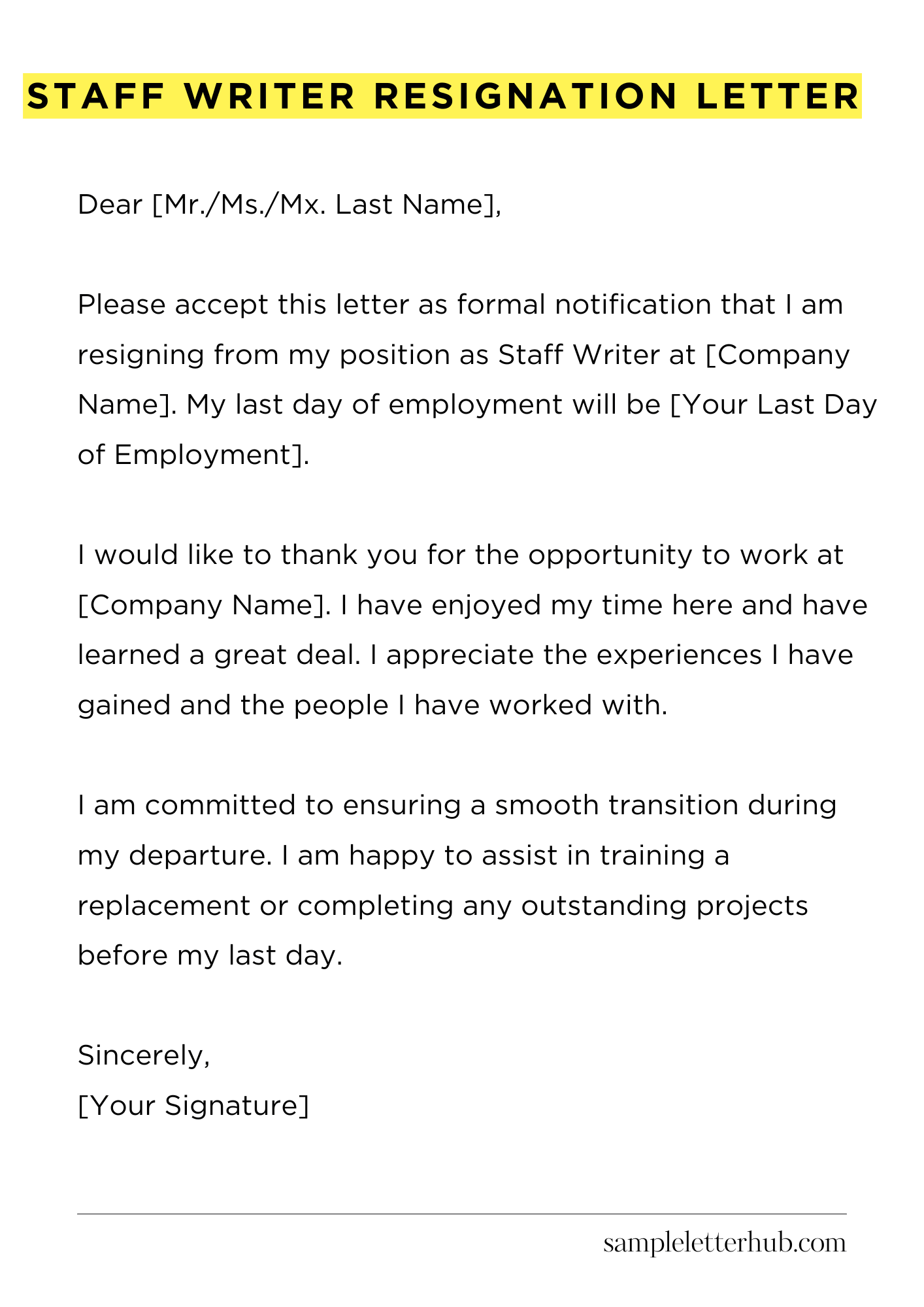
How to Write a Staff Writer Resignation Letter
Resigning from a job can feel like a big step. Especially when you’re a staff writer! You’ve likely spent time honing your skills, building relationships, and contributing to the company’s content. But sometimes, it’s time to move on. That’s where the resignation letter comes in. This document is your official notice that you’re leaving your position. Getting it right is crucial.
1. Why is a Resignation Letter Important?
Think of your resignation letter as the formal closing of a chapter. It serves a few vital purposes. First, it provides a clear record of your departure, including the date of your last day. This is important for both you and your employer.
Secondly, it allows you to express your gratitude for the opportunity and maintain a professional relationship. Let’s be honest, you might need a reference in the future! A well-written letter can help ensure a smooth transition. A positive tone is key.
2. Key Elements to Include
So, what exactly should you put in your letter? Start with a clear and concise statement of your intention to resign. Specify your last day of employment. This is the most critical piece of information. Next, express your gratitude for the opportunity and the experiences you’ve gained. Keep it sincere.
You can briefly mention any positive aspects of your time at the company. Then, offer to assist with the transition. This shows professionalism and a willingness to help. Finally, close with a professional sign-off and your printed name.
3. Crafting the Perfect Tone
The tone of your letter should be professional and positive. Even if you’re leaving due to negative reasons, avoid negativity in your letter. Focus on the positive aspects of your experience.
Expressing gratitude is always a good idea. Keep it brief. Avoid overly emotional language, even if you are feeling conflicted. The goal is to leave on a good note. A calm, respectful tone is always the best approach. It is about how you want to be remembered.
4. Examples and Templates
Need some help getting started? Here’s a basic template:
[Your Name]
[Your Address]
[Your Email]
[Your Phone Number]
[Date]
[Employer’s Name]
[Employer’s Title]
[Company Name]
[Company Address]
Dear [Mr./Ms./Mx. Last Name],
Please accept this letter as formal notification that I am resigning from my position as Staff Writer at [Company Name]. My last day of employment will be [Date].
I am grateful for the opportunities I’ve had during my time here. I have learned a lot and appreciate the experience.
I am happy to assist with the transition process in any way I can.
Thank you again for the opportunity.
Sincerely,
[Your Signature]
[Your Printed Name]
Feel free to adjust this to fit your specific situation. Remember to customize it with your own details. Consider adding a short, positive note about a specific project or colleague if appropriate. Many online resources offer resignation letter templates. These can serve as great starting points.
5. Before You Hit Send: Proofread and Review
Before you send your resignation letter, proofread it carefully. Check for any grammatical errors or typos. Ensure all the information is accurate and correct.
Double-check the date, the recipient’s name, and the company name. Have a friend or colleague read it over if possible. A second pair of eyes can catch anything you might have missed. Taking these final steps will ensure your letter is polished and professional. Your attention to detail will reflect well on you and your professionalism, leaving a positive lasting impression.
FAQs about Staff Writer resignation letter
How do I start my Staff Writer resignation letter?
Begin your Staff Writer resignation letter by clearly stating your intention to resign. Include your name, the date, and the effective date of your resignation. Ensure that this opening is direct, professional, and unambiguous. You should also clearly state your position title, such as “Staff Writer” at the beginning of the letter.
What key information should I include in my Staff Writer resignation letter?
Your letter should contain the effective date of your resignation, a brief statement of your reason for leaving (optional but often included), and a thank you to the employer for the opportunity. You should also mention any assistance you can provide during the transition period and offer to help with the transfer of your responsibilities.
Is it necessary to provide a reason for resigning in my Staff Writer resignation letter?
While not always required, briefly stating your reason for leaving can be beneficial. It helps your employer understand your decision and may provide an opportunity for them to address any concerns. Keep your reason concise and professional, focusing on the future and new opportunities, and try to keep it positive.
However, if you are uncomfortable sharing, it is also perfectly acceptable to simply state that you are resigning.
How should I format the closing of my Staff Writer resignation letter?
Close your letter by expressing your gratitude for the opportunity to work as a Staff Writer. You can also offer to assist with the transition. Include a professional closing such as “Sincerely,” or “Respectfully,” followed by your full name and signature. If submitting electronically, your typed name usually serves as your signature.
What is the proper etiquette for submitting my Staff Writer resignation letter?
Submit your resignation letter in writing to your direct supervisor or Human Resources, following your company’s policy. It’s often best to provide a hard copy, but an email is also acceptable.
Be sure to submit your letter at least two weeks before your intended last day, in keeping with standard professional practice. Always maintain a professional and respectful tone, regardless of your personal feelings.
Related:
Resignation letter due to rude boss
Resignation letter moving to another state
Resignation letter due to illness of family member
Resignation letter due to study