

A staff resignation letter is a formal document. It informs an employer that an employee is leaving their job. This letter officially marks the end of employment. It also helps with a smooth transition.
Preparing to leave a job can be stressful. You need to write a professional resignation letter. Don’t worry, we are here to help. We have compiled various templates for you. These will guide you through the writing process.
Inside, you will find several examples. You can adapt them to your specific situation. Whether you’re moving to a new role or retiring, we’ve got you covered. This makes the whole process easier. Let’s get started.
Staff Resignation Letter
Below is a sample of a Staff Resignation Letter:
[Your Name]
[Your Address]
[Your Phone Number]
[Your Email Address]
[Date]
[Recipient’s Name]
[Recipient’s Title]
[Company Name]
[Company Address]
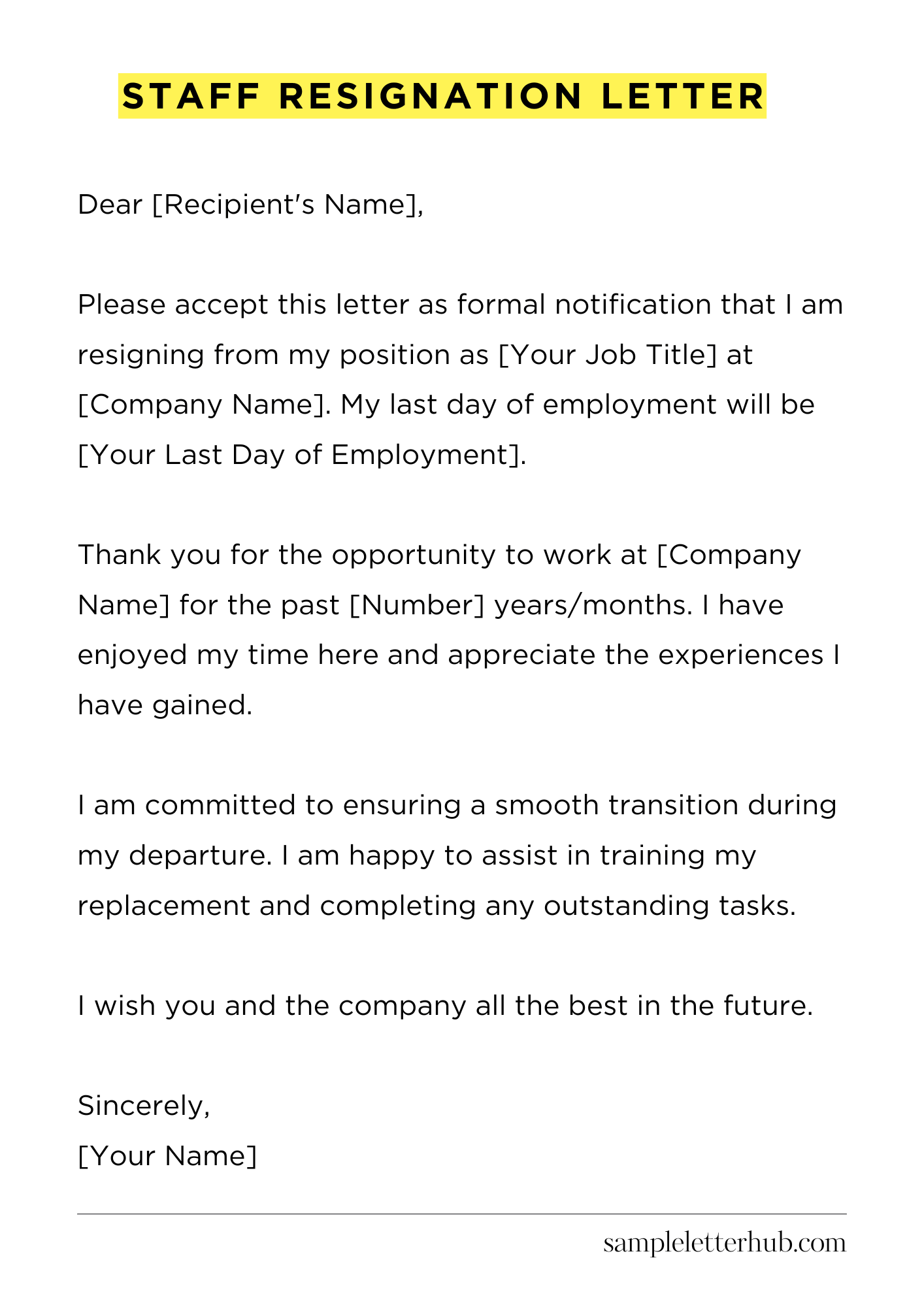
Dear [Recipient’s Name],
Please accept this letter as formal notification that I am resigning from my position as [Your Job Title] at [Company Name]. My last day of employment will be [Your Last Day of Employment].
Thank you for the opportunity to work at [Company Name] for the past [Number] years/months. I have enjoyed my time here and appreciate the experiences I have gained.
I am committed to ensuring a smooth transition during my departure. I am happy to assist in training my replacement and completing any outstanding tasks.
I wish you and the company all the best in the future.
Sincerely,
[Your Name]
How to Write a Staff Resignation Letter
Leaving a job is a big decision. It marks the end of a chapter and the beginning of a new one. A key part of this process is crafting a professional resignation letter. It’s more than just a formality; it’s a critical communication. Let’s explore how to write one that leaves a positive impression, no matter your reason for leaving.
1. Keep it Simple and Direct
The primary goal is to clearly and concisely state your intention to resign. Avoid overly complex language. Your letter should be easy to understand. Start by stating your position and then clearly state your resignation.
For example, “I am writing to inform you of my resignation from the position of [Your Position] at [Company Name], effective [Your Last Day of Employment].” This gets straight to the point without any ambiguity. No need for lengthy explanations here. Clarity is the key ingredient.
2. Show Gratitude and Professionalism
Even if your departure is less than amicable, it is always a good idea to maintain a professional tone. Thank your employer for the opportunity and the experience gained. You can briefly mention what you have learned, which is an impressive gesture. Consider something like, “I am grateful for the opportunities I have been given during my time here.”
Or “I would like to express my gratitude for the opportunities I have had while working at [Company Name]”. This showcases maturity and leaves a positive final impression. This is a critical aspect, especially for potential future references.
3. Provide Necessary Details
Include essential information, such as your last day of employment. This helps ensure a smooth transition. Also, it’s wise to mention if you are available to assist with the handover process. For example, “I am available to assist with the transition of my duties during the next two weeks.” This reflects positively on your commitment. This simple step can make a big difference.
4. Avoid Unnecessary Information
Keep the letter focused on your resignation. Avoid going into excessive detail about your reasons for leaving, unless explicitly requested by your employer. A concise and respectful letter is much more effective. Refrain from negativity. Keep your explanation brief. You don’t need to list all the issues you had.
Instead, a simple statement like, “I am pursuing other opportunities,” is often sufficient and professional. Remember, you want to end on a positive note.
5. Proofread and Format
Before sending your letter, always proofread carefully. Ensure there are no spelling or grammatical errors. A polished letter shows attention to detail. Use a standard business letter format. Include your contact information (email and phone number) at the top or bottom of the letter.
A well-formatted and error-free letter is a sign of respect for your employer and your professionalism. This is a critical final step, showcasing your attention to detail.
FAQs about Staff Resignation Letter
What is the primary purpose of a staff resignation letter?
The primary purpose of a staff resignation letter is to formally notify an employer of an employee’s intent to leave their position. It serves as an official record of the resignation, the employee’s last day of employment, and often includes a brief statement of thanks or a reason for leaving. It’s a crucial document for legal and HR purposes, initiating the offboarding process.
What essential information should be included in a resignation letter?
A well-written resignation letter should include: a clear and concise statement of resignation; the employee’s name and job title; the effective date of the resignation (last day of employment); a formal closing; and the employee’s signature. Optional elements may include a brief expression of gratitude for the opportunity or a reason for leaving, if desired.
How much notice should an employee give when resigning?
The required notice period depends on the employment contract, company policy, and local labor laws. Most companies require a minimum of two weeks’ notice, but this can vary. It’s essential for employees to review their employment agreement or company handbook to understand the stipulated notice period and adhere to it to avoid potential issues.
Should I provide a reason for resigning in my letter?
Providing a reason for resigning is optional. While it’s generally good practice to maintain professionalism, the level of detail is at the employee’s discretion.
A simple statement such as “I am pursuing other opportunities” or “I am seeking a career change” is usually sufficient. Avoid negative comments about the company or colleagues, unless there are serious legal reasons to include them.
How should I deliver my resignation letter?
The preferred method of delivering a resignation letter is typically in writing, either as a physical letter or as an email. Check company policy for the preferred method, or ask your manager.
Always maintain a professional tone, and ensure a copy of the letter is kept for personal records. It’s also often best practice to have a conversation with your manager before submitting the formal letter.
Related:
Resignation letter due to rude boss
Resignation letter moving to another state
Resignation letter due to illness of family member
Resignation letter due to study