

A Senior Accountant resignation letter is a formal document. It informs your employer of your departure. It officially ends your employment. This letter is crucial for a smooth transition.
Preparing to move on can be hard. Writing the letter shouldn’t be. We’ve got you covered. This article offers helpful templates. We’ll share various examples. They will guide you.
Our samples cover various scenarios. Need a quick and easy letter? We’ve got it. Want to express gratitude? You’ll find options here. Choose the best fit. Make your exit easy and professional.
Sr Accountant Resignation Letter
Below is a sample of a Sr Accountant Resignation Letter:
[Your Name]
[Your Address]
[Your Phone Number]
[Your Email Address]
[Date]
[Employer’s Name]
[Employer’s Title]
[Company Name]
[Company Address]
Dear [Employer’s Name],
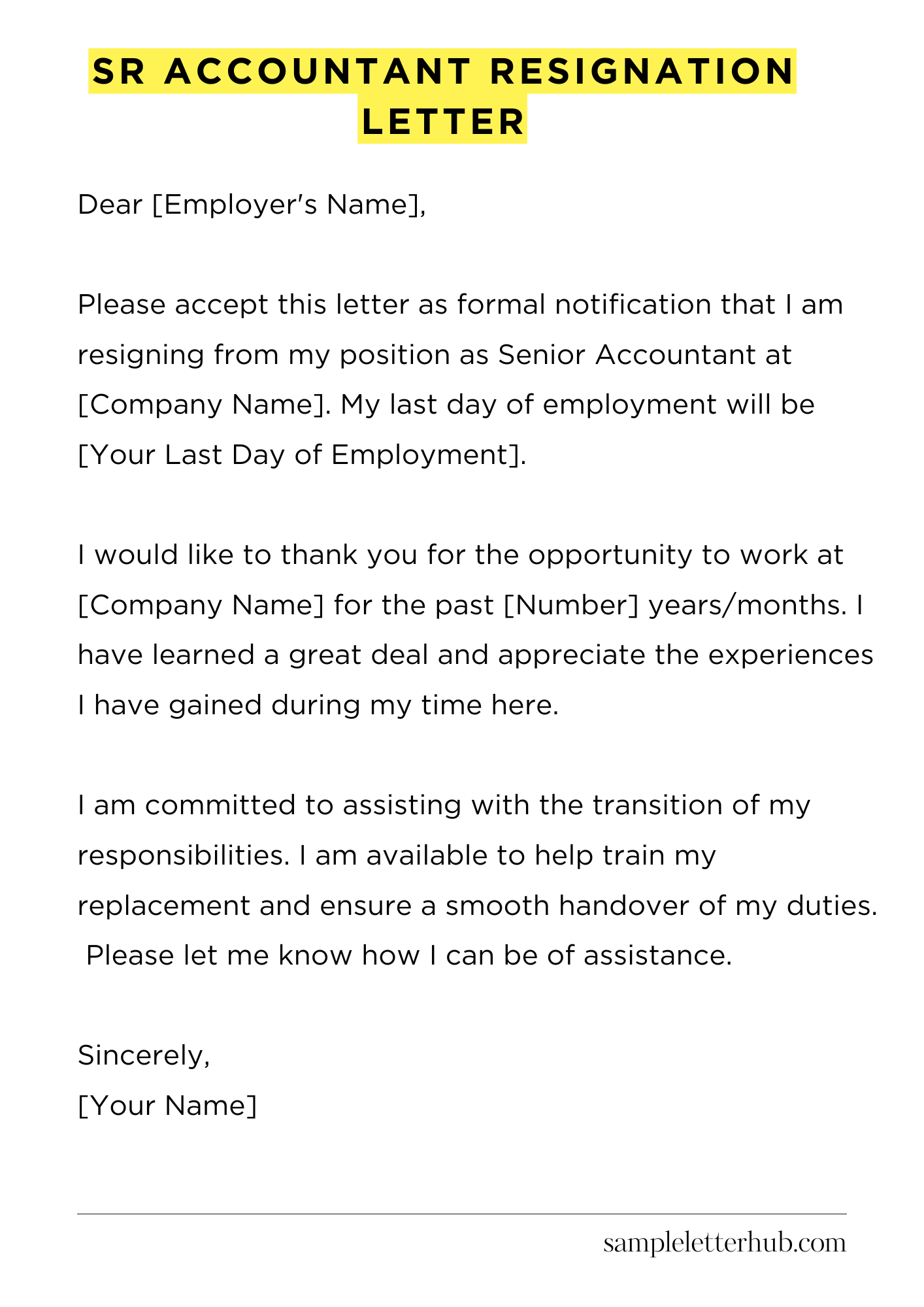
Please accept this letter as formal notification that I am resigning from my position as Senior Accountant at [Company Name]. My last day of employment will be [Your Last Day of Employment].
I would like to thank you for the opportunity to work at [Company Name] for the past [Number] years/months. I have learned a great deal and appreciate the experiences I have gained during my time here.
I am committed to assisting with the transition of my responsibilities. I am available to help train my replacement and ensure a smooth handover of my duties. Please let me know how I can be of assistance.
I wish you and [Company Name] all the best in the future.
Sincerely,
[Your Name]
How to Write a Sr Accountant Resignation Letter
So, you’re ready to move on. You’ve weighed the pros and cons, and now you need to resign from your Senior Accountant position. Writing a resignation letter is a crucial step.
It’s not just a formality; it’s a professional statement that reflects your character and sets the stage for your departure. Let’s delve into crafting a resignation letter that is clear, concise, and professional. It’s easier than you think.
1. Start with a Clear and Concise Opening
The beginning of your letter should immediately state your intention to resign. Avoid beating around the bush. Get straight to the point. State your name, your position, and the effective date of your resignation.
For instance, start with something like this: “Dear [Manager’s Name], please accept this letter as formal notification that I am resigning from my position as Senior Accountant at [Company Name], effective [Your Last Day of Employment].” This is clear and unambiguous. Keep it short and sweet. Remember clarity is key.
2. Briefly Acknowledge Your Time and Express Gratitude
While you might be eager to leave, expressing gratitude is always a good idea. Briefly mention the period you’ve worked at the company. Then, acknowledge the experience you’ve gained or the opportunities you’ve had. This doesn’t require flowery language. A simple sentence or two can suffice.
For example: “I have greatly valued my time at [Company Name] and appreciate the opportunities I’ve been given over the past [Number] years/months.” This positive note leaves a good impression. Consider adding a short thank you for something specific you value. It makes it more personal and memorable.
3. Provide Necessary Information and Offer Assistance
This is where you demonstrate your professionalism and commitment, even on your way out. You’ll want to specify the details you have and what you would like to mention. Include a line about assisting with the transition. Offer to help with the handover of your duties.
This shows you’re not just abandoning your responsibilities. Consider saying something like: “I am committed to ensuring a smooth transition during my departure.
I am happy to assist in training my replacement and completing any outstanding tasks before my last day.” If there are specific tasks you are happy to assist with, feel free to mention them. This shows a high level of professionalism. Provide a few weeks notice, ideally, if possible.
4. Keep it Professional and Avoid Negativity
This is arguably the most important point. No matter the reasons for your departure, keep your letter positive and professional. Avoid criticizing your employer, colleagues, or the company. Refrain from mentioning any grievances or complaints. Remember, your resignation letter is a permanent record.
It will remain in your personnel file. It could be seen by potential future employers. Focus on the positive aspects of your experience. A brief, neutral sentence is sufficient. Focus on moving forward. A bitter tone will only reflect poorly on you. This is not the appropriate place for negativity, no matter your feelings.
5. Closing and Formalities
End your letter with a polite and professional closing. Reiterate your last day of employment. Include a final expression of gratitude, if you wish. Then, sign your name and print your name below the signature.
For example: “I wish the company continued success in the future. Sincerely, [Your Signature] [Your Typed Name]”. After all, you have a professional image to maintain. Always keep the formality.
Proofread your letter carefully before submitting it. Make sure there are no spelling or grammatical errors. Ensure that you have the correct addressee. The little things are important.
FAQs about Sr Accountant resignation letter
How do I write a resignation letter as a Senior Accountant?
A Senior Accountant resignation letter should be professional and concise. Start by stating your intention to resign, the effective date of your resignation, and a brief thank you for the opportunity.
Keep it positive and avoid negative comments. You may also offer to assist with the transition. Include your name, title, and contact information. Consider using a template as a starting point, but personalize it to fit your situation and relationship with your employer. Proofread carefully before submitting.
What should I include in the Senior Accountant resignation letter?
Your resignation letter should include: a clear statement of resignation, the date of your last day of employment, a brief and professional expression of gratitude for the opportunity, and an offer to assist with the transition, if desired.
You should also include your name, title, and contact information. It’s best to keep it brief, focusing on the essential information, and maintaining a positive tone.
How much notice should I give when resigning as a Senior Accountant?
Generally, it’s customary to give at least two weeks’ notice, but this can vary depending on your employment contract or company policy. Some organizations may require more notice, especially for senior roles.
Review your employment contract to determine the required notice period. Providing more notice is often seen as a courtesy and can help maintain a positive relationship with your employer. Consider giving more notice if you are involved in critical projects or have complex responsibilities.
Can I provide a reason for leaving in my Senior Accountant resignation letter?
You are not required to provide a reason for leaving in your resignation letter, and it is often best to keep the reason simple and positive. If you choose to offer a reason, keep it brief and professional.
Common reasons include pursuing a new opportunity or personal growth. Avoid being overly critical of your current employer or colleagues. If you have a good relationship with your manager, you might discuss the reasons for leaving separately.
What if I have unvested stock options or benefits when I resign as a Senior Accountant?
When resigning, it’s essential to understand the implications on your unvested stock options and benefits. Review your employment agreement or any related documentation for details on vesting schedules and how your resignation will affect your eligibility to receive them.
Contact your HR department to get clarification on any specific questions you may have. You may need to exercise any vested options within a specific timeframe after your last day of employment. Be sure to understand any deadlines related to benefits such as health insurance or retirement plans.
Related:
Resignation letter due to rude boss
Resignation letter moving to another state
Resignation letter due to illness of family member
Resignation letter due to study