

A Senior Account Executive resignation letter is a formal document. It notifies your employer of your departure. The purpose is to officially end your employment. It’s a crucial step in leaving your job professionally.
Need to resign? Writing this letter can be tricky. We’re here to help! We’ve prepared several templates. These are designed for Sr. Account Executives like you.
You’ll find various examples. Each is crafted to suit different situations. Consider them a starting point. Feel free to customize them. Make your resignation process easier.
Sr Account Executive Resignation Letter
Below is a sample of a Sr Account Executive Resignation Letter:
[Your Name]
[Your Address]
[Your Phone Number]
[Your Email Address]
[Date]
[Hiring Manager Name] (If known, otherwise use title)
[Hiring Manager Title]
[Company Name]
[Company Address]
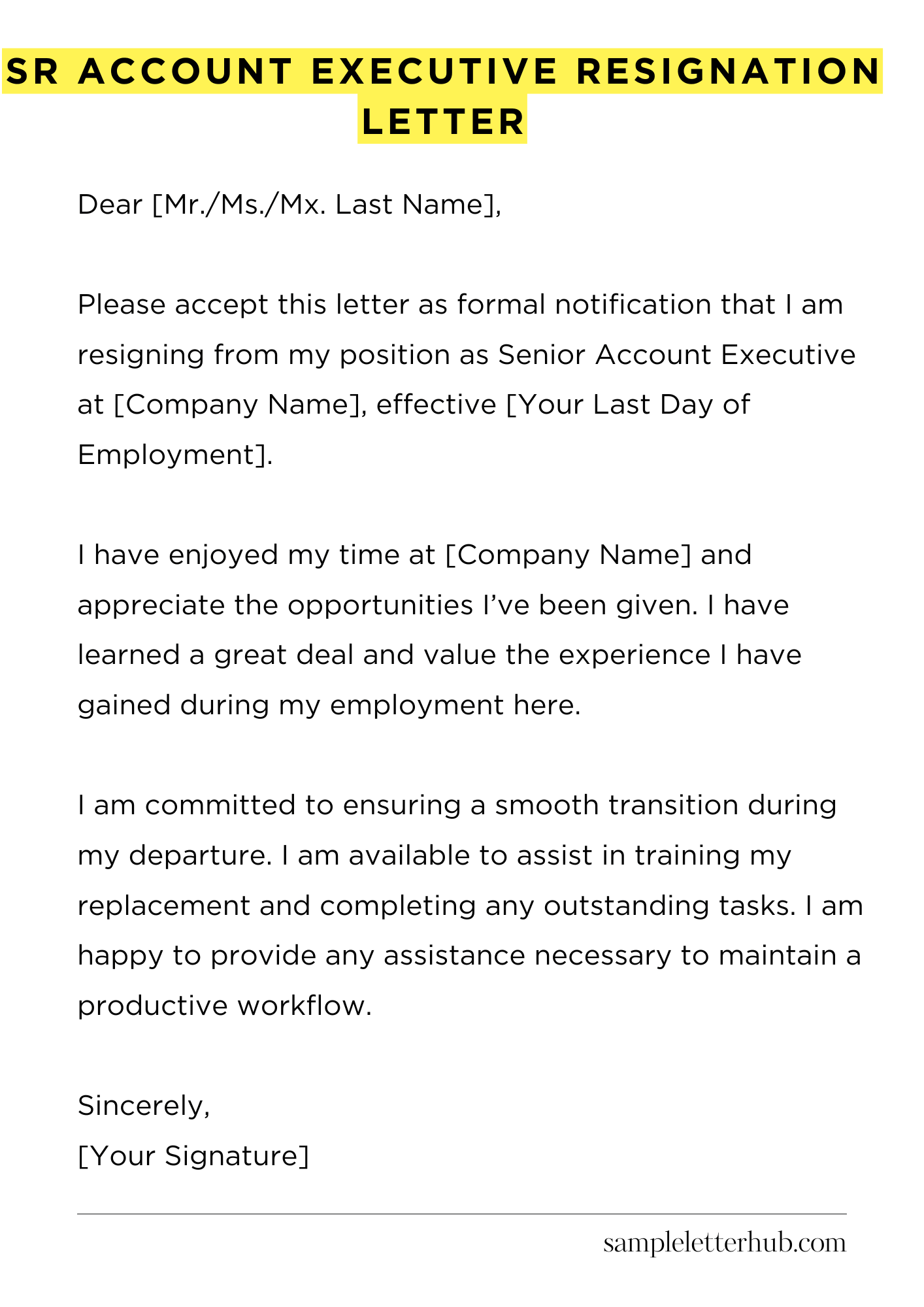
Dear [Mr./Ms./Mx. Last Name],
Please accept this letter as formal notification that I am resigning from my position as Senior Account Executive at [Company Name], effective [Your Last Day of Employment].
I have enjoyed my time at [Company Name] and appreciate the opportunities I’ve been given. I have learned a great deal and value the experience I have gained during my employment here.
I am committed to ensuring a smooth transition during my departure. I am available to assist in training my replacement and completing any outstanding tasks. I am happy to provide any assistance necessary to maintain a productive workflow.
Thank you for the support and experiences I have received during my time at [Company Name]. I wish the company continued success in the future.
Sincerely,
[Your Signature]
How to Write a Sr Account Executive Resignation Letter
Leaving a job, especially a senior one, is a big decision. It’s vital to do it professionally and with grace. One of the most important aspects of this process is crafting a well-written resignation letter.
This letter serves as your formal notice, sets the tone for your departure, and can significantly impact your future career prospects. Don’t underestimate its importance; it’s more than just a formality.
1. Start with a Clear and Concise Statement
Your opening paragraph should be straightforward and to the point. State your intention to resign from your position as Senior Account Executive. Be direct, avoid ambiguity, and clearly indicate your last day of employment. This information is the most critical element; don’t bury it.
You might start by saying, “Please accept this letter as formal notification that I am resigning from my position as Senior Account Executive at [Company Name], effective [Your Last Day of Employment].” Keep it simple; there is no need to overcomplicate it. This sets the stage and leaves no room for misunderstanding.
2. Express Gratitude and Positive Reinforcement
While you’re leaving, show your appreciation for the opportunities and experiences you’ve gained. A touch of gratitude leaves a lasting positive impression.
Mention specific aspects of the job or company you valued. This could include the people you worked with, the skills you developed, or the projects you enjoyed. This step demonstrates professionalism.
For example, “I am grateful for the opportunities I’ve been given at [Company Name] over the past [Number] years, and I have greatly valued my time here.” A quick sentence highlighting a positive experience shows class. Avoid negativity; focus on the positive.
3. Offer Assistance with the Transition
Leaving on good terms is crucial. Indicate your willingness to assist with the transition. Offer to help train your replacement, document your responsibilities, or answer any questions from your colleagues. This demonstrates your commitment and shows that you value your current relationships.
It reflects well on your professionalism and your dedication. This willingness could be expressed as, “I am committed to ensuring a smooth transition during my departure and am happy to assist in any way possible to help train my replacement and/or handover any project documents.” Your offer of help can ease the burden on your former employer.
4. Keep it Brief and Professional
Resignation letters should be concise and professional. Avoid lengthy explanations about your reasons for leaving, unless you’ve been asked for them separately. Focus on the essential information: your resignation, your gratitude, your last day, and your offer of assistance. Keep your letter to a single page.
Too much detail can clutter the message. Steer clear of any negative comments or complaints about your job or the company. Maintain a tone of professionalism from start to finish. Keep it to the point and make it easy to read.
5. Proofread and Proofread Again, and then Close Appropriately
Before submitting your letter, carefully proofread it for any spelling or grammatical errors. Mistakes can detract from your professionalism. Ensure all your contact information is correct. End your letter with a professional closing, such as “Sincerely,” or “Respectfully,” followed by your full name.
Also, consider adding your contact information below your signature. Once you have proofread and edited, print it and hand it in or send an email; ensure you send it to the right person.
FAQs about Sr Account Executive resignation letter
How much notice should I give in my Sr Account Executive resignation letter?
Generally, a standard two weeks’ notice is considered professional. However, the appropriate notice period can vary depending on your employment contract, company policy, and industry norms.
Review your employment agreement to determine if a longer notice period is required. Providing more notice, if possible, can be beneficial, especially if you have a good relationship with your employer and want to ensure a smooth transition of your responsibilities.
What should be included in a Sr Account Executive resignation letter?
Your resignation letter should be concise and professional. It should clearly state your intention to resign, your last day of employment, and a brief expression of gratitude for the opportunity. While optional, you may include a sentence or two acknowledging your experience and thanking your colleagues or supervisors.
Avoid negative comments or detailed explanations for your departure in the letter itself. Keep it simple, factual, and positive.
Should I provide a reason for resigning in my Sr Account Executive resignation letter?
You are not obligated to provide a specific reason for your resignation. You can keep it general, such as “for personal reasons” or “to pursue other opportunities.” If you have a positive relationship with your manager, you might choose to briefly mention your new role or plans in a separate conversation.
However, the letter’s primary focus should be on formally notifying your employer of your departure. Avoid going into excessive detail or including any negative feedback about your current employer.
Can I use a template for my Sr Account Executive resignation letter?
Yes, using a template can be a good starting point. Many templates are available online. However, customize the template to fit your specific situation and the tone you want to convey.
Ensure the template is appropriate for your industry and company culture. Proofread the letter carefully to avoid any errors and to personalize it with your own details. Never copy and paste a template without reviewing and adjusting it to your specific situation and circumstances.
How should I deliver my Sr Account Executive resignation letter?
The standard practice is to deliver your resignation letter to your direct supervisor or HR department. Consider delivering it in person, if possible, followed by a digital copy via email for documentation.
Make sure to keep a copy of the letter for your records. Before submitting, it’s wise to review company policies on the resignation process. Schedule a meeting with your supervisor to discuss your departure and any handover procedures.
Related:
Resignation letter due to rude boss
Resignation letter moving to another state
Resignation letter due to illness of family member
Resignation letter due to study