

A “Special Agent resignation letter” is a formal document. It is written by a Special Agent. The purpose is to officially notify their agency of their intention to leave their position. This letter follows specific protocols. It ensures a smooth transition.
Considering stepping away from your role? Crafting the right resignation letter is crucial. We have you covered. This article features helpful templates. You’ll find examples and samples.
Use these to guide your own letter. Make the process easy. No need to stress about wording. Your transition can be straightforward. Let’s get started.
Special Agent Resignation Letter
Below is a sample of a Special Agent Resignation Letter:
[Your Name]
[Your Address]
[Your Phone Number]
[Your Email Address]
[Date]
[Hiring Manager Name] (If known, otherwise use title)
[Hiring Manager Title]
[Agency Name]
[Agency Address]
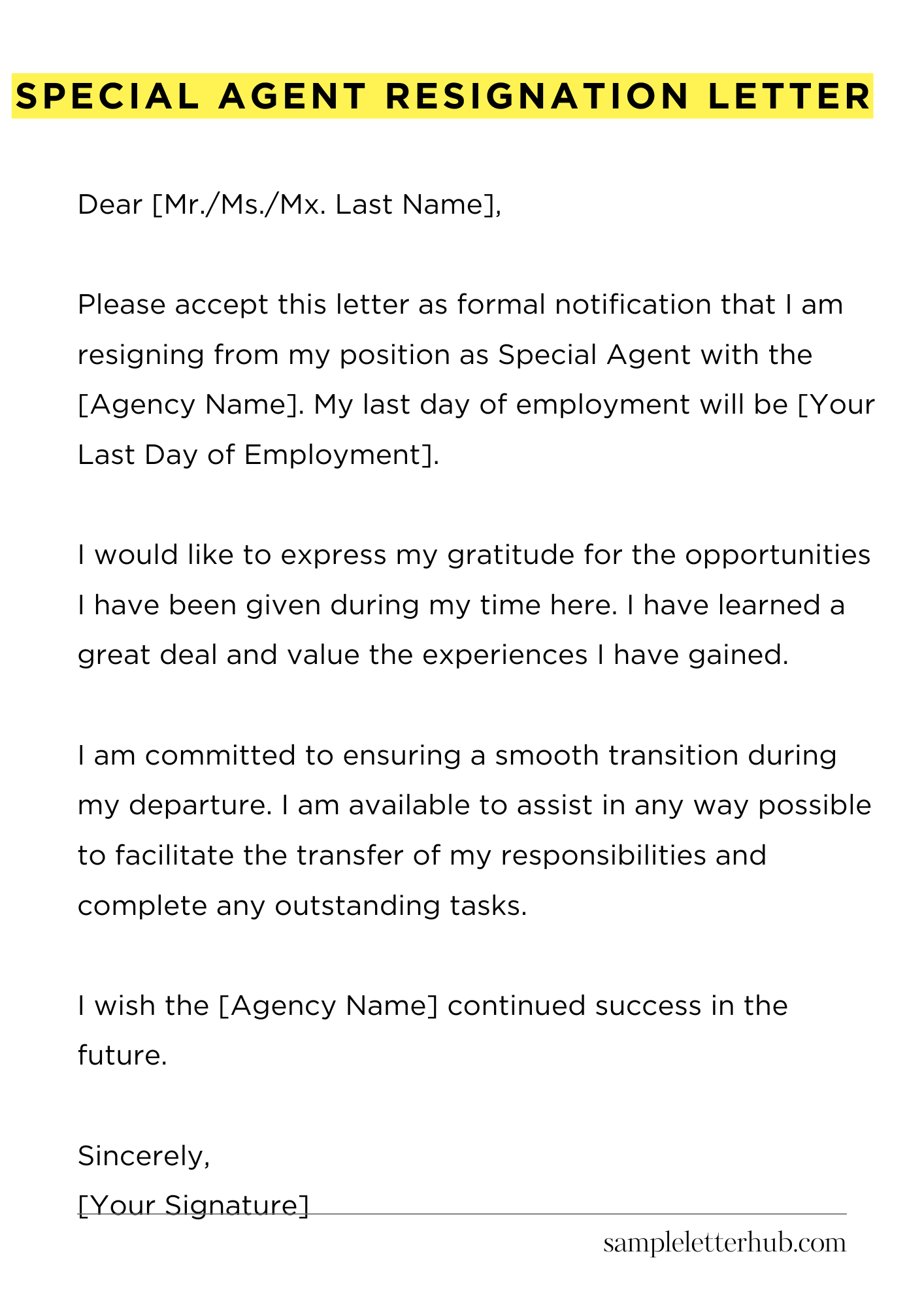
Dear [Mr./Ms./Mx. Last Name],
Please accept this letter as formal notification that I am resigning from my position as Special Agent with the [Agency Name]. My last day of employment will be [Your Last Day of Employment].
I would like to express my gratitude for the opportunities I have been given during my time here. I have learned a great deal and value the experiences I have gained.
I am committed to ensuring a smooth transition during my departure. I am available to assist in any way possible to facilitate the transfer of my responsibilities and complete any outstanding tasks.
I wish the [Agency Name] continued success in the future.
Sincerely,
[Your Signature]
How to Write a Special Agent Resignation Letter
Understanding the Stakes
Resigning from a position as a Special Agent is a big deal. You’re leaving a career that often involves significant training, specialized skills, and a strong sense of duty. This isn’t a decision to be taken lightly. Therefore, your resignation letter needs to reflect that seriousness and professionalism.
Think about the impact your departure has. Consider the chain of command, the ongoing investigations, and the overall perception of your actions. Crafting a well-written letter is the first step in ensuring a smooth transition.
The Essentials: What to Include
Certain elements are non-negotiable. First and foremost, you need a clear and concise statement of your intent to resign. State your name, your current title (Special Agent), and the date you intend your resignation to be effective. This is your official notification; make it count. Avoid ambiguity.
Next, be sure to include the date and your official contact address. You can also include your employee ID, although that’s not a strict requirement.
Then, express your gratitude for the opportunity to serve. Acknowledge the experience you’ve gained and the people you’ve worked with. Remember, you want to leave a positive impression, even when moving on.
While you’re not obligated to give a reason for your departure, you might choose to offer a brief, general explanation, such as “to pursue other opportunities” or “for personal reasons.” Keep it brief and professional. Finally, close with a polite and respectful farewell. Sign it properly.
Form and Format: Making it Look Right
Presentation matters, especially in a profession where attention to detail is paramount. Use a professional business letter format. This means single-spaced text, a standard font like Times New Roman or Arial, and 1-inch margins.
Address your letter to the appropriate superior, usually your immediate supervisor or a higher-ranking official. Be sure the letter is on good-quality, clean paper. Remember, the letter will become a permanent part of your employment record.
Proofread everything carefully! Typos and grammatical errors are unacceptable in this context. Double-check names, dates, and titles. Getting a second pair of eyes to review your letter is always a smart idea before submitting.
The “Why” (Optional): When and How to Explain
Do you need to share the reasons for your resignation? No, you don’t. While it’s generally best to keep the reason brief and neutral, there are times you might want to give more of an explanation.
This depends on your situation and your relationship with your superiors. If you’re leaving due to personal reasons, you can politely explain what’s going on. However, avoid going into unnecessary detail. This will allow for less back-and-forth communication.
If you’re resigning because of a specific issue within the agency, exercise caution. Consult with a legal professional before mentioning any sensitive matters in your letter. You may be required to sign an NDA (Non-Disclosure Agreement).
Above all, keep the tone professional and avoid making accusations. If you have been wronged, the resignation letter is not the correct place to state that.
The Final Steps: Submitting and Following Up
Once you’ve finalized your letter, it’s time to submit it. Always make a copy of your letter for your records. The standard procedure is to hand it in personally, or send it via certified mail with return receipt requested. This provides proof of delivery. Confirm receipt of your letter with your supervisor, or whoever the letter was addressed to.
Be prepared for a possible exit interview. After resigning, be professional. You might be asked questions about your experience or reasons for leaving. Remember, your goal is a smooth departure. Maintaining a positive and cooperative attitude ensures you leave with a good reputation. Treat the transition with respect. Then it is time to move on.
FAQs about Special Agent Resignation Letter
What is the typical format and structure for a Special Agent resignation letter?
A typical resignation letter for a Special Agent should follow a professional business letter format. It should begin with your contact information, the date, and the recipient’s information (usually the Special Agent in Charge or Director).
The body of the letter should clearly state your intention to resign, the effective date of your resignation, and a brief, professional expression of gratitude for the opportunity to serve.
Avoid overly emotional language or negative comments about your experience. A concise and respectful tone is paramount. You might also include a statement regarding the completion of any outstanding tasks or projects, and offer assistance with the transition if possible.
What key information must be included in a Special Agent resignation letter?
The core elements of a Special Agent resignation letter are non-negotiable. First and foremost, you must explicitly state your intent to resign. Secondly, the effective date of your resignation is crucial, ensuring a clear understanding of your last day of employment. Your name and contact information, as well as the recipient’s details, are also necessary.
It’s advisable to include a brief statement of gratitude for your time with the agency.
Avoid including sensitive or classified information. While not mandatory, a brief and professional offer to assist with the transition is often considered courteous.
Are there any legal or contractual obligations I need to be aware of when resigning as a Special Agent?
Yes, there are several legal and contractual obligations to consider. You must comply with any relevant agency policies regarding resignation, which may include specific notice periods (typically 30 days or more), required procedures for handling classified information and government property (including your badge, credentials, and equipment).
You will be required to participate in an exit interview or debriefing.
Review any non-disclosure agreements (NDAs) or security clearance requirements. Understand the potential implications for your retirement benefits, including any vesting schedules or penalties. Failure to comply with these obligations could result in legal consequences or delays in receiving benefits.
What are the potential consequences of resigning from the Special Agent position without proper notice or procedure?
Resigning without adhering to established protocols can have significant consequences. You might face potential legal repercussions, especially if you have access to classified information or government property.
It could lead to the revocation of your security clearance, which would severely limit future employment opportunities requiring such clearances. You could also be subject to financial penalties.
Furthermore, it could negatively impact your ability to obtain future employment with federal, state, or local law enforcement agencies, and you could potentially lose benefits, like your retirement benefits. Always ensure you are following the rules and guidelines laid out by your agency before tendering your resignation.
How should I handle sensitive information and property when resigning as a Special Agent?
Handling sensitive information and government property is of utmost importance. Before your resignation, review and fully understand your agency’s policies on handling classified or sensitive information. You must return all government-issued equipment, including your badge, credentials, and any government-owned devices.
Follow the procedures for properly disposing of classified documents or data, and any agency-provided software. Cooperate fully with any exit interviews or debriefings to ensure all sensitive information and property is accounted for. Failure to do so can have serious legal and professional implications.
Related:
Resignation letter due to rude boss
Resignation letter moving to another state
Resignation letter due to illness of family member
Resignation letter due to study