

A Software Designer resignation letter is a formal document. It informs your employer that you are leaving your job. The letter states your last day of employment. It’s a crucial step in the process of leaving your current position.
Crafting the perfect resignation letter can be tricky. It needs to be professional and polite. We are here to help you. We have gathered templates and examples. These samples will guide you.
This article provides various resignation letter samples. Choose the best fit for your situation. Adapt the templates to your specific needs. Writing your resignation letter just got easier.
Software Designer Resignation Letter
Below is a sample of a Software Designer Resignation Letter:
[Your Name]
[Your Address]
[Your Phone Number]
[Your Email Address]
[Date]
[Employer’s Name]
[Employer’s Title]
[Company Name]
[Company Address]
Dear [Employer’s Name],
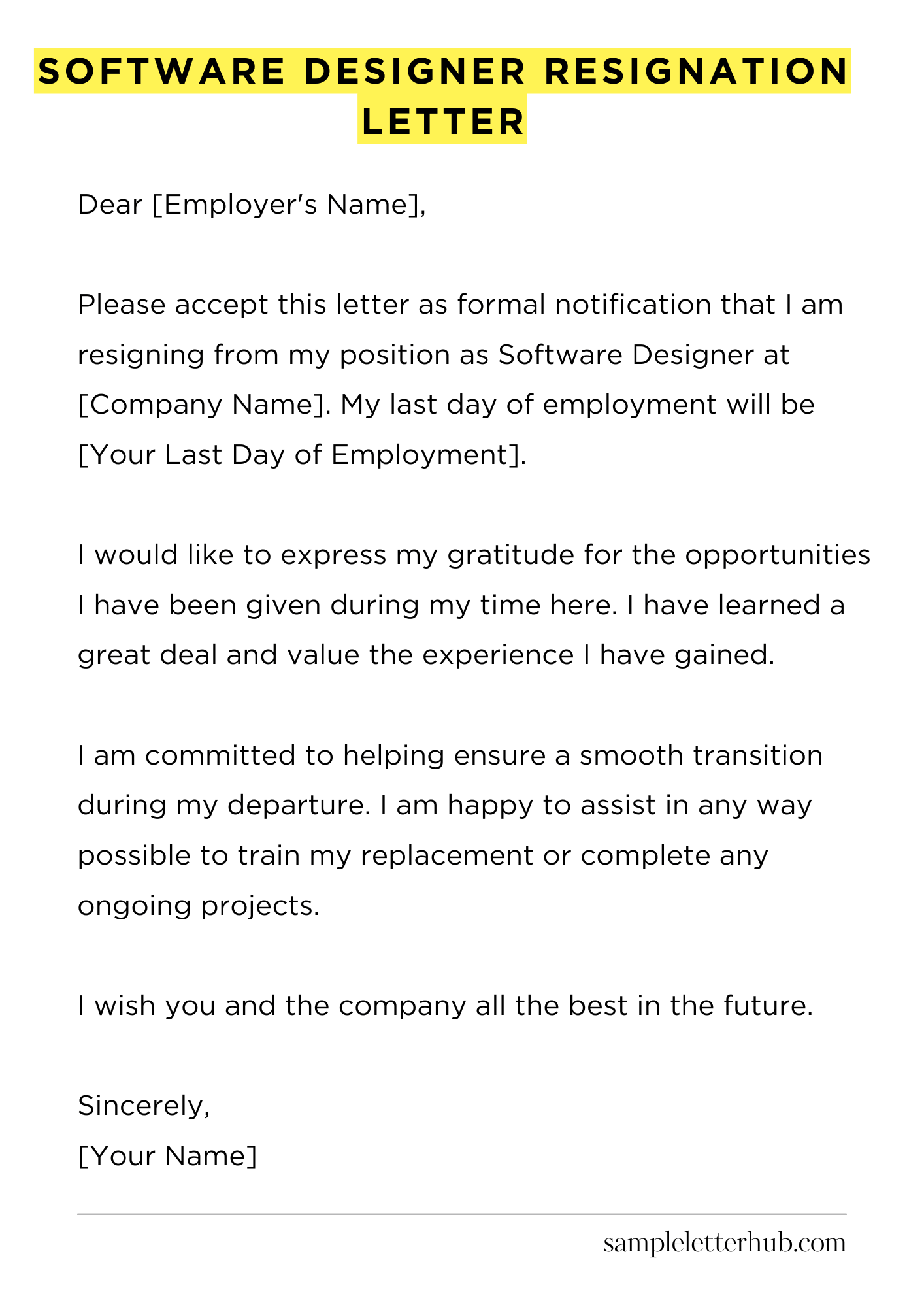
Please accept this letter as formal notification that I am resigning from my position as Software Designer at [Company Name]. My last day of employment will be [Your Last Day of Employment].
I would like to express my gratitude for the opportunities I have been given during my time here. I have learned a great deal and value the experience I have gained.
I am committed to helping ensure a smooth transition during my departure. I am happy to assist in any way possible to train my replacement or complete any ongoing projects.
I wish you and the company all the best in the future.
Sincerely,
[Your Name]
How to Write Software Designer Resignation Letter
Resigning from your Software Designer position? It’s a big step. A well-crafted resignation letter is crucial. It’s not just about saying goodbye; it’s about leaving a positive lasting impression.
This is vital, not just for your current employer, but for your future career prospects as well. Let’s walk through the essential elements to help you write a professional resignation letter.
1. Start with a Clear and Concise Statement
Your opening needs to be direct. Avoid beating around the bush. The purpose of the letter is to formally announce your departure. Here’s a good way to begin: “Please accept this letter as formal notification that I am resigning from my position as Software Designer at [Company Name], effective [Your Last Day of Employment].”
See? Simple. Easy. This immediately establishes your intention. Keep it professional and direct from the very start. Clarity is key here, in case there are any doubts.
2. Express Gratitude and Acknowledge the Experience
Even if you’re leaving for challenging reasons, showing appreciation is paramount. It reflects well on you. Consider adding a brief sentence or two acknowledging your experience. For example: “I am grateful for the opportunities I’ve had during my time here and I appreciate the experiences gained during my tenure.”
This shows professionalism. It highlights the positive aspects of your employment, even as you move on to new endeavors. This is the opportunity to be gracious. Remember, you never know when you might cross paths with these people again.
3. Provide Necessary Information and Offer Assistance
Provide some kind of valuable information. This is a critical section. You should clearly state your last day of employment. Also, you should show a willingness to help with the transition. Offer to assist in any way you can. This might include training your replacement, documenting projects, or answering questions.
Something like this could work well: “My last day of employment will be [Date]. I am happy to assist with the transition in any way possible to ensure a smooth handover of my responsibilities.” Consider your current projects. Think about what needs to be done before your departure.
4. Keep It Brief and Avoid Negativity
Resignation letters shouldn’t be overly long. Avoid getting into detailed explanations about why you’re leaving. Stick to the essentials. Also, resist the urge to complain or air grievances.
Even if you’ve had a negative experience, keep the tone positive and professional. It is never the right time to burn any bridges. Focus on the future, not the past. Remember, your resignation letter is a reflection of you. It’s a key part of your professional image.
5. Formal Closing and Contact Information
Close your letter formally. You can use a simple closing like “Sincerely” or “Best Regards.” Include your printed name. Provide your contact information, such as your phone number and personal email address.
This makes it easy for your employer to reach you with any final questions. Make sure your contact information is up-to-date. Proofread your letter carefully before sending it. Double-check for any spelling or grammatical errors. A polished letter demonstrates professionalism and respect.
FAQs about Software Designer Resignation Letter
Why is it important to write a formal resignation letter as a Software Designer?
A formal resignation letter is crucial for several reasons. Firstly, it provides a documented record of your departure, officially communicating your intent to leave the company.
This protects both you and your employer, clarifying the end date of your employment. Secondly, it allows you to maintain a professional relationship with your former employer, which can be valuable for future references or networking opportunities. Finally, it demonstrates professionalism and respect for the company’s policies and procedures.
What key information should be included in a Software Designer resignation letter?
The core elements to include are your clear and concise statement of resignation, which should state your intention to leave and the effective date of your resignation. Also, expressing gratitude for the opportunity to work at the company and acknowledging your time there is important.
You might also want to briefly mention the reason for your departure if you feel comfortable doing so (e.g., career advancement, relocation, personal reasons). It is also important to offer assistance during the transition phase, such as helping to train a replacement or handing over projects.
Additionally, if the situation is applicable include your contact information for the offboarding process or any post-employment queries.
What are some common mistakes to avoid when writing a Software Designer resignation letter?
Avoid being overly negative or critical of your employer or colleagues. Keep the tone professional and positive. Do not include excessive detail about the reasons for your departure, unless you are comfortable doing so. Be sure to proofread the letter carefully for any spelling or grammatical errors before submission.
Another common mistake is to fail to provide adequate notice as stipulated in your employment contract. Also, avoid burning bridges by making offensive or unprofessional remarks. Finally, make sure to adhere to the company’s internal protocol for submitting resignations.
How much notice should a Software Designer give when resigning?
The notice period is typically specified in your employment contract or company policy. Common notice periods are two weeks, a month, or in some cases, longer, particularly for senior roles.
Always review your contract to determine the required notice. Failure to provide the required notice can lead to consequences, such as forfeiture of unused vacation time or potential legal ramifications. If your contract doesn’t specify a notice period, it’s generally best practice to provide at least two weeks’ notice, unless otherwise negotiated with your employer.
Can a Software Designer’s resignation letter be used as a reference for future job applications?
While the resignation letter itself isn’t typically used as a direct reference, its professionalism and tone can set the stage for a positive recommendation from your former employer. The letter demonstrates your communication skills and ability to leave a role in good standing. Your employer may choose to consider the content of your letter when providing a reference.
Therefore, it’s wise to ensure your resignation letter is polite, professional, and reflects a positive attitude toward your previous employer. The details included in your letter may also inform your former employer’s response when they are contacted by potential future employers.
Related:
Resignation letter due to rude boss
Resignation letter moving to another state
Resignation letter due to illness of family member
Resignation letter due to study