

So, you’re a social worker. You’re ready to move on to a new chapter. That’s where a resignation letter comes in. This important document officially informs your employer of your departure. It’s a professional way to end your employment.
Writing this letter might seem tricky. Don’t worry, we’ve got you covered. We’ll provide several letter examples. You can use them to craft your own. They’re designed to be clear and concise.
These samples make the process easy. Whether you need a simple notice or a more detailed letter, we can help. Choose the one that fits your situation. Make your transition smoother and stress-free.
Social Worker Resignation Letter
Below is a sample of a Social Worker Resignation Letter:
[Your Name]
[Your Address]
[Your Phone Number]
[Your Email Address]
[Date]
[Supervisor’s Name]
[Supervisor’s Title]
[Agency/Organization Name]
[Agency/Organization Address]
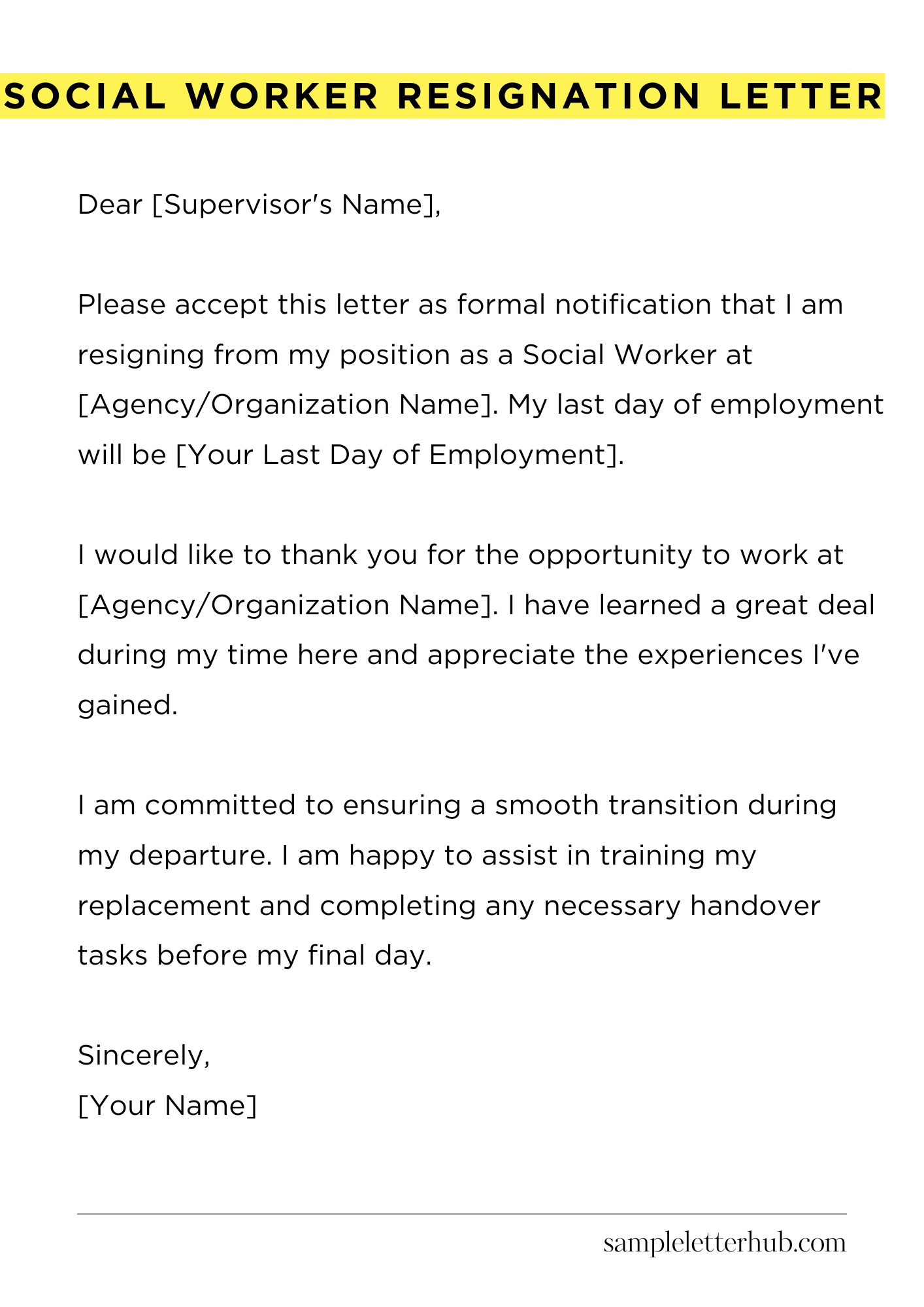
Dear [Supervisor’s Name],
Please accept this letter as formal notification that I am resigning from my position as a Social Worker at [Agency/Organization Name]. My last day of employment will be [Your Last Day of Employment].
I would like to thank you for the opportunity to work at [Agency/Organization Name]. I have learned a great deal during my time here and appreciate the experiences I’ve gained.
I am committed to ensuring a smooth transition during my departure. I am happy to assist in training my replacement and completing any necessary handover tasks before my final day.
I wish you and the agency all the best in the future.
Sincerely,
[Your Name]
How to Write a Social Worker Resignation Letter
Know the Basics Before You Start
Resigning from your social work position is a big step. First, ensure you’ve made your decision carefully. This is a crucial professional action. Before you even think about putting pen to paper (or fingers to keyboard), understand your employment contract. Check the terms regarding resignation notice periods.
This will dictate how far in advance you need to submit your letter. This is very important. Failing to provide adequate notice can have consequences.
Secondly, keep it professional and respectful. Regardless of your reasons for leaving, maintaining a positive tone is always best. Avoid the temptation to vent or air grievances in your resignation letter. That’s not the place for it. Finally, proofread everything. Accuracy is key. Small mistakes make a big difference.
Crafting the Core Content
Your social worker resignation letter needs to convey specific information. Start with a clear and concise statement of your intention to resign. Simply state that you are resigning from your position. Include your name, the date, and the effective date of your resignation. The effective date is when your employment officially ends. Be sure to be very clear.
Next, state the position you are resigning from. This avoids any confusion. Your reason for leaving is optional, but if you wish to share, keep it brief and positive. Avoid going into exhaustive details about anything. Finally, express gratitude for the opportunity. Thank your employer for the chance to work there. Remember, this is professional courtesy.
Writing the Body of Your Resignation
The body of the letter needs to be well-structured. Begin by addressing the letter to the appropriate person, usually your supervisor or the HR department. State your intent to resign immediately. Include your name and your current title. Now, mention the date of your last day of employment. This is really, really important.
If you wish, you can then give a short, positive reason for leaving.
Then, express your appreciation for the opportunity. You can mention any specific experiences or learning that you gained. For example, learning about a new program or skill. Try to keep it as simple as possible. Make sure to reiterate your last day to prevent further misunderstandings. Close with a brief offer to assist in the transition.
Formatting is Key to a Successful Resignation
Formatting matters. Always use a professional business letter format. Use a standard font like Times New Roman or Arial. Keep the font size between 10 and 12 points. Avoid overly flowery language. Maintain the letter in single-spaced with a double space between paragraphs. Be clean and professional.
Include your contact information (name, address, phone number, and email address). After the body, add a professional closing such as “Sincerely” or “Best Regards.” And finally, sign the letter. Print the letter and sign it with a pen. Or, if submitting electronically, you can type your name. Your typed name shows you agree with your resignation. Proofread your letter carefully.
Final Touches and Next Steps
Before submitting, proofread your letter at least twice. Check for any grammatical errors, spelling mistakes, and formatting inconsistencies. Make sure everything is perfect before you send it. Ensure you have the correct contact details of your supervisor. Then, make a copy of the letter for your records. It’s always a good idea to keep a copy of important documents.
Now, submit the letter according to your company’s policy. This will often mean giving it to your supervisor. Once submitted, be prepared to discuss your resignation. Your employer may want to talk to you about your decision. Prepare yourself for an exit interview. Maintaining a professional demeanor throughout the entire process is very critical. Good luck!
FAQs about Social Worker resignation letter
How do I write a social worker resignation letter?
A well-written resignation letter for a social worker typically includes the following: a clear statement of your resignation, the effective date of your departure, a brief expression of gratitude for the opportunity to work there, any handover plans or assistance you will provide, and your contact information. Be professional and keep the tone positive, even if your reasons for leaving are negative.
What should I include in the effective date of my resignation?
The effective date should be clearly stated. This is the last day you will be employed by the organization. Ensure the date aligns with any contractual obligations or notice periods outlined in your employment agreement. Consider your workload and any ongoing cases when determining your final date, aiming to provide sufficient time for a smooth transition.
How much notice should I give in my social work resignation?
The notice period typically depends on your employment contract, local laws, and company policy. Standard practice is often two weeks, but it could be longer for senior positions or those with specific contractual obligations. Always review your employment agreement to clarify the required notice period. Giving more notice can be beneficial for a smoother transition.
What are the common reasons for a social worker’s resignation?
Common reasons include burnout, high caseloads, lack of support from management, seeking better opportunities for career advancement, better compensation and benefits, a desire for a different work-life balance, or personal reasons such as relocation.
These reasons should be addressed in your letter if you are comfortable but are not required. It is important to remember what is important.
Should I explain the reasons for leaving in my resignation letter?
You are not obligated to provide detailed reasons for your departure. A brief and general statement expressing your decision is usually sufficient. If you choose to share your reasons, keep them concise and professional. If you have any concerns that could be addressed in the future, you may briefly mention them. It is important to be professional no matter what.
Related:
Resignation letter due to rude boss
Resignation letter moving to another state
Resignation letter due to illness of family member
Resignation letter due to study