

A “Slave Resignation Letter” is a fictional document. It’s used in creative writing or role-playing. It humorously portrays someone quitting their “job” in a dramatic way. The purpose is usually comedic or satirical.
This article explores the concept in more detail. We’ll provide different letter examples. These are designed to inspire your own writing. We want to make the process easy.
You will find a range of samples. Adapt them for your needs. Use these templates to craft your own unique letters. Have fun with it!
Slave Resignation Letter
Below is a sample of a Slave Resignation Letter:
[Your Name/Employee ID]
[Your Address]
[Your Phone Number]
[Your Email Address]
[Date]
[Employer’s Name]
[Employer’s Title]
[Company Name]
[Company Address]
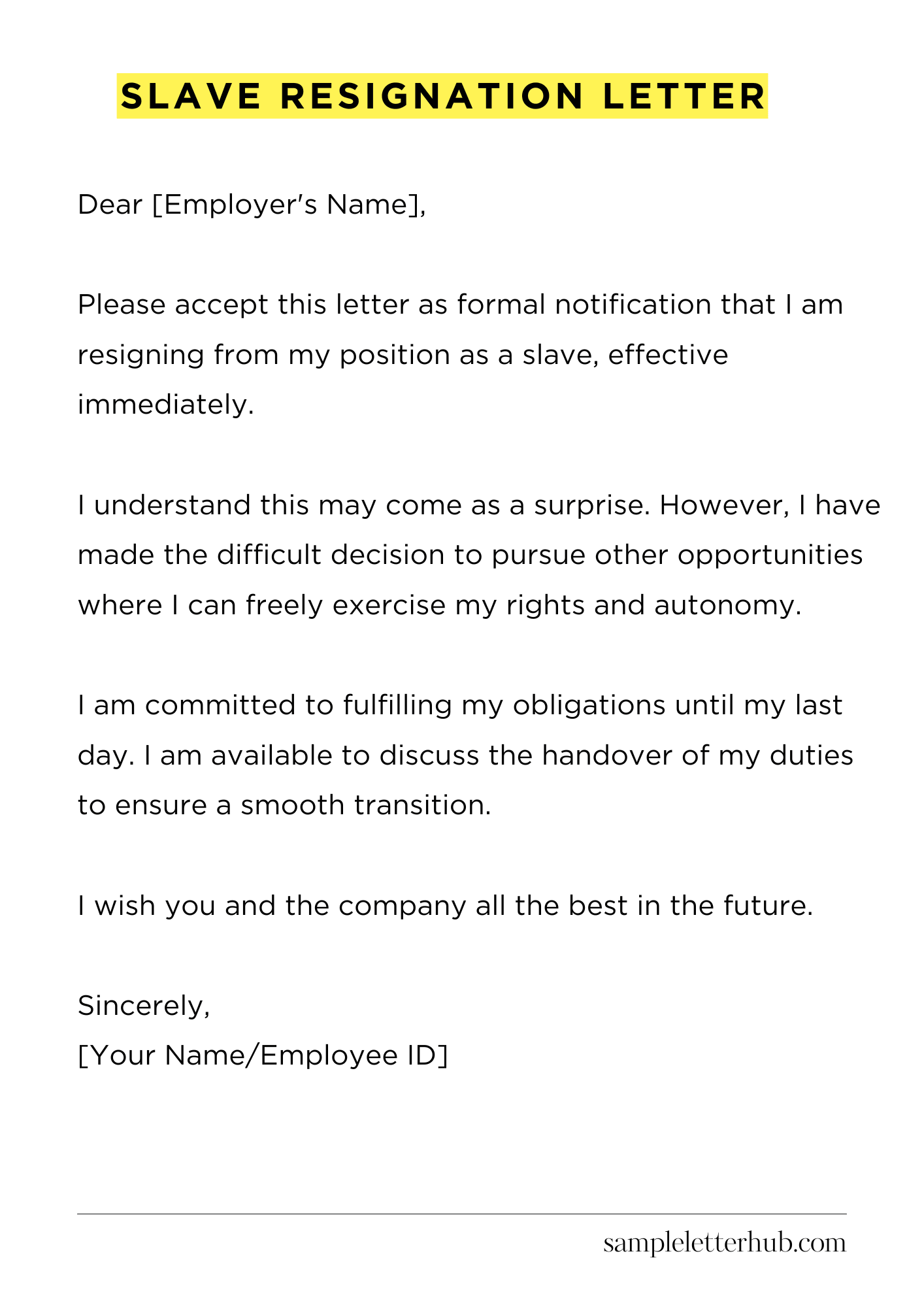
Dear [Employer’s Name],
Please accept this letter as formal notification that I am resigning from my position as a slave, effective immediately.
I understand this may come as a surprise. However, I have made the difficult decision to pursue other opportunities where I can freely exercise my rights and autonomy.
I am committed to fulfilling my obligations until my last day. I am available to discuss the handover of my duties to ensure a smooth transition.
I wish you and the company all the best in the future.
Sincerely,
[Your Name/Employee ID]
How to Write a Slave Resignation Letter
So, you’re ready to break free. You’ve made a huge decision: it’s time to resign from your position and take control of your future. This is a monumental step, but it doesn’t have to be daunting. Knowing how to write a clear, concise, and professional resignation letter is the first key.
1. Understand the Basics: Why a Letter Matters
You might be thinking, “Can’t I just tell my boss?” Yes, you can. But a written letter is crucial. It creates a formal record of your departure, protecting you and outlining your last day of work. A well-written letter also demonstrates professionalism, leaving a positive impression, even if your departure is less than amicable.
Think of it as the ultimate handshake; a formal acknowledgment of your decision.
2. The Essential Components: What to Include
Your resignation letter doesn’t need to be a novel. Keep it direct and to the point. Here’s a breakdown of the critical elements:
- Your Name and Contact Information: Start with your full name, address, phone number, and email address. This is standard practice.
- Date: Always include the date you’re writing the letter.
- Recipient’s Information: Write the recipient’s name, title, and the company’s name. Address it to your direct supervisor or HR.
- Formal Salutation: “Dear [Manager’s Name],” is a safe and respectful opening.
- Clear Statement of Resignation: State clearly that you are resigning from your position. Include the specific job title you are leaving.
- Effective Date of Resignation: Clearly state your last day of employment. Follow your company’s policy regarding notice periods. Generally, two weeks is considered standard.
- Brief Reason (Optional): You are not obligated to explain *why* you are leaving. However, a short, neutral statement (e.g., “to pursue other opportunities,” “to focus on personal commitments”) can be included if you wish. Avoid negativity.
- Offer of Assistance: Offer to help with the transition. A short sentence expressing your willingness to train a replacement or complete outstanding tasks can be very helpful.
- Expression of Gratitude (Optional): If you feel comfortable, a brief thank you can add a positive note.
- Closing: “Sincerely,” or “Respectfully,” followed by your typed name.
- Signature: Sign your letter by hand after printing.
3. Crafting the Perfect Wording: Examples and Tips
Let’s look at some example sentences to get you started:
Example Resignation Statement: “Please accept this letter as formal notification that I am resigning from my position as [Your Job Title] at [Company Name], effective [Your Last Day of Employment].”
Example Offer of Assistance: “I am committed to ensuring a smooth transition and am happy to assist in training my replacement.”
Example of Expression of Gratitude: “Thank you for the opportunities I have been given during my time here.”
Tips for a Polished Letter:
- Keep it concise: Avoid rambling.
- Be professional: Maintain a respectful tone.
- Proofread carefully: Errors create a negative impression.
- Choose a neutral tone: Avoid venting frustrations or making accusations.
- Keep it positive
4. Addressing Specific Situations: Difficult Departures
Sometimes, leaving a job is not easy. It is understandable if you dislike it. If your departure is due to negative circumstances, keep the tone professional and focus on the future.
Dealing with a Difficult Boss: Stick to the facts. Avoid personal attacks. Your goal is to resign, not to start a fight.
Leaving Quickly: If you need to leave sooner than the standard notice period, explain your situation briefly, and discuss this with your employer before submitting your letter, if possible.
5. Final Touches: Submission and Follow-Up
Submission: Print a hard copy and submit it to your supervisor or Human Resources, depending on company policy. Get a receipt if possible. Keep a copy for your records.
Follow-Up: After submitting your letter, be prepared for a meeting. Be professional and answer any questions. Cooperate with your employer during your remaining time. This will help maintain good relationships.
Congratulations! You’ve taken a significant step toward a new beginning. Writing a well-crafted resignation letter is a key ingredient. Good luck in your future endeavors!
FAQs about Slave Resignation Letter
What is a slave resignation letter, and why is it significant?
A slave resignation letter, while seemingly paradoxical, refers to a hypothetical document. It underscores a person’s desire to be released from servitude. Its significance lies in its reflection of historical struggles against oppression and the fight for basic human rights. It can be seen as a symbol of resistance and the assertion of self-determination in the face of forced labor.
What are the key elements to include in a slave resignation letter?
Although contextually sensitive, key elements would likely include a clear declaration of the desire to be free, a concise statement of the reasons for seeking liberation (e.g., unjust treatment, inhumane conditions), and potentially, a request for the immediate or phased termination of forced labor. It could also express a plea for respect and dignity.
What legal and ethical considerations are relevant to this topic?
The topic of a slave resignation letter is deeply entangled with legal and ethical considerations. Legally, slavery is universally condemned and illegal.
Ethically, the letter’s concept centers on issues of human rights, bodily autonomy, and the inherent worth of every individual. Discussing such a letter brings to the forefront the need to acknowledge historical injustices and condemn all forms of involuntary servitude.
How can one find examples or templates of such letters?
Given the highly sensitive nature of the topic, directly searching for templates of “slave resignation letters” may not yield practical examples. Historical documents such as petitions for freedom, or personal accounts from enslaved individuals, could offer insight into the struggles for liberation.
Educational resources on the abolitionist movement and human rights history can give important context.
What resources are available to learn more about the abolition of slavery and human rights?
Numerous resources are available for those seeking to learn more about the abolition of slavery and human rights. These include reputable historical archives, educational websites, museums dedicated to the history of slavery and emancipation, and organizations devoted to human rights advocacy.
Academic institutions often offer courses and research materials on related subjects, and films and documentaries provide different perspectives.
Related:
Resignation letter due to rude boss
Resignation letter moving to another state
Resignation letter due to illness of family member
Resignation letter due to study