

A shift supervisor resignation letter is a formal document. It informs your employer of your decision to leave. The letter officially ends your employment. It states your last day of work.
Writing a resignation letter can be tricky. You want to be professional. You also want to convey your message clearly. We understand. This article is here to help.
We’ve gathered various templates and examples. These will guide you through the process. Whether you need a simple letter or something more specific, we have you covered. Use these samples to create your perfect resignation.
Shift Supervisor Resignation Letter
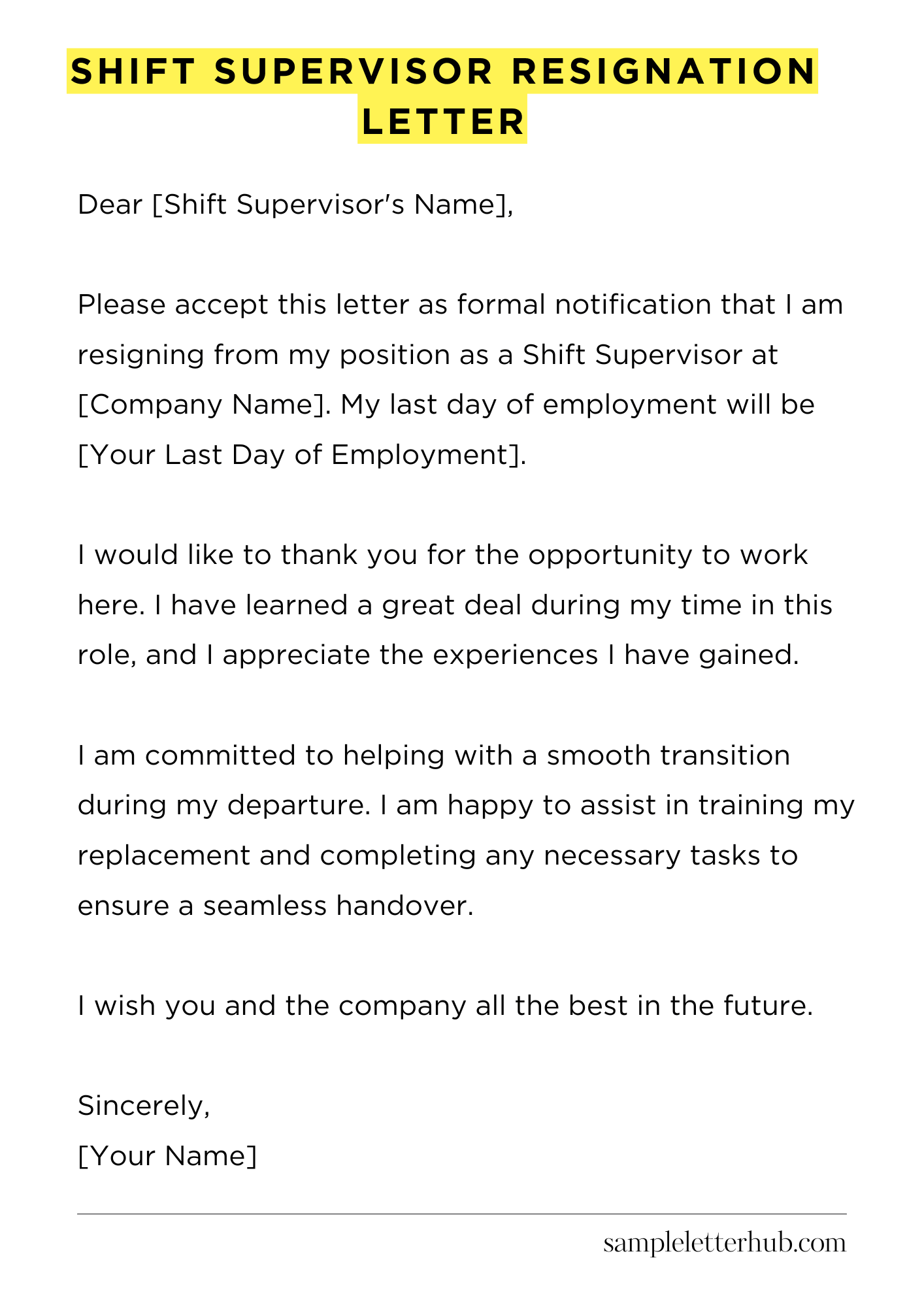
Below is a sample of a Shift Supervisor Resignation Letter:
[Your Name]
[Your Address]
[Your Phone Number]
[Your Email Address]
[Date]
[Shift Supervisor’s Name]
[Company Name]
[Company Address]
Dear [Shift Supervisor’s Name],
Please accept this letter as formal notification that I am resigning from my position as a Shift Supervisor at [Company Name]. My last day of employment will be [Your Last Day of Employment].
I would like to thank you for the opportunity to work here. I have learned a great deal during my time in this role, and I appreciate the experiences I have gained.
I am committed to helping with a smooth transition during my departure. I am happy to assist in training my replacement and completing any necessary tasks to ensure a seamless handover.
I wish you and the company all the best in the future.
Sincerely,
[Your Name]
How to Write Shift Supervisor Resignation Letter
So, you’re moving on! Congratulations on your next adventure. Writing a resignation letter as a Shift Supervisor doesn’t have to be a headache. It’s a professional courtesy, a bridge to maintain, and a way to end your tenure on a positive note. Let’s break down how to do it right.
1. Keep it Concise and Clear
First things first, keep it simple. A long, rambling resignation letter is unnecessary and can muddy the waters. The goal is to inform, not to over-explain your life story. Start by stating your intention to resign and your last day of employment. These are the most critical pieces of information.
For example, “I am writing to inform you of my resignation from the position of Shift Supervisor, effective [Your Last Day of Employment].” Boom! Done.
Avoid unnecessary details about why you’re leaving, unless specifically requested.
If they ask for an exit interview, it is up to you to oblige.
2. Show Gratitude (Yes, Even If It’s Hard)
Even if the job wasn’t a walk in the park, expressing gratitude is vital. It’s professional. A simple “Thank you for the opportunity” can go a long way.
Consider mentioning something specific you learned or experienced. This shows you valued the role, even if you are moving on. Maybe you learned a new management skill or gained invaluable experience in a particular area.
A brief acknowledgment like, “I appreciate the opportunity to have developed my leadership skills while at [Company Name],” adds a touch of class.
It’s about leaving a good impression.
3. Provide a Smooth Transition (Be Helpful)
Your goal is to make the handover as easy as possible. Offering to assist with the transition is a smart move. You can include a statement such as, “I am happy to assist in training my replacement and ensuring a smooth handover of my responsibilities.” This demonstrates professionalism and a commitment to your team.
Prepare a handover document outlining your key tasks, ongoing projects, and any important contacts.
This will be very helpful. Remember, leaving a positive impression is crucial; you never know when you might need a reference or cross paths again.
Your actions now impact your future options.
4. Maintain a Professional Tone
Keep the tone formal and professional. Avoid negativity, complaints, or personal attacks. This is not the time to air grievances. Steer clear of slang, jargon, or overly casual language. Proofread carefully before sending it. Errors create a bad impression. Use a professional email signature with your name, title, and contact information.
Consider using a template as a starting point, but always personalize it. This is your chance to shine and leave a legacy of professionalism.
Words matter; make sure you use them carefully.
5. Review and Submit
Once you’ve written your letter, review it carefully. Check for grammar and spelling errors. Make sure the date and your last day are correct. Ensure it aligns with your employment contract terms regarding notice periods.
Once you’re satisfied, submit your letter to the appropriate person, usually your direct supervisor or HR. Keep a copy for your records. Congratulations! You’ve successfully navigated the resignation process, demonstrating professionalism and respect. Now, go forth and conquer your next adventure!
Follow these steps, and you will be done with it.
FAQs about Shift Supervisor Resignation Letter
What is the primary purpose of a Shift Supervisor resignation letter?
The primary purpose of a Shift Supervisor resignation letter is to formally notify the employer of the employee’s intent to leave their position. It serves as an official record of the resignation, the effective date of departure, and, often, a brief statement of gratitude or reason for leaving.
This letter helps to ensure a smooth transition and complies with professional standards and company policy.
What key elements should be included in a Shift Supervisor resignation letter?
A well-crafted Shift Supervisor resignation letter should include: the date, the employee’s name, the supervisor or HR representative’s name and title, a clear statement of resignation, the specific last day of employment, a brief expression of gratitude (optional but recommended), and the employee’s signature. Consider including contact information for any follow-up.
How much notice should a Shift Supervisor provide when resigning?
The amount of notice a Shift Supervisor should provide varies based on company policy and employment contracts, but the standard is typically two weeks. However, the exact timeframe should be specified in the employee handbook or employment agreement. It is best to give as much notice as possible to allow for a smoother transition.
Should I provide a reason for resigning in my Shift Supervisor resignation letter?
It’s generally up to the employee whether to include a reason for resigning. While not always required, a brief, professional statement of the reason (e.g., pursuing a new opportunity, personal reasons) can be included. Avoid negativity or providing excessive detail. Keep the reason brief and focus on the future.
How can a Shift Supervisor ensure a professional resignation process?
To ensure a professional resignation process, a Shift Supervisor should: provide a formal written resignation letter, adhere to the agreed-upon notice period, remain professional and cooperative during the transition, complete all assigned tasks until the last day, and be prepared to participate in an exit interview if requested. This will leave a positive lasting impression.
Related:
Resignation letter due to rude boss
Resignation letter moving to another state
Resignation letter due to illness of family member
Resignation letter due to study