

A Senior Technical Consultant resignation letter is a formal document. It informs your employer that you’re leaving your job. The purpose is to officially announce your departure. It also helps to maintain a professional relationship.
Planning your exit can be tough. Drafting a proper resignation letter is a key step. Don’t worry. We’ve got you covered. We’ll share several templates and examples.
These samples will make things simpler. You can adapt them to your specific needs. Easily create a resignation letter that’s right for you.
Senior Technical Consultant Resignation Letter
Below is a sample of a Senior Technical Consultant Resignation Letter:
[Your Name]
[Your Address]
[Your Phone Number]
[Your Email Address]
[Date]
[Recipient Name]
[Recipient Title]
[Company Name]
[Company Address]
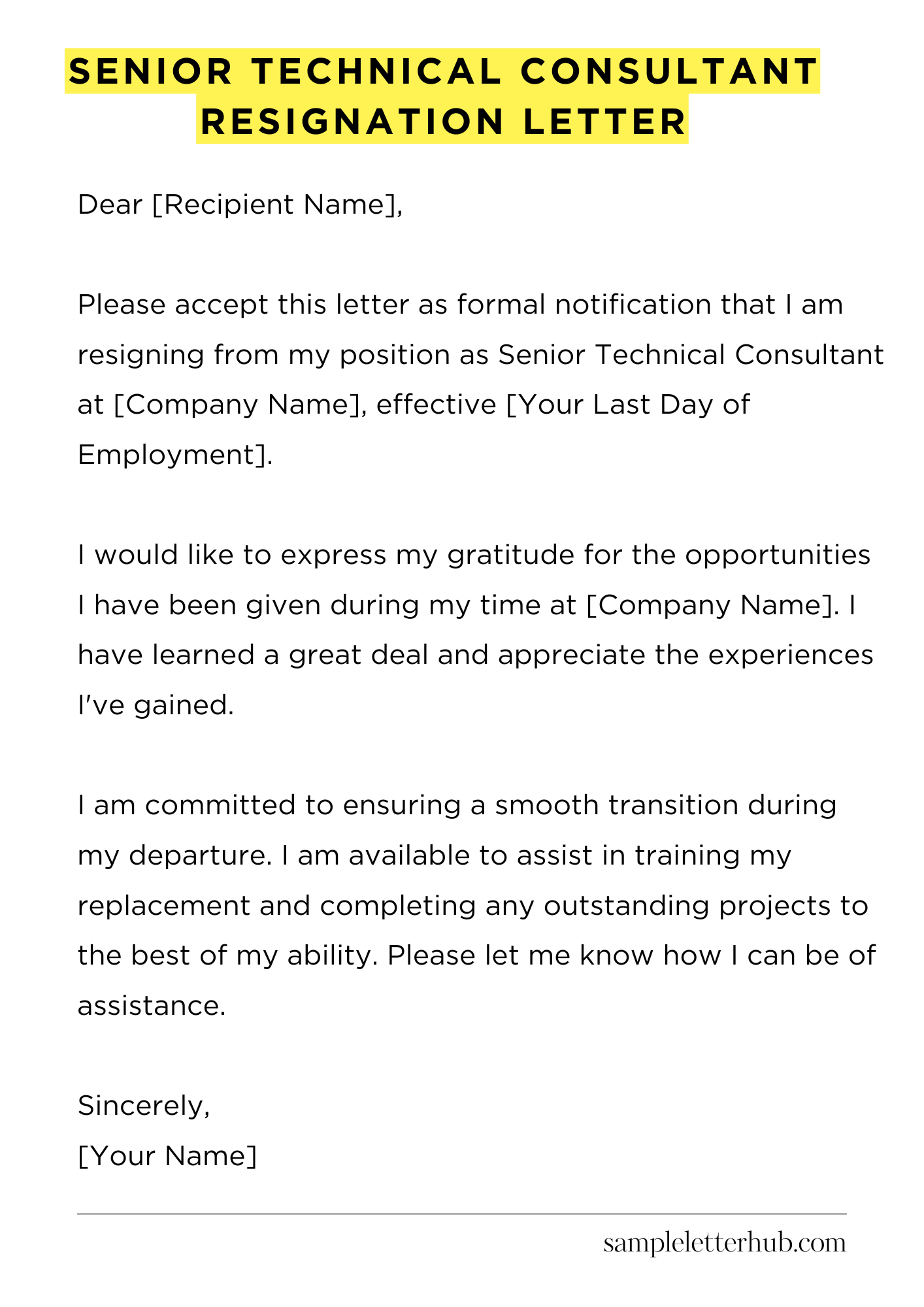
Dear [Recipient Name],
Please accept this letter as formal notification that I am resigning from my position as Senior Technical Consultant at [Company Name], effective [Your Last Day of Employment].
I would like to express my gratitude for the opportunities I have been given during my time at [Company Name]. I have learned a great deal and appreciate the experiences I’ve gained.
I am committed to ensuring a smooth transition during my departure. I am available to assist in training my replacement and completing any outstanding projects to the best of my ability. Please let me know how I can be of assistance.
I wish you and [Company Name] all the best in the future.
Sincerely,
[Your Name]
How to Write a Senior Technical Consultant Resignation Letter
1. Preparation is Key: Before You Start Writing
So, you’ve made a big decision! Resigning from your Senior Technical Consultant role is a significant move. Before you even think about penning that letter, there are a few crucial steps to take. First, make sure you’ve actually decided to leave. Really and truly. Next, review your employment contract.
Understand the specifics of your notice period. This is often a critical element. Knowing the required time frame will inform the content of your letter. Finally, think about your final day. Plan ahead so you know how you can handover your projects effectively. These upfront actions will set the stage for a smooth and professional departure.
2. Crafting the Core: The Body of Your Letter
Now, let’s get to the writing itself! Your Senior Technical Consultant resignation letter is not the place for lengthy explanations or airing grievances (unless absolutely unavoidable, and even then, tread carefully!). Keep it concise and professional. Start with a clear and direct statement of your intent to resign.
State your position, then state the date of your last day of employment. This is the heart of the matter. Next, briefly express your gratitude for the opportunity.
This is a sign of good professional etiquette and always leaves a good impression. Consider adding a short sentence about what you’ve learned. It is a nice touch, but it isn’t essential. Finally, remember to include your contact information. Keep your tone positive and professional throughout.
3. The Details Matter: Essential Elements to Include
Don’t overlook the details. Accuracy is critical. Double-check all dates, names, and titles to avoid any errors. Be sure to address your letter to the correct person. It is usually your direct supervisor or the Human Resources department. Use a professional business letter format.
This includes your contact information at the top, the date, the recipient’s information, a formal salutation (e.g., “Dear [Manager’s Name]”), and a closing (e.g., “Sincerely”). Consider offering your assistance with the handover of your duties. This shows you’re committed to making the transition seamless, and is a big plus.
4. Proofreading and Polishing: Getting it Right
You’ve written the letter, but you are not quite done yet! Proofreading is absolutely essential. Read your resignation letter multiple times. Check for any grammatical errors, spelling mistakes, or typos.
Ask a trusted colleague or friend to read it over for a second pair of eyes. They might catch something you missed. Ensure the language is clear, polite, and professional. It’s a reflection of your character.
Make any necessary revisions. A polished letter leaves a lasting positive impression. This is a very important part of the process and cannot be ignored.
5. Delivery and Beyond: What to do After You Send
You’ve written, and checked, the letter. Now it’s time to deliver it. Follow your company’s protocol for submitting your resignation. This might involve handing a physical copy to your manager or sending it via email.
Once you’ve submitted the letter, be prepared for a meeting with your manager. This is standard procedure and a good time to discuss your transition. Maintain a positive and professional attitude during this meeting, and throughout your remaining time with the company.
Focus on completing your handover tasks effectively. Your departure is now set, so stay focused and end on a high note. Your professional reputation is important, so remember this.
FAQs about Senior Technical Consultant resignation letter
How do I start a Senior Technical Consultant resignation letter?
Begin your resignation letter with a professional and direct salutation, such as “Dear [Manager’s Name]”. Immediately state your intention to resign from your position as Senior Technical Consultant. Be clear about your last day of employment. This sets the tone for a formal and unambiguous communication.
What key information should be included in a Senior Technical Consultant resignation letter?
The core elements should include your formal resignation, the effective date of your departure, a concise statement of your reason (optional, but a brief, professional explanation can be helpful), and a note of gratitude for the opportunity.
Mention your willingness to assist with the transition of your responsibilities. Finally, end with a professional closing like “Sincerely” or “Best regards,” followed by your full name.
Should I provide a reason for resigning in my letter?
Providing a reason is optional. If you choose to, keep it brief and professional. Examples include citing new opportunities, relocation, or personal reasons. Avoid negative comments about your current employer or colleagues. If you prefer not to disclose a reason, simply stating “I am pursuing other opportunities” or a similar neutral phrase is perfectly acceptable.
How should I handle the transition of my responsibilities in the resignation letter?
Offer your assistance in transitioning your duties. Mention your willingness to help train your replacement, document your work, or provide any necessary support to ensure a smooth handover.
This demonstrates professionalism and a commitment to ensuring a positive outcome for your team and the company. Be specific about your availability for the transition period.
What is the proper format for delivering a Senior Technical Consultant resignation letter?
While an email is generally acceptable, it’s often best practice to deliver the resignation letter both electronically and in hard copy. Address the letter to your manager and/or HR department.
Ensure the format is professional, using a standard font like Arial or Times New Roman, and maintain clear and concise language. Keep the tone formal and respectful throughout the letter.
Related:
Resignation letter due to rude boss
Resignation letter moving to another state
Resignation letter due to illness of family member
Resignation letter due to study