

So, you’re a Senior Systems Analyst ready to move on. A resignation letter is your formal notice. It’s a professional document. It communicates your departure to your employer. It officially ends your employment.
Crafting this letter can seem daunting. Where do you even begin? Don’t worry, we’ve got you covered. We’ll provide you with various letter samples. These are templates for your use. They are designed to streamline the writing process.
Think of these samples as your starting point. You can easily adapt them. Make them fit your specific situation. This article makes your resignation easier. You’ll be able to create a professional letter.
Senior Systems Analyst Resignation Letter
Below is a sample of a Senior Systems Analyst Resignation Letter:
[Your Name]
[Your Address]
[Your Phone Number]
[Your Email Address]
[Date]
[Employer’s Name]
[Employer’s Title]
[Company Name]
[Company Address]
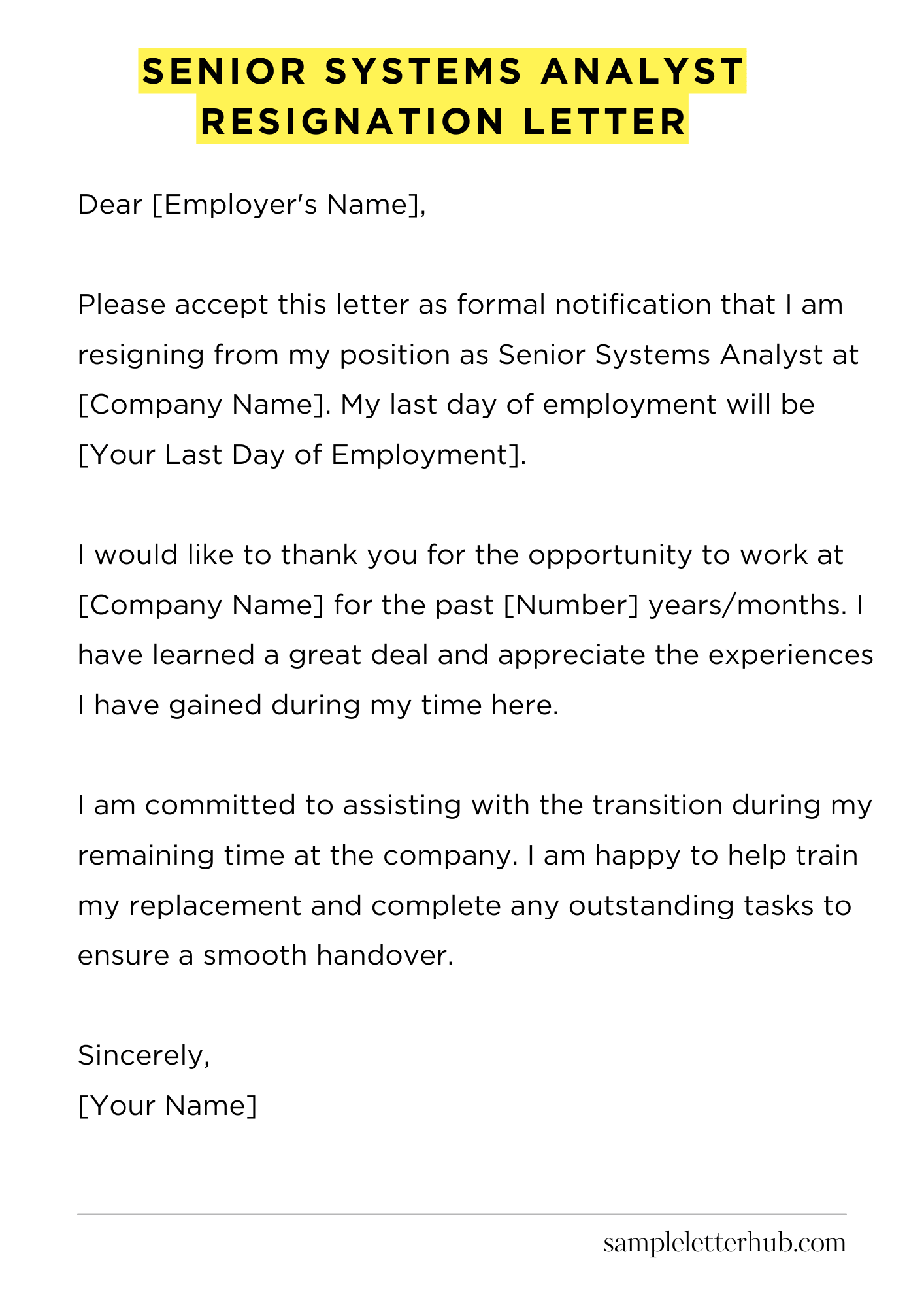
Dear [Employer’s Name],
Please accept this letter as formal notification that I am resigning from my position as Senior Systems Analyst at [Company Name]. My last day of employment will be [Your Last Day of Employment].
I would like to thank you for the opportunity to work at [Company Name] for the past [Number] years/months. I have learned a great deal and appreciate the experiences I have gained during my time here.
I am committed to assisting with the transition during my remaining time at the company. I am happy to help train my replacement and complete any outstanding tasks to ensure a smooth handover.
I wish you and [Company Name] all the best in the future.
Sincerely,
[Your Name]
How to Write Senior Systems Analyst Resignation Letter
Understanding the Importance of a Well-Crafted Resignation
Leaving a job, especially a Senior Systems Analyst position, requires a certain level of professionalism. You’ve invested time and effort, and you’ll want to depart on good terms.
A well-written resignation letter is critical. This is because it sets the tone for your departure and can impact your future career prospects. It’s not just a formality; it’s a statement. It reflects your character and your commitment to a smooth transition. Think of it as a bridge, ensuring you leave a positive impression.
Essential Elements: What to Include
Your letter must include core information. First and foremost, clearly state your intention to resign. Specify your last day of employment. This avoids any confusion. Next, express your gratitude for the opportunity. Briefly acknowledge the experiences you gained and any positive aspects of your time at the company. Keep it concise.
Then, if you feel it’s appropriate, you can offer to assist with the handover of your responsibilities. Finally, close with a professional sign-off. This could be something like “Sincerely,” or “Respectfully,” followed by your full name.
Structuring Your Letter for Clarity
Organization matters! Start with a formal greeting, addressed to your supervisor or HR representative. Use a professional font like Times New Roman or Arial. Keep the letter concise; aim for a single page. This demonstrates respect for the reader’s time.
Your resignation should be simple. Break the letter down into paragraphs to enhance readability. Avoid lengthy sentences. Proofread carefully before sending it. Errors can undermine your credibility. Remember to make a copy for your records.
Adding a Personal Touch (Optional)
While maintaining professionalism is paramount, you can consider adding a personal touch. This depends on your relationship with your employer. If you had a positive experience, you could briefly mention a specific project or a colleague you enjoyed working with.
However, avoid negativity. Do not air grievances or criticize the company. Keep the focus on your future. Remember, the goal is to leave a positive lasting impression.
If you’re unsure, it’s always best to err on the side of caution and keep your tone neutral. A simple thank you can be far more effective than trying to be too friendly and can backfire.
Example Resignation Letter and Final Thoughts
Here’s a basic template to get you started:
[Your Name]
[Your Address]
[Your Phone Number]
[Your Email Address]
[Date]
[Supervisor’s Name]
[Supervisor’s Title]
[Company Name]
[Company Address]
Dear [Supervisor’s Name],
Please accept this letter as formal notification that I am resigning from my position as Senior Systems Analyst at [Company Name]. My last day of employment will be [Your Last Day of Employment].
I am grateful for the opportunities I have been given during my time here, and I have learned a great deal. I wish the company continued success in the future.
I am willing to assist in the transition of my responsibilities during my remaining time here.
Sincerely,
[Your Full Name]
Remember that you should customize this template to fit your situation. Resignation is a serious matter. Ensure your letter accurately reflects your intentions and leaves a positive final impression.
FAQs about Senior Systems Analyst Resignation Letter
What is the typical format for a Senior Systems Analyst resignation letter?
A standard resignation letter typically includes a clear and concise statement of your intent to resign, the effective date of your resignation, a brief expression of gratitude for the opportunity, and your contact information. It’s often written in a formal business letter format, including a date, the recipient’s name and title, and a professional closing.
What key information should a Senior Systems Analyst include in their resignation letter?
The core elements of a Senior Systems Analyst resignation letter are the date, your full name, the recipient’s name and title, the specific date of your last day of employment (the effective date), a straightforward statement of resignation, a thank you, and your contact details. Consider including a brief statement about assisting with the transition, if possible.
How much notice should a Senior Systems Analyst give when resigning?
The standard notice period is typically two weeks, although this can vary depending on your employment contract, company policy, and the laws of your jurisdiction. It’s best to review your employment agreement to clarify the required notice. Consulting with your HR department is also a good practice for confirmation.
Should a Senior Systems Analyst explain the reason for their resignation in the letter?
While not mandatory, you are not usually required to give a detailed explanation for your departure. It’s often sufficient to state you are resigning for personal or professional reasons. If you do wish to provide a reason, keep it brief, professional, and positive, focusing on the future and new opportunities, and avoiding negativity about the current employer.
What should a Senior Systems Analyst do after submitting their resignation letter?
After submitting your letter, discuss your transition plan with your manager. This may involve training a replacement, documenting processes, or completing any outstanding projects. Be prepared to answer questions and assist the team during your notice period. Maintain professionalism and a positive attitude throughout this time, and ensure all company property is returned.
Related:
Resignation letter due to rude boss
Resignation letter moving to another state
Resignation letter due to illness of family member
Resignation letter due to study