

A Senior Systems Administrator resignation letter is a formal document. It is written by a Senior Systems Administrator. The purpose is to officially announce their departure from a company. It informs the employer of the last day of employment.
Are you a Senior Systems Administrator planning to move on? Writing a resignation letter can be tricky. We’ve got you covered. We’ll share several helpful templates. You can use them as a starting point.
These samples are designed for ease. Customize them to fit your specific situation. Craft a professional and polished resignation letter. Leaving a positive lasting impression is possible.
Senior Systems Administrator Resignation Letter
Below is a sample of a Senior Systems Administrator Resignation Letter:
[Your Name]
[Your Address]
[Your Phone Number]
[Your Email Address]
[Date]
[Employer’s Name]
[Company Name]
[Company Address]
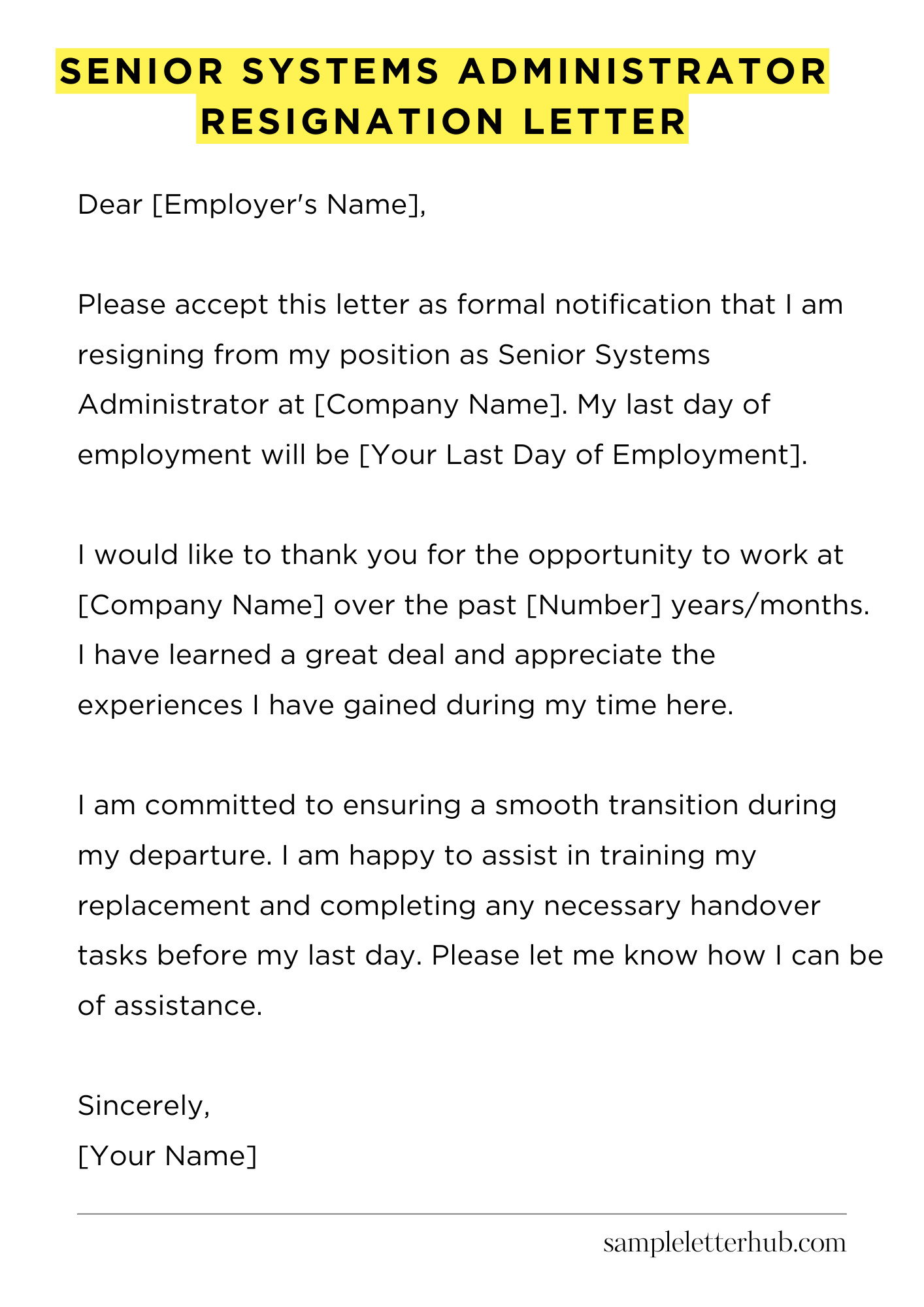
Dear [Employer’s Name],
Please accept this letter as formal notification that I am resigning from my position as Senior Systems Administrator at [Company Name]. My last day of employment will be [Your Last Day of Employment].
I would like to thank you for the opportunity to work at [Company Name] over the past [Number] years/months. I have learned a great deal and appreciate the experiences I have gained during my time here.
I am committed to ensuring a smooth transition during my departure. I am happy to assist in training my replacement and completing any necessary handover tasks before my last day. Please let me know how I can be of assistance.
I wish you and [Company Name] all the best in the future.
Sincerely,
[Your Name]
How to Write a Senior Systems Administrator Resignation Letter
So, you’ve made the big decision! You’re moving on from your Senior Systems Administrator role. That’s a huge step. Now, you need to write a resignation letter. This is important.
A well-crafted letter can help you leave on good terms, paving the way for future opportunities. Don’t underestimate this task. It’s more than just a formality; it is a professional courtesy. It sets the tone for your departure. Let’s break down how to do it right.
1. Start with the Basics: Your Opening Paragraph
Your opening paragraph is the first impression. Keep it clear, concise, and professional. Start by stating your intention to resign. Include the date your resignation will be effective.
Be direct. Avoid ambiguity. For example: “Please accept this letter as formal notification that I am resigning from my position as Senior Systems Administrator, effective two weeks from today, [Date].” This is straightforward and leaves no room for confusion. You are letting them know that it is happening now.
A simple, polite beginning sets the right tone. It indicates that you respect the process and the recipient.
2. Briefly Acknowledge Your Time and Express Gratitude
This is where you show some appreciation. Acknowledge your tenure with the company, if you wish. Briefly mention what you’ve enjoyed or learned. Offer a general statement of thanks for the opportunity.
This shows professionalism. It doesn’t need to be overly effusive. A simple “I have truly valued my time at [Company Name] and appreciate the opportunities I’ve been given” is sufficient. It is a sign of respect and shows you are not just walking away, but acknowledging your experiences there. A brief mention of your time there is good.
3. Outline Your Transition Assistance
This is crucial for maintaining a positive relationship. Offer your assistance in the transition process. State your willingness to help train your replacement, document procedures, or assist in any way possible to ensure a smooth handover. This is how to leave on a positive note.
For example: “I am committed to ensuring a smooth transition during my departure and am happy to assist in training my replacement and documenting my current responsibilities.” This kind of statement demonstrates responsibility. It also demonstrates your professionalism and your desire to help your former team. It is a great way to leave the job.
4. Keep it Short, Sweet, and to the Point
Avoid excessive detail or negativity. Don’t use the letter as a platform to complain about the job or the company. Keep the tone positive and forward-looking. Remember that this letter is part of your professional record. It can come back to you. The goal is to leave on a positive note.
Focus on the essentials. Avoid unnecessary length. Get your points across clearly and concisely. You want to be remembered for your contributions, not your complaints. Keep it professional. Maintain your dignity.
5. Finalize with a Professional Closing
End the letter with a professional closing. Thank your employer one last time. Include your contact information for any follow-up questions. Consider a simple “Sincerely,” or “Best regards,” followed by your full name. It’s also a good idea to include your contact information again (email and/or phone number) for any questions.
This makes it easy for them to contact you if needed. Proofread the letter carefully before sending. Make sure there are no typos or grammatical errors. Ensure that you have all of the dates correct. This is the last impression, make it a good one.
FAQs about Senior Systems Administrator Resignation Letter
What is the essential information to include in a Senior Systems Administrator resignation letter?
A Senior Systems Administrator resignation letter should include your formal resignation, the effective date of your departure, a concise statement of your reason for leaving (optional but often included), gratitude for the opportunity, and any relevant details regarding the handover of responsibilities.
Be sure to provide your contact information to assist with post-employment communication if needed.
How far in advance should a Senior Systems Administrator submit their resignation letter?
It is generally advisable for a Senior Systems Administrator to submit their resignation letter at least two weeks before their intended last day of employment.
However, specific notice periods may vary depending on company policy or your employment contract. Some organizations may require a longer notice, particularly for roles involving critical infrastructure or sensitive data. Always consult your employment agreement for the specific stipulations.
Should a Senior Systems Administrator include a reason for leaving in their resignation letter, and if so, what are the best practices?
Including a reason for leaving in your resignation letter is optional but can be beneficial. If you choose to provide a reason, keep it brief, professional, and positive.
Avoid negativity or personal grievances. Examples of acceptable reasons include “pursuing a new opportunity,” “seeking career advancement,” or “relocating.” Focus on your future goals rather than any dissatisfaction with your current position.
What is the best way for a Senior Systems Administrator to handle the handover of responsibilities when resigning?
A successful handover is crucial. Offer to assist in the transition by documenting your critical systems, processes, and knowledge. Be prepared to train your replacement or provide support to colleagues.
Create a detailed handover document outlining all relevant systems, accounts, access protocols, and any ongoing projects. Be cooperative and available during your notice period to ensure a smooth transition.
What tone and language should a Senior Systems Administrator use in their resignation letter?
The tone of your resignation letter should be professional, courteous, and appreciative. Use clear, concise language and maintain a respectful and positive attitude.
Express your gratitude for the opportunity and avoid any negative comments about your current employer or colleagues. Your resignation letter is a representation of your professional image, so maintain a tone that reflects positively on your work ethic and character.
Related:
Resignation letter due to rude boss
Resignation letter moving to another state
Resignation letter due to illness of family member
Resignation letter due to study