

So, you’re a senior employee, and you’re ready to move on. A senior resignation letter is your official way of informing your company about your departure. It’s a formal document. It states your intention to leave your job. It also includes your last day of employment.
Writing this letter can feel tricky. It is an important step. You want to make a good impression. You want to leave on a positive note. We’ve got you covered.
Here are examples of senior resignation letters. They will help you craft your own. Choose the right one for your situation. Adapt them to fit your needs. You can easily make your letter stand out.
Senior Resignation Letter
Below is a sample of a Senior Resignation Letter:
[Your Name]
[Your Address]
[Your Phone Number]
[Your Email Address]
[Date]
[Recipient’s Name]
[Recipient’s Title]
[Company Name]
[Company Address]
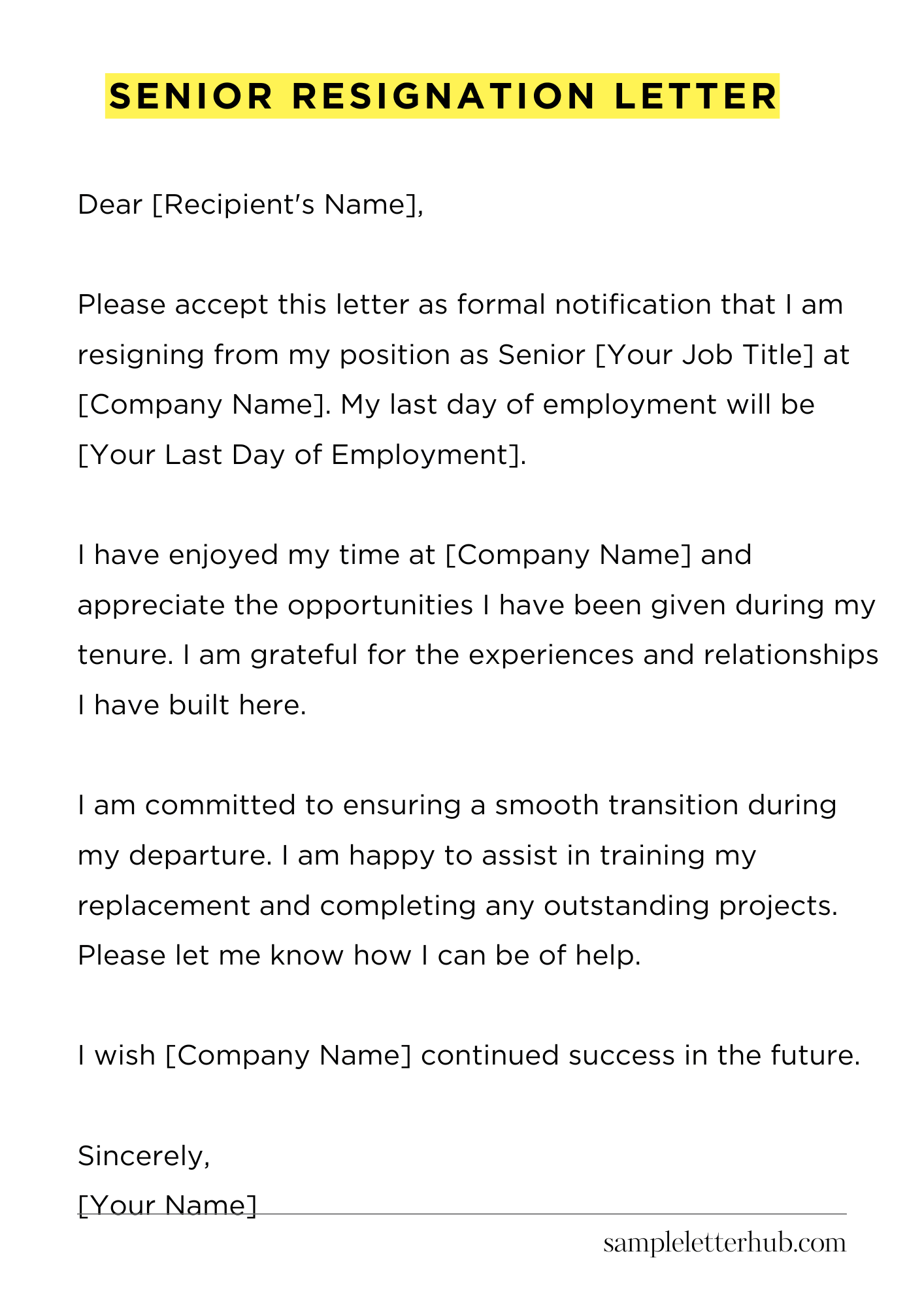
Dear [Recipient’s Name],
Please accept this letter as formal notification that I am resigning from my position as Senior [Your Job Title] at [Company Name]. My last day of employment will be [Your Last Day of Employment].
I have enjoyed my time at [Company Name] and appreciate the opportunities I have been given during my tenure. I am grateful for the experiences and relationships I have built here.
I am committed to ensuring a smooth transition during my departure. I am happy to assist in training my replacement and completing any outstanding projects. Please let me know how I can be of help.
I wish [Company Name] continued success in the future.
Sincerely,
[Your Name]
How to Write a Senior Resignation Letter
1. Preparation is Key: Understanding Your Goals
Before putting pen to paper (or fingers to keyboard), take a moment. Actually, you should take several moments. What do you *really* want to achieve with this letter? This isn’t just about quitting your job. It’s about preserving relationships, protecting your reputation, and ensuring a smooth transition.
Consider your legacy! Your goal is to leave on a positive note, even if the circumstances leading to your departure are less than ideal. Think about your future. You’ll likely need references, and burning bridges is never a good idea.
Think about the tone you want to convey. Are you feeling grateful? Disappointed? A bit of both? Knowing your desired outcome will help guide your writing.
2. Structure: Laying the Foundation for a Professional Letter
A senior resignation letter, like any formal communication, needs a solid structure. Think of it as building a house: you need a strong foundation before you build the walls.
Start with your contact information (name, address, email, phone number) at the top, followed by the date. Then, address the letter to your immediate supervisor or the appropriate person, such as the CEO or Head of HR.
Use a formal salutation like “Dear [Manager’s Name],” or “Dear Hiring Manager,”. Next, state your intention to resign. This is the main purpose of your letter.
Keep your language clear and concise. This isn’t the time for flowery prose.
3. Content: The Heart of Your Senior Departure
The core of your letter should include: your formal resignation, the date your resignation takes effect, a brief statement of gratitude, and an offer to help with the transition. A senior resignation letter should be specific.
First and foremost, state your intent to resign. For example, “Please accept this letter as formal notification that I am resigning from my position as [Your Job Title] at [Company Name].” Be direct.
Then, clearly state your last day of employment. This is crucial for planning purposes. Mention your availability to help with the transition. Offer to assist in training your replacement or transferring knowledge. Always show respect for the role and the company.
Keep the reasoning brief. You don’t need to go into a long explanation of why you’re leaving, unless, of course, the company already knows.
4. Tone and Language: Choosing Your Words Carefully
The language you use significantly impacts how your letter is received. The importance of tone is understated! It sets the stage for future interactions.
Maintain a professional and respectful tone. Avoid negativity, even if you had negative experiences. Keep your language positive and polite, even if you felt differently.
Expressing gratitude is also beneficial. Thank your employer for the opportunities you were given. Thank your boss. You can mention specific positive experiences you gained during your tenure. Keep the tone amicable. Your resignation letter is a formal document.
Proofread everything. Double-check your letter for any errors in grammar and punctuation. Get a second opinion from a friend, colleague or family member.
5. After the Letter: Wrapping Up and Moving Forward
Once you’ve sent your letter, the process isn’t over. Your actions after submitting the letter matter just as much as what you wrote.
Be prepared for a response. Your supervisor may want to discuss your resignation. You could have an exit interview. Be professional throughout the process. Complete all outstanding tasks and projects. Offer support in the transition. Your aim is to show that you are going to leave on a high note.
Lastly, keep a copy of your resignation letter for your records. It’s important to document your departure. That could be very helpful.
FAQs about Senior Resignation Letter
What is the primary purpose of a senior resignation letter?
The primary purpose of a senior resignation letter is to formally notify an employer of an employee’s intent to leave their position. It serves as an official record of the resignation, the last day of employment, and often, a brief statement of gratitude or farewell. It is a vital document for HR and legal purposes, establishing a clear separation date and initiating the exit process.
What key elements should be included in a senior resignation letter?
A senior resignation letter should include: a clear and concise statement of resignation; the employee’s name and job title; the effective date of resignation (last day of employment); a professional and courteous tone; and potentially, a brief expression of gratitude to the employer or a specific manager.
Optional elements may include an offer to assist with the transition, contact information, and a signature.
How much notice should a senior give when resigning?
The amount of notice a senior employee should give depends on several factors, including the company’s policy, the employment contract (if any), and local laws.
Generally, a notice period of two to four weeks is considered standard and respectful. However, senior-level positions or roles with significant responsibilities might warrant a longer notice period, potentially a month or more. It’s crucial to review the employment contract and company handbook for specific guidelines.
How should a senior employee handle the delivery of their resignation letter?
A senior employee should typically deliver their resignation letter in writing to their direct supervisor and/or to the HR department. It’s often recommended to deliver the letter in person if feasible, and then follow up with an email copy for documentation.
Ensure the letter is professionally formatted, free of errors, and reflects a positive or neutral tone. Avoid making negative comments about the company or colleagues in the letter.
Are there any legal implications associated with a senior resignation letter?
Yes, there can be legal implications. The resignation letter itself can become a part of the employee’s permanent record. It is important that the letter is accurate and does not include any false or defamatory statements.
Also, the employer might use the letter as evidence regarding contract agreements. In some cases, depending on local labor laws, a resignation might trigger entitlements to benefits or a final paycheck, all of which are based on the information provided in the letter.
Related:
Resignation letter due to rude boss
Resignation letter moving to another state
Resignation letter due to illness of family member
Resignation letter due to study