

A Senior Property Manager resignation letter is a formal document. It officially informs an employer of your intent to leave your job. The letter clearly states your last day of employment. This is a crucial step in the job separation process.
Are you a Senior Property Manager ready to move on? Writing a resignation letter can feel daunting. We’ve got you covered. This article offers several letter samples. You can use these as a guide.
We provide diverse examples. These include different scenarios and formats. Find the perfect fit for your needs. Simplify the process of crafting your resignation letter.
Senior Property Manager Resignation Letter
Below is a sample of a Senior Property Manager Resignation Letter:
[Your Name]
[Your Address]
[Your Phone Number]
[Your Email Address]
[Date]
[Senior Property Manager’s Name]
[Property Management Company Name]
[Company Address]
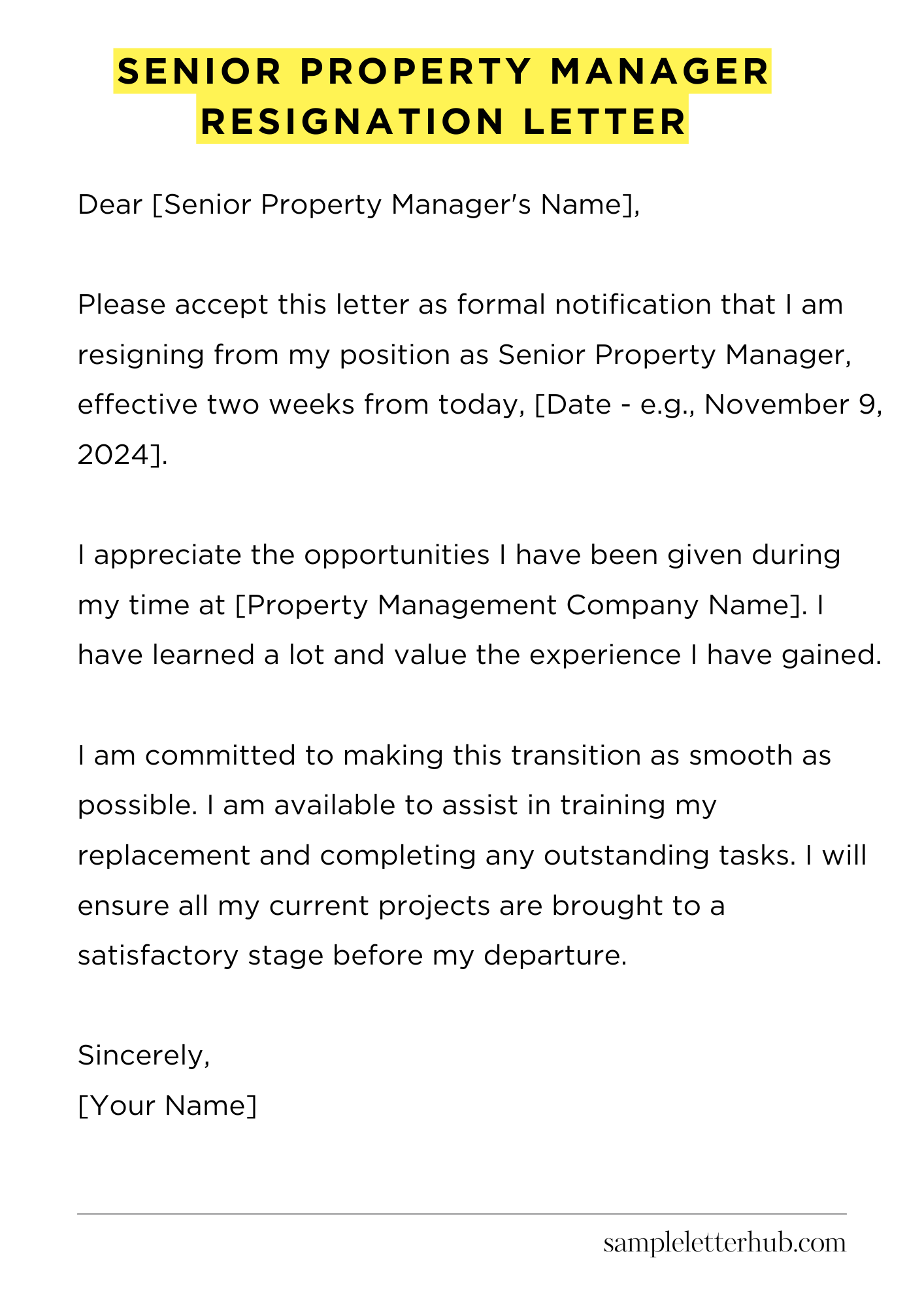
Dear [Senior Property Manager’s Name],
Please accept this letter as formal notification that I am resigning from my position as Senior Property Manager, effective two weeks from today, [Date – e.g., November 9, 2024].
I appreciate the opportunities I have been given during my time at [Property Management Company Name]. I have learned a lot and value the experience I have gained.
I am committed to making this transition as smooth as possible. I am available to assist in training my replacement and completing any outstanding tasks. I will ensure all my current projects are brought to a satisfactory stage before my departure.
I wish you and [Property Management Company Name] all the best in the future.
Sincerely,
[Your Name]
How to Write a Senior Property Manager Resignation Letter
1. Why Resign? – Get Your Reasons Straight
Leaving a job, especially a Senior Property Manager role, is a big decision. Before you even think about penning your resignation letter, it’s crucial to understand *why* you’re leaving.
Think about it carefully. Are you unhappy with the current company culture? Perhaps a better opportunity has come along. Maybe the workload is unsustainable.
Whatever the reason, taking the time to truly figure it out is the first and most critical step. This clarity will not only help you in the letter itself but also in any potential exit interviews or future discussions.
Consider all possible scenarios.
2. Structure: The Foundation of a Good Resignation
Your resignation letter needs a clear and professional structure. This is what you should cover: First, state your intention to resign. Keep it concise and direct.
Then, mention your last day of employment. Be sure to double-check your employment contract to give the correct notice period. Next, express your gratitude for the opportunity.
You don’t need to write a novel. A simple thank you is sufficient. Finally, you can offer to assist with the transition. A seamless handover is a mark of professionalism. It’s smart to include your contact information for the future.
Good structure is important!
3. Content: What to Include and How to Say It
The core of your letter is the content. Keep it professional. Avoid negative language. You do not need to list every single grievance you have. Start with a straightforward statement of resignation, followed by your last day. Remember to be polite. Express appreciation for the experience you gained.
Do not burn any bridges. Be willing to help with the transition. A good attitude will help you on your way. You may choose to provide a brief explanation for leaving, but it is not necessary. Focus on the positives and future plans instead.
Use precise and professional language.
4. Formatting and Tone: Professionalism Matters
Formatting is about making your letter easy to read. Use a standard business letter format. Include your contact information and the date. Address the letter to your direct supervisor or the appropriate person in HR.
Use a professional font like Times New Roman or Arial. Keep the tone formal and respectful throughout the letter. Proofread it carefully before sending. Check for grammar and spelling errors. Keep it brief. Aim for a polished, professional document that represents you well.
Double-check everything!
5. Examples and Templates: Get Inspired
Sometimes seeing a good example helps. Look for templates and examples of resignation letters online. This gives you a starting point. Feel free to adapt them to suit your situation.
Remember to customize it with your details. Examples can guide your structure. Tailor the content to reflect your specific role and experiences. The goal is a letter that’s both professional and personalized to your situation. This makes the whole process easier.
Use examples as a guide.
FAQs about Senior Property Manager resignation letter
A Senior Property Manager’s resignation is a significant event, prompting several common inquiries regarding the process and content of the letter. This section addresses frequently asked questions to provide clarity and guidance.
What is the typical format and structure of a Senior Property Manager resignation letter?
The typical format for a Senior Property Manager resignation letter is a formal business letter. It should include your contact information at the top, followed by the date, the recipient’s information (usually the direct supervisor or HR department), and a clear subject line indicating “Resignation.”
The body of the letter typically opens with a clear statement of resignation, followed by the effective date of your departure. Next, you can briefly express gratitude for the opportunity and any specific positive experiences. A brief and professional closing is standard, and it is usually followed by your signature and printed name.
What key information must be included in a Senior Property Manager resignation letter?
Essential information in the letter includes a clear statement of your intent to resign, the effective date of your resignation, and a brief expression of gratitude for the opportunity or experience.
It’s also helpful to include information regarding the transition of your responsibilities, such as your willingness to assist in the handover process. This information will help ensure a smooth transition and maintain a professional image.
How much notice should a Senior Property Manager provide in their resignation letter?
The standard notice period for a Senior Property Manager is typically two to four weeks. However, the exact length may depend on the employment contract, company policy, or the complexity of your role and responsibilities.
It is essential to review your employment contract and company guidelines for the correct notice period. Providing adequate notice is a professional courtesy that allows the company sufficient time to find a replacement and ensure a smooth transition.
Should a Senior Property Manager explain the reasons for leaving in their resignation letter?
It is generally not required to go into detail about the reasons for leaving in the resignation letter. A brief and neutral statement is usually sufficient. You could simply state that you are pursuing other opportunities.
However, if you have specific positive experiences you want to mention or if you feel compelled to share any constructive feedback, you can do so in a separate conversation with your supervisor.
What are some common mistakes to avoid when writing a Senior Property Manager resignation letter?
Common mistakes to avoid include negativity, unprofessional language, and including complaints about the company or colleagues. Avoid burning bridges by remaining professional and focusing on the positive aspects of your employment.
It is also important to ensure accuracy with dates and other details. Lastly, proofread the letter carefully to avoid any typos or grammatical errors before submission.
Related:
Resignation letter due to rude boss
Resignation letter moving to another state
Resignation letter due to illness of family member
Resignation letter due to study