

So, you’re a Senior Process Executive ready to move on. A resignation letter is the official document. It formally communicates your intent to leave your current role. This letter is crucial for a smooth transition. It sets the tone for your departure. It ensures all the necessary procedures are followed.
Crafting the perfect resignation letter can feel daunting. That’s where we come in. We understand the importance of this document. We’ve compiled various templates and examples. They are specifically tailored for Senior Process Executives.
Prepare to explore our collection. You’ll find different formats and styles. We aim to simplify your task. Get ready to adapt these samples to your unique situation. We hope they make your writing process easier.
Senior Process Executive Resignation Letter
Below is a sample of a Senior Process Executive Resignation Letter:
[Your Name]
[Your Address]
[Your Phone Number]
[Your Email Address]
[Date]
[Recipient’s Name]
[Recipient’s Title]
[Company Name]
[Company Address]
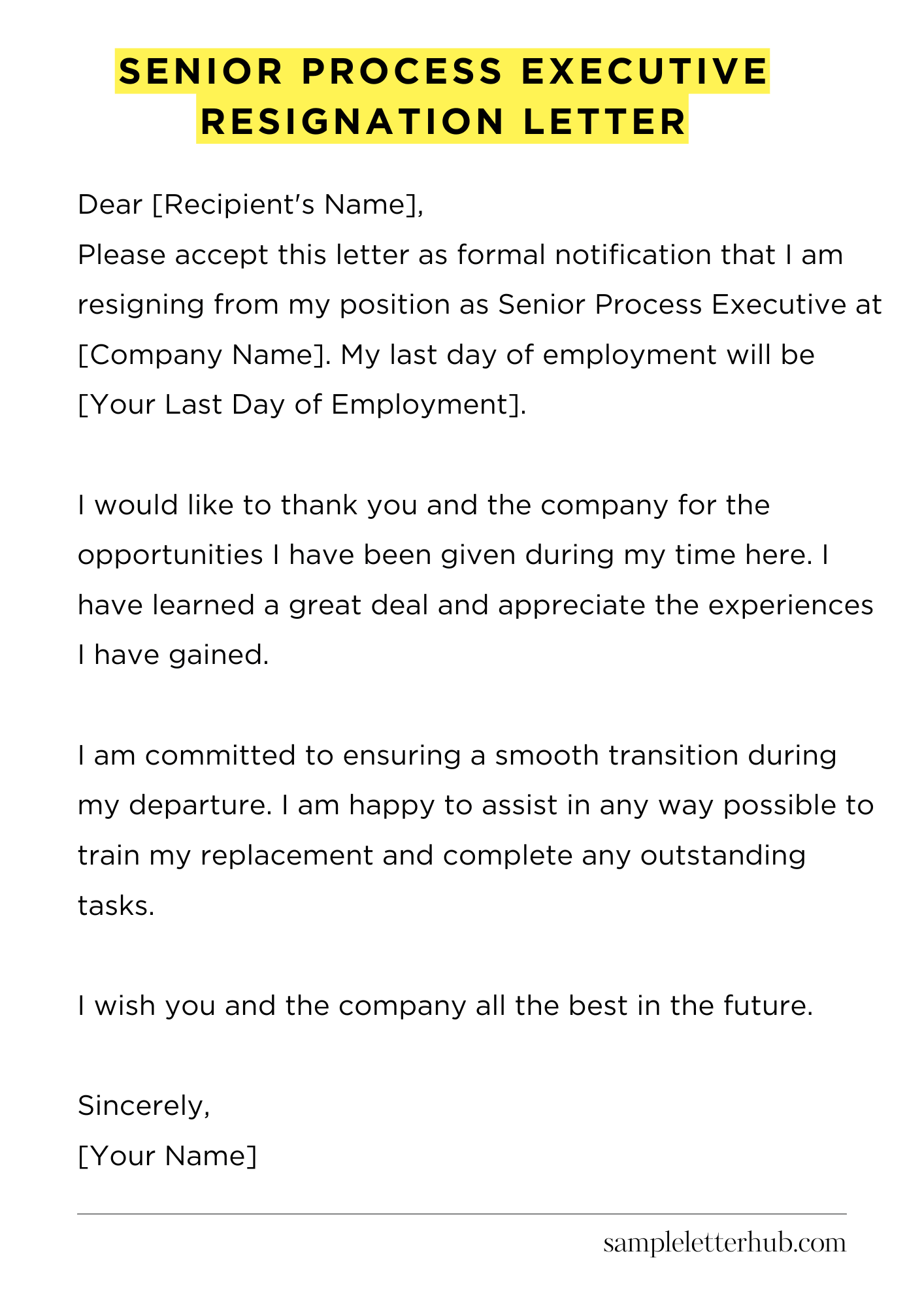
Dear [Recipient’s Name],
Please accept this letter as formal notification that I am resigning from my position as Senior Process Executive at [Company Name]. My last day of employment will be [Your Last Day of Employment].
I would like to thank you and the company for the opportunities I have been given during my time here. I have learned a great deal and appreciate the experiences I have gained.
I am committed to ensuring a smooth transition during my departure. I am happy to assist in any way possible to train my replacement and complete any outstanding tasks.
I wish you and the company all the best in the future.
Sincerely,
[Your Name]
How to Write a Senior Process Executive Resignation Letter
Resigning from any job can be a daunting task, particularly when you hold a senior position like Senior Process Executive. It involves more than just a simple “I quit.”
You’re dealing with a crucial role, responsibilities, and the need to leave a professional and lasting impression. This letter is a formal document. Therefore, it requires careful consideration. Let’s delve into how to craft a resignation letter that is both respectful and effective.
1. The Essential Elements: What to Include
A well-structured resignation letter is key. Several elements are non-negotiable. First and foremost, you MUST clearly state your intention to resign. Specify your last day of employment. This is critical for HR and your management team to plan accordingly. Next, express your gratitude for the opportunity.
Even if you’re leaving for reasons you don’t necessarily love, acknowledging the experience shows professionalism. Briefly mention any significant contributions you made during your tenure, particularly those related to your process executive role. This could be streamlining workflows or improving operational efficiency.
Finally, and this is very important, offer to assist with the transition. It can significantly impact how your departure is perceived.
2. Formatting and Tone: Maintaining Professionalism
The tone of your letter should remain professional, regardless of your personal feelings. Avoid negativity or personal attacks. Keep it concise. Clarity is your friend. Begin with a formal salutation.
Address your letter to your immediate supervisor and/or HR. Use a professional font like Times New Roman or Arial. Maintain a standard font size, usually 12 points.
Avoid slang or overly casual language. A simple, direct approach is often best. Proofread your letter meticulously before sending it. Errors can undermine your credibility. Focus on positive language. Think about what you would like to be remembered for.
3. Providing a Reason (Optional, But Sometimes Necessary)
You are not always required to provide a reason for your resignation. However, depending on your relationship with your employer or the company culture, it may be expected or beneficial. If you choose to include a reason, keep it brief and professional. It could be for a career advancement, a relocation, or a personal opportunity.
If you are leaving due to dissatisfaction, consider softening the language. For example, instead of saying “I am unhappy,” you might say “I am pursuing other opportunities that better align with my career goals.” Be honest, but tactful. The goal is to exit gracefully. Be prepared for a conversation about your reasons.
4. The Transition: Offering Support and Setting Boundaries
Your offer to help with the transition is crucial. Suggesting specific ways you can assist shows your commitment. This could be training a replacement, documenting procedures, or preparing handover notes. Be realistic about your availability. It’s also important to establish clear boundaries.
State the time frame you’re available to assist. Set reasonable expectations to protect your time and future commitments. Make sure your contributions are clearly defined.
Offer contact details, but indicate preferred communication methods and times. This can prevent misunderstandings. However, it’s also important to follow all workplace policies.
5. Review and Submission: The Final Steps
Before submitting your letter, review it carefully. Ask a trusted colleague or friend to proofread it. A fresh pair of eyes can catch any errors you may have missed.
Confirm your last day of employment with HR and your supervisor to avoid any confusion. Once you’re certain the letter is perfect, submit it according to company protocol.
This may be via email, in hard copy, or through a dedicated HR portal. Ensure you keep a copy of your resignation letter for your records. This is vital. Finally, prepare for a possible exit interview. Be prepared to answer questions and maintain your professionalism. Your last impression matters. Good luck!
FAQs about Senior Process Executive resignation letter
How much notice should a Senior Process Executive provide in their resignation letter?
The standard notice period for a Senior Process Executive resignation typically aligns with their employment contract or company policy. This often ranges from four to eight weeks, but it’s crucial to review the individual’s employment agreement. Providing ample notice allows for a smooth transition of responsibilities and demonstrates professionalism.
Some companies will have differing notice periods depending on the seniority of the role and the importance of the employee’s skill set.
What key elements should a Senior Process Executive include in their resignation letter?
A well-crafted resignation letter from a Senior Process Executive should include: a clear and concise statement of resignation, the effective date of departure, a brief expression of gratitude for the opportunity, and a professional offer to assist with the transition. It’s often beneficial to avoid overly critical or negative comments.
It is also good to check if there are any specific internal forms that are required to also be filled out at the time of your resignation.
Should a Senior Process Executive state the reason for their resignation in the letter?
While not mandatory, a Senior Process Executive can briefly and professionally state the reason for their resignation, but it is not necessary.
Reasons can vary, from pursuing a new career opportunity to personal reasons. Keep the explanation concise and positive, focusing on moving forward rather than dwelling on the past. Consider it an opportunity to briefly summarize your personal experience at the firm.
How should a Senior Process Executive handle the handover of responsibilities?
A Senior Process Executive should offer to assist with the handover of their responsibilities to ensure a seamless transition. This includes preparing documentation, training colleagues, and being available to answer questions.
They should document all key processes and provide a comprehensive overview of ongoing projects. This proactive approach reflects professionalism and dedication.
Is it necessary for a Senior Process Executive to have a final meeting with their manager after submitting their resignation?
Yes, a final meeting with the manager is highly recommended. This meeting offers a chance to discuss the resignation, answer any questions, and clarify the handover plan. It’s an opportunity to maintain a positive relationship and leave on good terms. Be prepared to discuss exit processes, benefits, and any outstanding matters.
Related:
Resignation letter due to rude boss
Resignation letter moving to another state
Resignation letter due to illness of family member
Resignation letter due to study