

A “Senior Policy Advisor resignation letter” is a formal document. It is written by a Senior Policy Advisor. Its purpose is to officially announce their departure. The letter communicates the advisor’s intention to leave their position.
This article will help you. We understand writing these letters can be tough. We’ve got you covered with examples. We will share templates for you to adapt. These samples will guide you. They will help streamline the process.
Crafting the perfect resignation is now easier. Whether you need a short notice. Or a specific reason. We offer various options. Find the perfect fit for your situation. Explore our resources.
Senior Policy Advisor Resignation Letter
Below is a sample of a Senior Policy Advisor Resignation Letter:
[Your Name]
[Your Address]
[Your Phone Number]
[Your Email Address]
[Date]
[Recipient’s Name]
[Recipient’s Title]
[Company Name]
[Company Address]
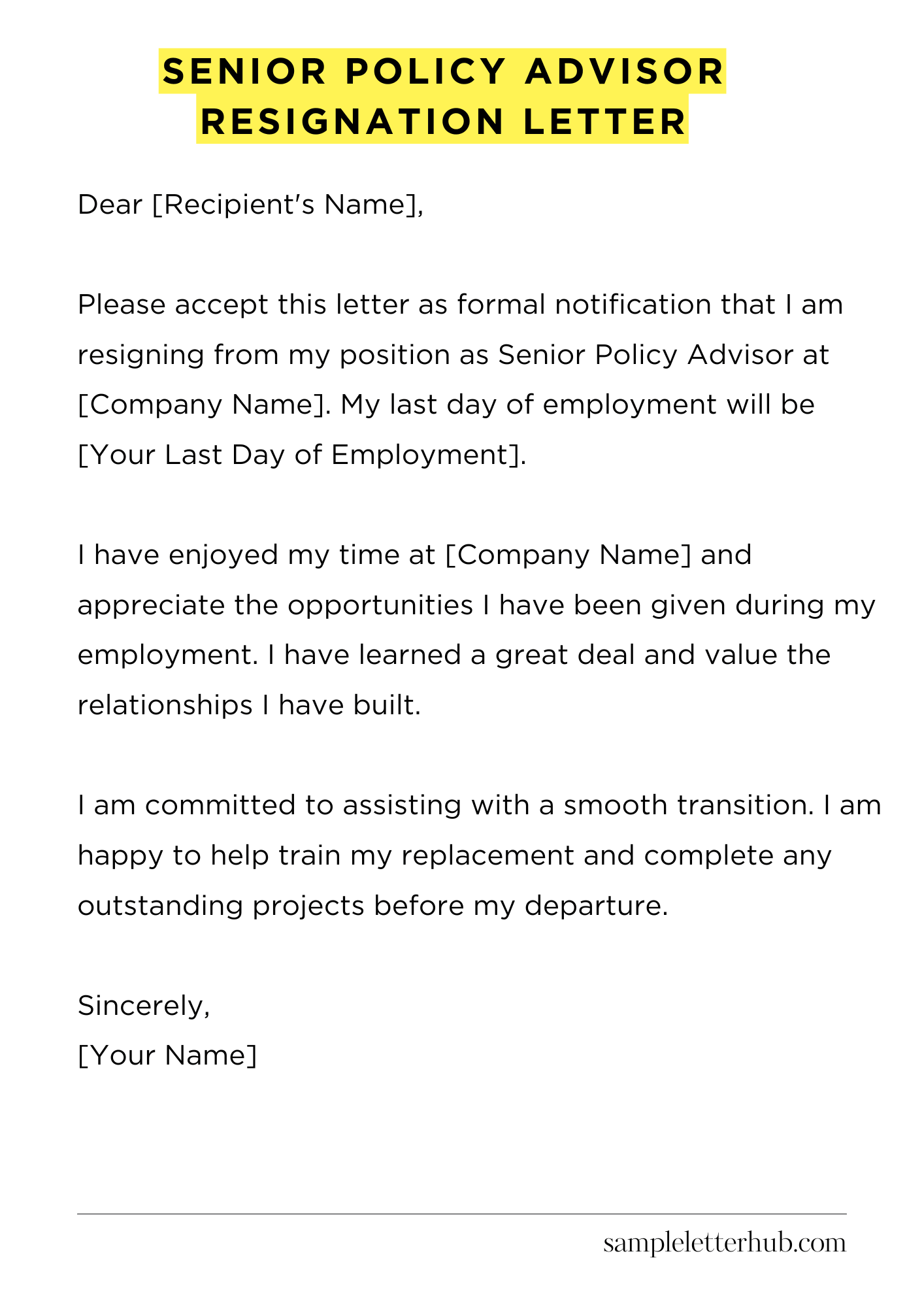
Dear [Recipient’s Name],
Please accept this letter as formal notification that I am resigning from my position as Senior Policy Advisor at [Company Name]. My last day of employment will be [Your Last Day of Employment].
I have enjoyed my time at [Company Name] and appreciate the opportunities I have been given during my employment. I have learned a great deal and value the relationships I have built.
I am committed to assisting with a smooth transition. I am happy to help train my replacement and complete any outstanding projects before my departure.
I wish you and [Company Name] all the best in the future.
Sincerely,
[Your Name]
How to Write a Senior Policy Advisor Resignation Letter
1. Grasping the Basics: Why Your Resignation Matters
Leaving a job, especially a senior role like a Policy Advisor, requires a well-crafted resignation letter. It’s more than just a formality; it’s a professional statement. It officially communicates your departure, sets a positive tone, and can even help maintain good relationships with your former employer.
Don’t underestimate its importance. Think of it as the final, important piece of professional communication you’ll have with your current company. It should be respectful and concise.
2. Essential Elements: What Your Letter MUST Include
Several key components are non-negotiable. First, explicitly state your intent to resign. Be clear about it. Secondly, specify your last day of employment. This is crucial for HR and payroll. Next, briefly express your gratitude for the opportunity. Even if the job wasn’t perfect, find something positive to say.
Mentioning specific skills you’ve developed or projects you’ve enjoyed is a good approach. Then, consider offering assistance with the transition. This shows professionalism and can make the handover smoother. Finally, proofread, proofread, proofread! Mistakes damage your credibility.
3. Framing Your Departure: Tone and Approach
The tone of your letter is critical. Aim for professionalism and politeness. Even if you’re unhappy, avoid negativity or complaints. Focus on future opportunities or personal growth. Consider keeping the reason for your departure brief. A simple statement like “pursuing other opportunities” is often sufficient.
Remember your goal is to leave on a positive note. Maintaining a good reputation will benefit you in the long run. Be mindful of the language you use; avoid jargon or overly casual phrasing.
4. Structuring Your Letter: A Template for Success
Here’s a basic structure to guide you: Start with your contact information and the date. Next, address the letter to your supervisor or HR. Begin with a clear statement of resignation, followed by your last day. Next, express your gratitude and briefly mention your experience or any achievements during your tenure.
Offer assistance with the transition. Close with a polite closing, such as “Sincerely” or “Best Regards,” followed by your name and signature (if sending a physical copy). Keep your paragraphs short and focused. This makes the letter easy to read.
5. Beyond the Letter: Follow-Up and Next Steps
Once you submit your letter, be prepared for a response. Your supervisor might want to schedule an exit interview. This is a chance to provide feedback and discuss your departure in more detail. Cooperate fully and professionally during this process. In addition, keep a copy of your resignation letter for your records.
Update your resume and LinkedIn profile to reflect your new job or career goals. Your resignation letter is a crucial part of the process, but the follow-up demonstrates your professionalism and is just as vital. Remember to be available for your company to transition your work.
FAQs about Senior Policy Advisor resignation letter
How do I start a Senior Policy Advisor resignation letter?
Begin your resignation letter with a formal salutation, such as “Dear [Manager’s Name]”. Clearly state your intention to resign from your position as Senior Policy Advisor. Include the effective date of your resignation, which allows your employer to plan for your departure and ensure a smooth transition.
What key information should be included in the body of the resignation letter?
The body of the letter should briefly state your reason for leaving. You can choose to be general (e.g., “pursuing other opportunities”) or, if you’re comfortable, provide more specific details. It’s also professional to express gratitude for the opportunity to work in the role, acknowledging any positive aspects of your experience.
Should I include the reason for my resignation in the letter?
It is generally not required to provide a detailed explanation for your departure. If you feel comfortable, you can provide a brief, professional reason. For example, you may write, “I am pursuing a new role.” However, it is perfectly acceptable to keep it brief if you are not comfortable sharing the specific reason.
How should I end the Senior Policy Advisor resignation letter?
Conclude the letter by offering your assistance during the transition period. This demonstrates your professionalism and commitment to a smooth handover. You can offer to help train a replacement or complete any ongoing projects. End with a formal closing, such as “Sincerely” or “Best regards,” followed by your full name.
What formatting guidelines should I follow for a Senior Policy Advisor resignation letter?
Maintain a professional and formal tone throughout the letter. Use a standard business letter format with a clear, concise layout. Keep the letter to one page in length. Proofread your letter carefully for any spelling or grammatical errors before submitting it. Ensure your contact information (phone number, email address) is up-to-date.
Related:
Resignation letter due to rude boss
Resignation letter moving to another state
Resignation letter due to illness of family member
Resignation letter due to study