

A “Senior Officer resignation letter” is a formal document. It is written by a high-ranking employee. The purpose is to officially announce their departure from a company. It provides details like the last day of employment. It’s crucial for a smooth transition.
Writing this type of letter can feel daunting. We’ve got you covered. We’ll share helpful templates. You’ll find different examples. These samples will guide you.
Our goal is to make it simple. We’re offering a variety. Use them as a starting point. Tailor them to fit your specific situation. This will ease the writing process.
Senior Officer Resignation Letter
Below is a sample of a Senior Officer Resignation Letter:
[Your Name]
[Your Address]
[Your Phone Number]
[Your Email Address]
[Date]
[Recipient Name]
[Recipient Title]
[Company Name]
[Company Address]
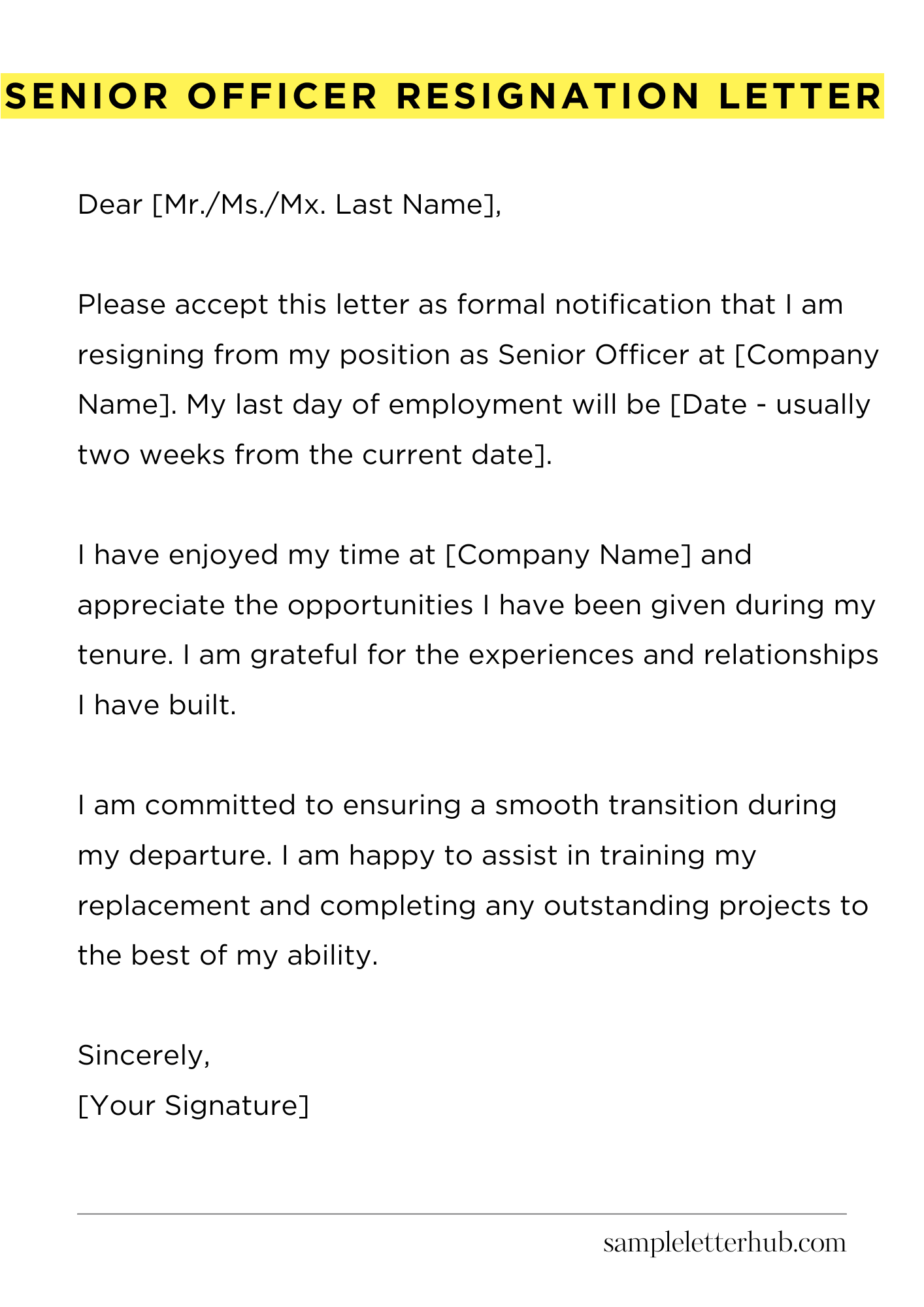
Dear [Mr./Ms./Mx. Last Name],
Please accept this letter as formal notification that I am resigning from my position as Senior Officer at [Company Name]. My last day of employment will be [Date – usually two weeks from the current date].
I have enjoyed my time at [Company Name] and appreciate the opportunities I have been given during my tenure. I am grateful for the experiences and relationships I have built.
I am committed to ensuring a smooth transition during my departure. I am happy to assist in training my replacement and completing any outstanding projects to the best of my ability.
I wish [Company Name] continued success in the future.
Sincerely,
[Your Signature]
How to Write a Senior Officer Resignation Letter
Resigning from a senior officer position is a significant decision. It’s not something you do lightly, and the letter you craft plays a crucial role. This document signals your departure and it has to be professional. A well-written resignation letter can leave a positive lasting impression. Follow these guidelines to ensure yours is effective.
1. Keep it Concise and Clear
Avoid any unnecessary fluff. The primary purpose of the letter is to inform your employer of your decision. State your resignation clearly and directly. The tone should remain polite and respectful.
Keep it brief. You need to keep it precise. Start with a simple sentence like, “Please accept this letter as formal notification that I am resigning from my position as [Your Position] at [Company Name].” That’s a strong start.
Then, simply state your last day of employment. No need to over-explain your reasoning at this stage. You can offer a more detailed explanation in person if you wish. Save all of that for later, if it even needs to be addressed.
2. Express Gratitude (Always a Good Idea)
Even if you’re leaving due to negative circumstances, it’s wise to express gratitude. A thank you can often go a long way. Acknowledge the opportunities you’ve been given during your tenure. Mention the skills you’ve developed or the relationships you’ve valued.
This shows you’re taking the high road and maintaining professionalism. You might say something like, “I am grateful for the opportunities I have been given at [Company Name] and the experience I have gained during my time here.” This demonstrates professionalism even when it is difficult.
Remember this crucial aspect of writing a resignation letter.
3. Provide Assistance with Transition
Offering your help during the transition period is a mark of a good leader. You are senior. Offer to help with training your replacement or transferring knowledge. Even if you’re ready to leave, try not to burn any bridges. Be willing to assist in any reasonable way to ensure a smooth handover.
You might include a sentence such as, “I am committed to ensuring a smooth transition and am available to assist in training my replacement or completing any outstanding projects.” It goes without saying that this is what is expected of you.
4. Include Formal Closing and Contact Information
Always end your letter with a formal closing. Use phrases such as “Sincerely,” “Respectfully,” or “Best Regards.” Sign the letter by hand. Typed signatures are not the best.
This personal touch shows a level of sincerity. Make sure that you have included your contact information. This can be very useful. Provide your phone number and personal email address. It’s also wise to send the letter both electronically and in hard copy.
Ensure that you have all of the necessary details.
5. Proofread Carefully
Before you send it, proofread the letter meticulously. Check for grammar and spelling errors. Errors can undermine your credibility. It may seem insignificant, but this is extremely important. Ask someone you trust to review it for clarity and tone. A fresh pair of eyes can often catch mistakes you missed. Make sure you avoid typos and ensure everything is easy to understand.
FAQs about Senior Officer resignation letter
Why is a senior officer resignation letter important?
A senior officer resignation letter is crucial for several reasons. It formally communicates your intent to leave the company, providing a clear record of your departure date and intention. It serves as a professional courtesy, allowing the company time to prepare for your exit and find a replacement.
Furthermore, a well-written letter can help maintain a positive relationship with your employer, which can be beneficial for future references or potential future opportunities.
What should be included in a senior officer resignation letter?
A comprehensive senior officer resignation letter typically includes the following elements: a formal salutation; a clear statement of your intention to resign; your official last day of employment; a brief expression of gratitude for the opportunities you’ve been given; and any relevant information regarding handover or transition plans.
It’s also important to follow company policies regarding the submission process, and you may want to include contact information for future correspondence.
How much notice should a senior officer give when resigning?
The required notice period for a senior officer’s resignation is typically outlined in their employment contract or company policy. However, as a general guideline, senior officers often provide a longer notice period than other employees, often ranging from 30 to 90 days or even longer, depending on the role, the company’s needs, and the contract terms.
Adhering to the agreed-upon notice period is vital for a smooth transition.
Can a senior officer negotiate their resignation terms?
Yes, in certain circumstances, a senior officer may be able to negotiate aspects of their resignation terms. This could involve the final date of employment, the terms of any non-compete agreements, or the details of their severance package. Negotiation is usually handled through private discussions with the relevant senior management or HR representatives.
It’s often beneficial to seek legal counsel to understand your rights and ensure that any agreements are in your best interest.
What are the legal considerations when writing a senior officer resignation letter?
When drafting a resignation letter, senior officers should be mindful of legal considerations. The letter should not contain any defamatory statements or reveal confidential company information. It’s also important to review any existing contracts, such as non-disclosure or non-compete agreements, to ensure you understand your obligations after leaving the company.
Consulting with a legal professional can provide guidance on legal compliance and minimize potential risks related to your resignation.
Related:
Resignation letter due to rude boss
Resignation letter moving to another state
Resignation letter due to illness of family member
Resignation letter due to study