

A Senior Manufacturing Engineer resignation letter formally announces your departure from a company. It’s a professional document. Its main purpose is to communicate your decision clearly. It also outlines your last day of employment.
Are you a Senior Manufacturing Engineer looking to move on? You may be wondering how to write a resignation letter. We understand the need for clarity and ease.
That’s where we come in. We’ve compiled helpful templates and examples. Use these samples to create your own effective resignation letter. Let’s get started.
Senior Manufacturing Engineer Resignation Letter
Below is a sample of a Senior Manufacturing Engineer Resignation Letter:
[Your Name]
[Your Address]
[Your Phone Number]
[Your Email Address]
[Date]
[Hiring Manager Name] (If known, otherwise use title)
[Hiring Manager Title]
[Company Name]
[Company Address]
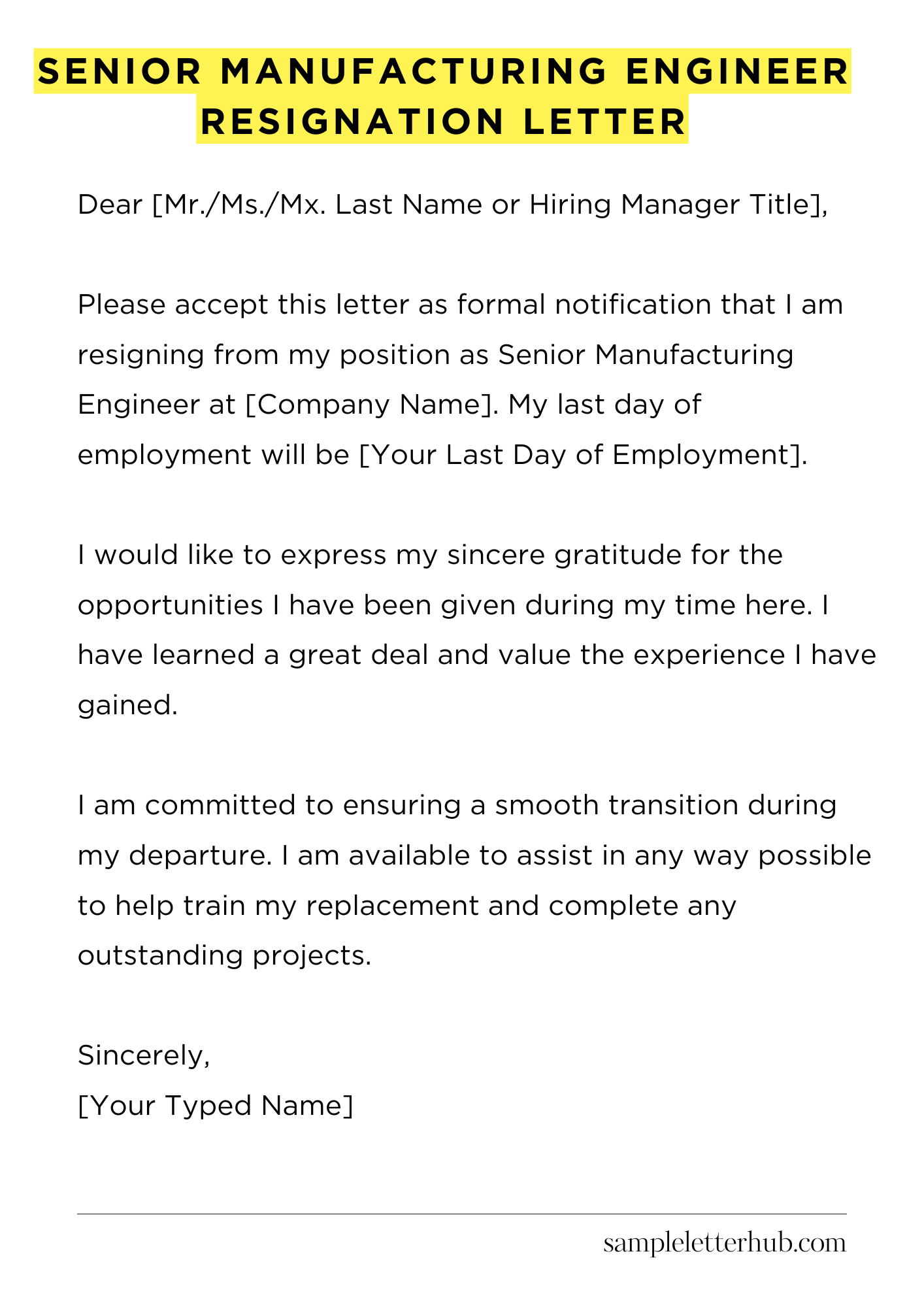
Dear [Mr./Ms./Mx. Last Name or Hiring Manager Title],
Please accept this letter as formal notification that I am resigning from my position as Senior Manufacturing Engineer at [Company Name]. My last day of employment will be [Your Last Day of Employment].
I would like to express my sincere gratitude for the opportunities I have been given during my time here. I have learned a great deal and value the experience I have gained.
I am committed to ensuring a smooth transition during my departure. I am available to assist in any way possible to help train my replacement and complete any outstanding projects.
I wish [Company Name] continued success in the future.
Sincerely,
[Your Typed Name]
How to Write Senior Manufacturing Engineer Resignation Letter
Getting Started: Your Intentions Matter
Resigning from any job requires careful consideration. You’re making a significant life change. As a Senior Manufacturing Engineer, you probably have a lot of responsibilities.
Your resignation letter needs to be clear, professional, and respectful. It will become a permanent part of your employment record, so take the time to get it right. Before you put pen to paper (or fingers to keyboard), decide on your final day of employment. This is crucial for a smooth transition.
Consider company policy regarding notice periods. Usually, it’s two weeks, but check your contract. Be sure you are ready to move on. Are you really ready? You should be.
The Core Elements: What to Include
Your resignation letter doesn’t need to be lengthy. It should be concise. Stick to the essential information. Begin with a formal salutation. Address your direct supervisor or the appropriate person in HR. Next, state your intention to resign. Clearly declare your last day of employment. Keep it simple and straightforward.
Do not beat around the bush. Briefly express your gratitude for the opportunity to work there. Perhaps mention a specific positive experience or skill you gained. Remember, you want to leave a good impression.
If you feel compelled, you might offer assistance with the transition. It can be useful to provide contact information for future references. Sign the letter with your full name. Typing your name at the end of the email is also accepted.
Crafting Your Tone: Keeping It Professional
Maintaining a professional tone is paramount. This means avoiding negativity or complaints. Even if you’re unhappy, your resignation letter isn’t the place to air grievances. Stick to factual statements. Refrain from making personal attacks or criticizing the company. Choose your words carefully. Be polite and respectful throughout the letter.
A neutral and objective tone is your best bet. Proofread your letter meticulously before sending it. Check for any grammatical errors or typos. Mistakes can undermine your professionalism. Double-check all dates and names. This will demonstrate you are serious.
Formatting and Delivery: Polishing Your Letter
Format your letter professionally. Use a standard business letter format. Include your contact information at the top. The company’s contact information should come right below that. Use a clear and easy-to-read font.
Choose a size that is comfortable for reading. The margins should be appropriate. Email is often the standard method of delivery. Consider sending a hard copy via your HR department, if company policy requires.
Always keep a copy of your resignation letter for your records. Remember, the letter is official documentation. Don’t send the letter when you’re angry or upset. Try to be calm and collected.
Example Resignation Letter: Putting It All Together
Here is an example to get you started:
[Your Name]
[Your Address]
[Your Phone Number]
[Your Email Address]
[Date]
[Supervisor’s Name]
[Supervisor’s Title]
[Company Name]
[Company Address]
Dear [Supervisor’s Name],
Please accept this letter as formal notification that I am resigning from my position as Senior Manufacturing Engineer at [Company Name]. My last day of employment will be [Your Last Day of Employment].
I am grateful for the opportunities I have been given during my time here. I have learned a lot. I wish you and the company all the best in the future. I would be happy to assist in the transition of my duties during my remaining time here.
Sincerely,
[Your Full Name]
This is a template. Feel free to adapt it to your specific situation, but remember to be professional and maintain a positive tone. Make it your own. You have got this!
FAQs about Senior Manufacturing Engineer Resignation Letter
What is the most important information to include in a Senior Manufacturing Engineer resignation letter?
The most crucial elements are a clear and concise statement of your intent to resign, the effective date of your resignation, and a professional expression of gratitude for the opportunities you’ve been given.
It is important to also include a brief statement of why you are leaving, such as a reason for wanting to explore new opportunities. It’s often advisable to offer assistance with the transition process.
Should I provide a detailed explanation for my resignation in the letter?
While you should briefly state your reason for leaving, you do not need to provide an exhaustive explanation. Keep it professional and focused. A simple statement such as “I have accepted a new opportunity that aligns more closely with my career goals” or “I am pursuing a new opportunity” is generally sufficient.
More detailed explanations can be reserved for a conversation with your manager if you choose to have one.
How much notice should I give in my resignation letter as a Senior Manufacturing Engineer?
The standard notice period is typically two weeks, though this can vary depending on your employment contract, company policy, and the specific role.
Always review your employment agreement to determine the required notice period. Providing more notice, if possible, can be beneficial, particularly in a specialized role like Senior Manufacturing Engineer. Consult with your manager or HR department.
What tone should I use in my Senior Manufacturing Engineer resignation letter?
Maintain a professional and respectful tone throughout the letter. Express gratitude for the opportunities you’ve been given and for the relationships you’ve built. Avoid negative comments about the company, your colleagues, or your experiences. A positive and professional tone leaves a lasting good impression.
Can I use a template for my Senior Manufacturing Engineer resignation letter?
Yes, using a template is perfectly acceptable and can be a good starting point. However, always customize the template to reflect your specific situation and experiences. Tailor it to the company and the position. Ensure the template is edited for accuracy and professional language before sending.
Related:
Resignation letter due to rude boss
Resignation letter moving to another state
Resignation letter due to illness of family member
Resignation letter due to study