

Leaving a job is a big decision. A “Senior Key Account Manager resignation letter” is a formal document. Its purpose is to officially announce your departure. It informs your employer of your last day of work.
Writing this letter can feel daunting. We’re here to make it easier. We’ll share several templates and examples. These are designed for a Senior Key Account Manager role.
These samples will guide you. They’ll help you craft your own letter. You can adapt them to your specific situation. This will save you time and stress.
Senior Key Account Manager Resignation Letter
Below is a sample of a Senior Key Account Manager Resignation Letter:
[Your Name]
[Your Address]
[Your Phone Number]
[Your Email Address]
[Date]
[Hiring Manager Name] (If known, otherwise use title)
[Hiring Manager Title]
[Company Name]
[Company Address]
Dear [Mr./Ms./Mx. Last Name],
Please accept this letter as formal notification that I am resigning from my position as Senior Key Account Manager at [Company Name], effective [Your Last Day of Employment].
I have enjoyed my time here and appreciate the opportunities I’ve been given. I am grateful for the experience I have gained and the relationships I have built with my colleagues and clients.
I am committed to ensuring a smooth transition during my departure. I am happy to assist in training my replacement and completing any outstanding tasks to the best of my ability. Please let me know how I can best support the company during this period.
I wish you and [Company Name] all the best in the future.
Sincerely,
[Your Signature]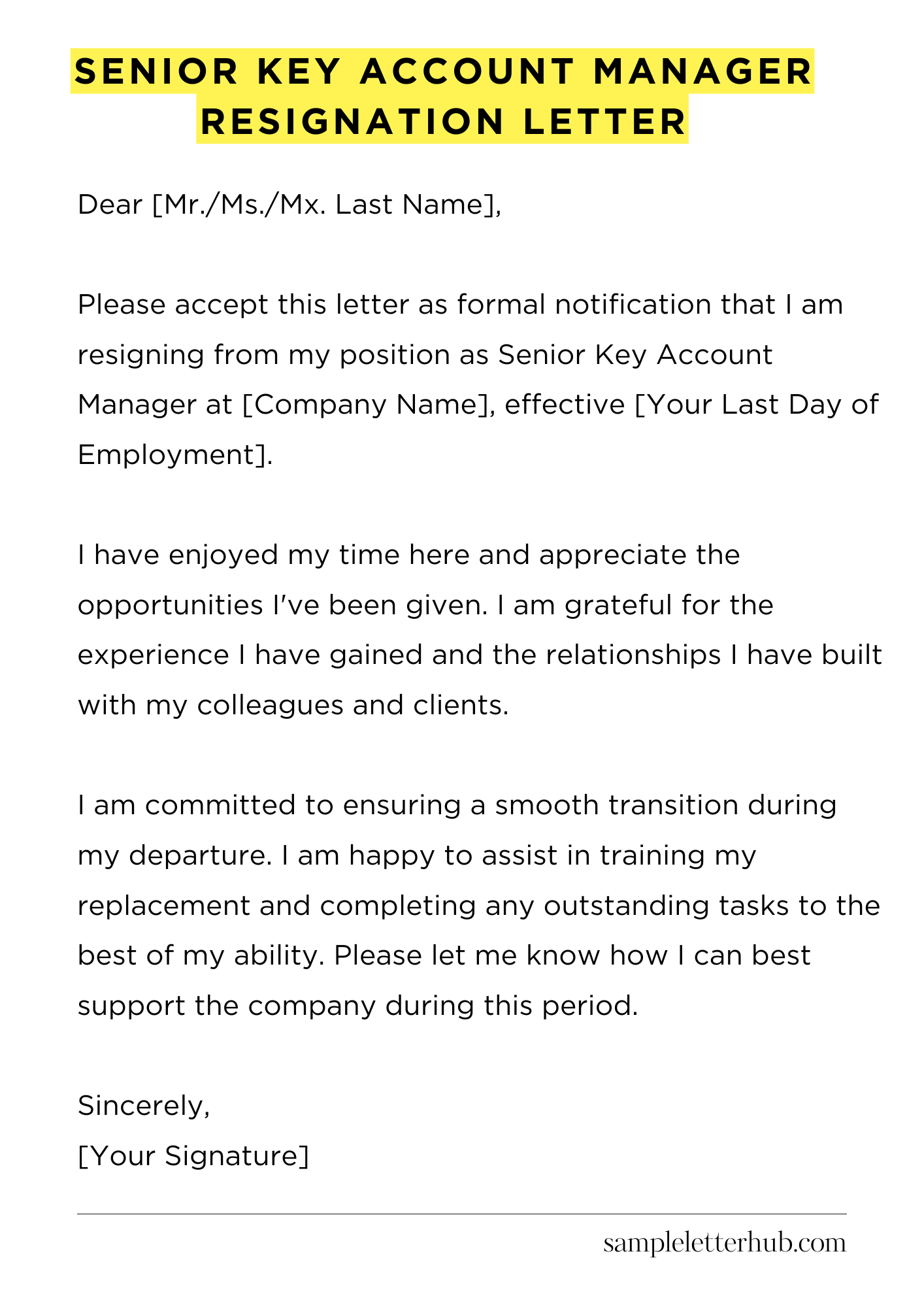
How to Write a Senior Key Account Manager Resignation Letter
1. Why is a Strong Resignation Letter Important?
Leaving a job, especially a senior role like Senior Key Account Manager, requires careful handling. You’ve likely built strong relationships, and your departure impacts not only your immediate team but also your key clients.
A well-crafted resignation letter is more than just a formality; it’s a critical tool. Think of it as your final professional statement. It sets the tone for your exit and can influence your future prospects.
It can leave a positive lasting impression. A poorly written letter, on the other hand, can burn bridges and potentially damage your reputation. It’s a key document that will become a part of your employment record.
2. Essential Elements to Include in Your Letter
First and foremost, keep it concise and professional. Begin with a clear statement of your intention to resign. Specify your last day of employment. This is crucial for your employer to plan accordingly. Make sure to adhere to your employment contract’s stipulations regarding notice periods.
Express your gratitude for the opportunity. Briefly mention what you’ve learned or the experiences you’ve gained during your tenure. Keep it positive. Now, acknowledge the impact of your departure. Offer assistance with the transition. This shows consideration and professionalism.
Finally, include your contact information for any follow-up questions. Your phone number and personal email should be included here. Avoid any negative comments about your employer or colleagues; this is not the time to air grievances. Remember that this is a professional communication.
3. Structuring Your Letter for Maximum Impact
Start with a formal salutation, such as “Dear [Manager’s Name]”. Then, move directly into your resignation statement: “Please accept this letter as formal notification that I am resigning from my position as Senior Key Account Manager at [Company Name], effective [Your Last Day of Employment].” This is the core of the letter. Stick to the facts!
Follow up with your expression of gratitude. Briefly mention something positive about your time at the company. In the next paragraph, offer your assistance with the transition.
Specify how you will help train your replacement. In the final paragraph, express your best wishes to the company and provide your contact information. End with a professional closing, such as “Sincerely” or “Best Regards,” followed by your signature and printed name.
4. Examples and Templates to Get You Started
Here’s a basic template you can adapt:
Dear [Manager’s Name],
Please accept this letter as formal notification that I am resigning from my position as Senior Key Account Manager at [Company Name], effective [Your Last Day of Employment].
I am grateful for the opportunities I have been given during my time here. I have learned a great deal, and I appreciate the experience.
I am happy to assist in the transition process. I am available to train my replacement and ensure a smooth handover of my responsibilities.
I wish the company continued success in the future. Please feel free to contact me at [Phone Number] or [Email Address].
Sincerely,
[Your Signature]
[Your Printed Name]
Remember to tailor the template to your specific situation. You can find many variations online as well.
5. After the Letter: Handling the Follow-Up
Once you’ve submitted your resignation letter, be prepared for a response. Your manager may want to discuss your reasons for leaving or to arrange an exit interview. Be professional and courteous during these discussions.
It’s important to maintain a positive attitude. Cooperate with any requests to assist with the handover of your responsibilities. This includes sharing your knowledge and assisting in the training of your replacement.
Ensure you complete any outstanding tasks. Remember, how you leave is as important as how you started. Finally, always be gracious and professional. Your reputation follows you, so make sure you leave on good terms.
FAQs about Senior Key Account Manager resignation letter
How do I start a Senior Key Account Manager resignation letter?
Begin your letter by clearly stating your intent to resign from your position as Senior Key Account Manager. Include your name, the date, and the effective date of your resignation. Be direct and concise in this initial statement. It is also good practice to address the letter to your immediate supervisor or the appropriate HR representative.
What should I include in the body of a Senior Key Account Manager resignation letter?
In the body of your letter, briefly express your gratitude for the opportunity to work with the company. While you do not need to provide extensive details about your reasons for leaving, you can offer a general statement if you wish (e.g., “pursuing other opportunities”). Maintain a professional tone throughout the letter.
Acknowledge your commitment to a smooth transition and any outstanding responsibilities you intend to address before your departure.
What key information about the transition should be included in the letter?
Your letter should clearly state your last day of employment. Offer your assistance in facilitating the transition, such as training a replacement or documenting key account information. It’s also often helpful to indicate your willingness to be contacted for future questions.
Is it necessary to provide a reason for resigning in the letter?
While not strictly required, you may choose to briefly state your reason for leaving. This is often a good practice. You can simply state that you are “pursuing other opportunities,” “seeking new challenges,” or “relocating.” Avoid negativity or detailed complaints. The focus should be on a professional and positive closure.
How should I end a Senior Key Account Manager resignation letter?
End your letter by expressing your appreciation for the opportunity, any specific experiences or learning from the experience, and wishing the company and your colleagues well in the future. Include your formal signature above your typed name. Keep it concise, positive, and professional to leave a favorable lasting impression.
Related:
Resignation letter due to rude boss
Resignation letter moving to another state
Resignation letter due to illness of family member
Resignation letter due to study