

So, you’re ready to move on. A “Senior Director resignation letter” is your formal goodbye. It’s a crucial document. It officially informs your company of your departure. It outlines your last day of employment.
Writing this letter can feel tricky. You want to be professional. You want to leave a good impression. Luckily, you’ve come to the right place. We’ve got you covered.
This article provides helpful examples. You’ll find templates and samples. These will guide you through the process. Craft your perfect resignation with ease.
Senior Director Resignation Letter
Below is a sample of a Senior Director Resignation Letter:
[Your Name]
[Your Address]
[Your Phone Number]
[Your Email Address]
[Date]
[Recipient Name]
[Recipient Title]
[Company Name]
[Company Address]
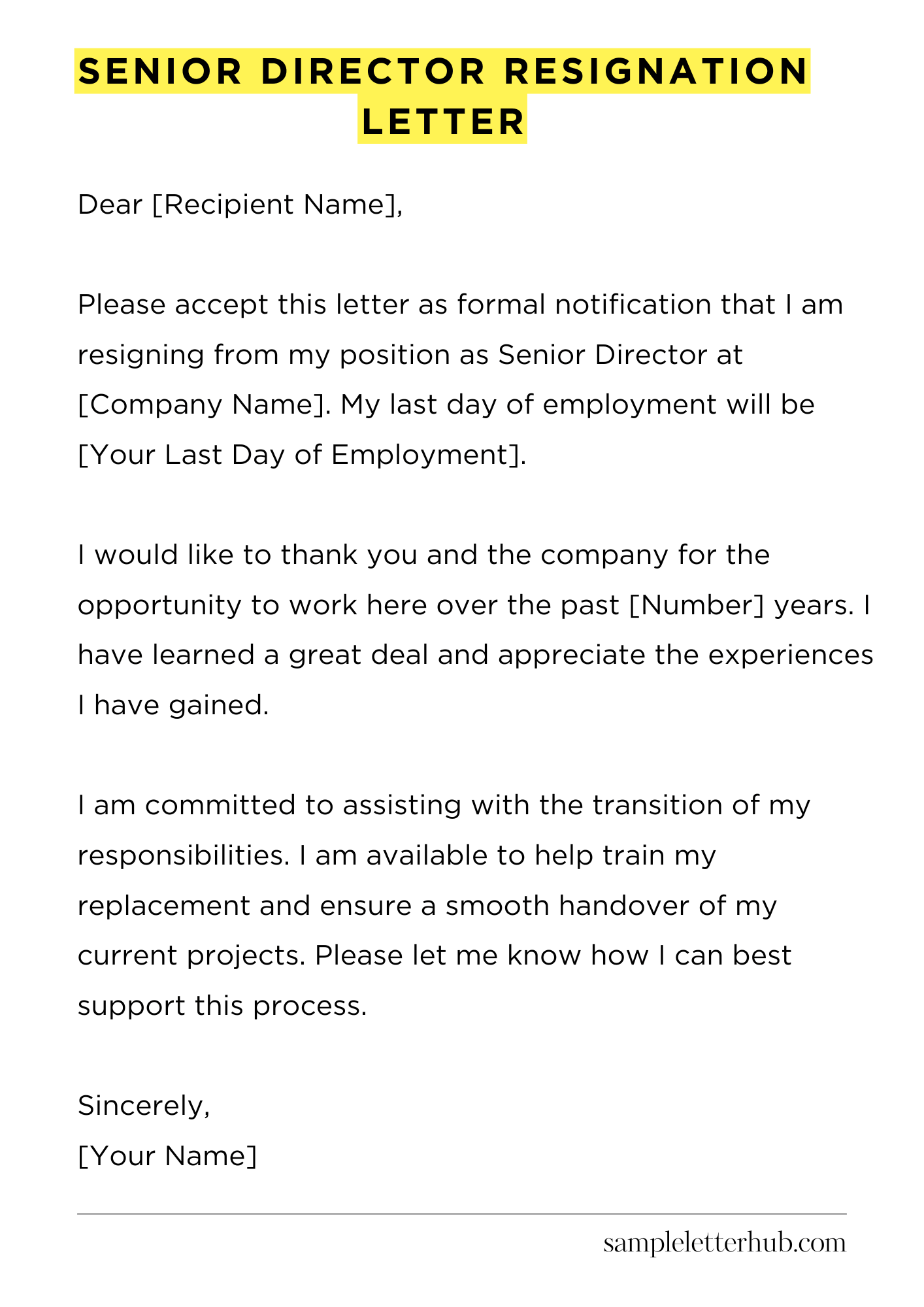
Dear [Recipient Name],
Please accept this letter as formal notification that I am resigning from my position as Senior Director at [Company Name]. My last day of employment will be [Your Last Day of Employment].
I would like to thank you and the company for the opportunity to work here over the past [Number] years. I have learned a great deal and appreciate the experiences I have gained.
I am committed to assisting with the transition of my responsibilities. I am available to help train my replacement and ensure a smooth handover of my current projects. Please let me know how I can best support this process.
I wish you and [Company Name] all the best in the future.
Sincerely,
[Your Name]
How to Write a Senior Director Resignation Letter
Resigning from a Senior Director role is a significant step in your career. You’ve likely poured considerable time and energy into the position. You need a letter that reflects your professionalism and leaves a positive lasting impression. This guide will walk you through crafting a resignation letter that is clear, concise, and respectful.
1. Preparation is Key: Before You Start Typing
Before putting pen to paper (or fingers to keyboard), take a breath. Think through the logistics. Have you secured your next role? Do you know when you want your employment to end? These things are crucial. You must be prepared to leave your current role, and you will state that time frame clearly.
Research your company’s policy regarding resignation. Are there any specific procedures you need to follow, like submitting the letter to HR directly? Understanding company protocol prevents potential complications.
Finally, make sure all your ducks are in a row. You will write a professional letter, but before that, you need to have a clear understanding of your personal situation.
2. Structure and Content: What to Include
Your resignation letter should be straightforward and to the point. Start with a formal salutation, such as “Dear [Manager’s Name]”. Then, state your intention to resign. This is where you clearly and unequivocally state that you’re leaving your position. Include your last day of employment.
This is usually determined by your employment contract, so be sure you follow it. Express gratitude for the opportunity. Briefly acknowledge the experience you’ve gained or the contributions you’ve made during your tenure. Keep it positive. Offer to assist with the transition. This shows your commitment to a smooth handover.
Then, close the letter with a professional closing, such as “Sincerely” or “Best regards,” followed by your full name and signature (if sending a hard copy).
3. Crafting the Right Tone: Be Professional
The tone of your letter is incredibly important. You’re leaving a senior position, therefore, maintain a professional tone throughout. Avoid negativity, even if you have had negative experiences.
Keep the letter concise and to the point. While you can be grateful, there is no need for excessive detail or lengthy explanations. Stay focused on the key information: your resignation, your last day, and your willingness to help with the transition. You want to leave a positive lasting impression.
4. Proofreading and Review: Check, Check, and Recheck
Once you’ve written your letter, proofread it carefully. Look for any spelling or grammatical errors. Ensure that the language is clear and professional. Ask a trusted colleague or friend to review it as well.
A fresh pair of eyes can often catch mistakes you might have missed. Proofreading helps you avoid any misunderstandings and ensures that your letter is polished. Ensure your name is typed correctly. Always. The last thing you want is a typo on your letter. A polished letter reflects well on you and your professionalism.
5. Delivery and Follow-Up: The Final Steps
Finally, how you deliver your resignation letter matters. Usually, the best approach is to hand deliver it to your manager. This is followed by a discussion, which is an important step. Be prepared to answer questions about your decision and be respectful of any concerns they may have. Always be polite.
Follow up with your HR department. After the conversation, if your company policy allows, provide a copy to your HR department. This keeps everyone informed. Maintain a professional demeanor throughout the entire process. This can leave a positive legacy, and can help you down the road. You never know when your paths may cross again.
FAQs about Senior Director Resignation Letter
What information should I include in my Senior Director resignation letter?
Your resignation letter should include: your formal resignation, stating your last day of employment (typically two weeks from the date of the letter), a brief and professional statement of your reason for leaving (if you choose to include one, such as pursuing other opportunities).
Your contact information is also a good addition.
How much notice should a Senior Director give when resigning?
While it can vary based on your employment contract and company policy, as a Senior Director, it is generally expected that you provide at least four weeks’ notice, but six weeks to two months can also be provided. Confirming the specific requirements within your employment agreement is crucial for compliance.
Should I include a reason for leaving in my Senior Director resignation letter?
Including a reason is optional. However, if you are comfortable, providing a brief, professional reason (e.g., “pursuing other opportunities,” “seeking a new challenge”) can be beneficial. It allows for a more personable letter and avoids speculation. Avoid overly negative statements or personal criticisms.
What is the proper format for a Senior Director resignation letter?
Use a formal business letter format. Include your name and address, the date, the name and address of your superior or HR department, a clear subject line (“Resignation”), a professional salutation (e.g., “Dear [Manager’s Name]”), the body of your letter containing the key information.
How can I ensure a smooth transition of my responsibilities as a Senior Director?
To ensure a smooth transition, offer to assist in the handover process. This includes being available to answer questions, creating documentation for your key tasks, and training your replacement or a team member who will take over. It demonstrates professionalism and respect for the company. Include this offer in your resignation letter.
Related:
Resignation letter due to rude boss
Resignation letter moving to another state
Resignation letter due to illness of family member
Resignation letter due to study