

So, you’re a Senior Account Manager. It might be time to move on. A resignation letter is the official document. It tells your company you’re leaving. It formally ends your employment.
Writing this letter can feel tricky. It doesn’t have to be. We’ve got you covered. We’ll share some helpful examples.
Get ready to see some letter samples. These will make the process easier. You can adapt them to fit your needs. Writing your own letter will be a breeze.
Senior Account Manager Resignation Letter
Below is a sample of a Senior Account Manager Resignation Letter:
[Your Name]
[Your Address]
[Your Phone Number]
[Your Email Address]
[Date]
[Hiring Manager Name] (If known, otherwise use title)
[Hiring Manager Title]
[Company Name]
[Company Address]
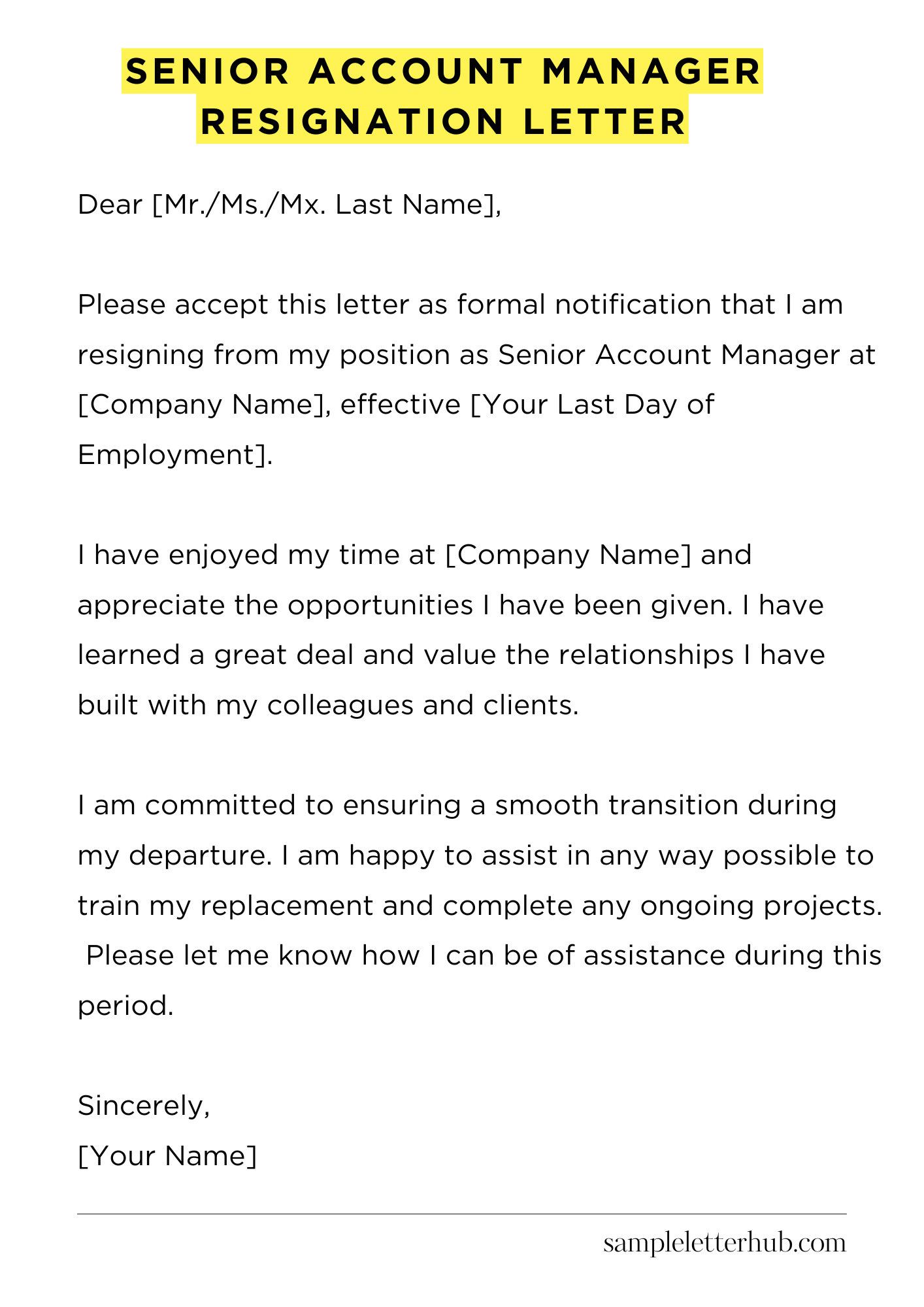
Dear [Mr./Ms./Mx. Last Name],
Please accept this letter as formal notification that I am resigning from my position as Senior Account Manager at [Company Name], effective [Your Last Day of Employment].
I have enjoyed my time at [Company Name] and appreciate the opportunities I have been given. I have learned a great deal and value the relationships I have built with my colleagues and clients.
I am committed to ensuring a smooth transition during my departure. I am happy to assist in any way possible to train my replacement and complete any ongoing projects. Please let me know how I can be of assistance during this period.
I wish [Company Name] continued success in the future.
Sincerely,
[Your Name]
How to Write a Senior Account Manager Resignation Letter
1. Preparation is Key Before You Even Start Typing
Leaving a job is a big decision. It’s a step that shouldn’t be taken lightly, especially when you’re in a senior role. Before you begin writing your resignation letter, take a breath! Think through your reasons for leaving. Are you moving to a new opportunity? Seeking a better work-life balance?
Maybe the company culture just isn’t a good fit. Clearly understanding your motivations will help you write a letter that’s both professional and effective.
Also, check your employment contract! Knowing the required notice period is vital. Failing to adhere to the terms could lead to problems, so don’t skip this important step. Finally, make sure you know who your resignation letter should be addressed to; usually, it’s your direct supervisor or HR. Plan this beforehand, you need this clarity.
2. The Essential Elements: What Your Letter MUST Include
A well-crafted resignation letter is more than just a formality. It’s a professional statement that should include certain essential elements. First and foremost, state your intention to resign. This is a must! Specifically, state that you are resigning from your position as Senior Account Manager.
Clearly and concisely mention your last day of employment. This is often dictated by the notice period in your contract. Next, offer your gratitude. Thank the company and, if applicable, specific individuals for the opportunities you’ve been given. Briefly acknowledge any positive experiences you had during your tenure.
Keep it positive; even if your reasons for leaving are negative, this is not the place to air them publicly. Finally, offer to assist with the transition. This simple gesture demonstrates your professionalism and commitment to ensuring a smooth handover.
3. Crafting the Core: The Body of Your Resignation
The body of your resignation letter should be short, sweet, and to the point. Avoid overly lengthy explanations for leaving; keep it concise. However, you can briefly state the reason for your departure if you feel inclined. Focus on what you’ll be doing. For example, perhaps you’re moving on to another job.
Mentioning this can give context without oversharing personal details. If you have special responsibilities such as client interaction, indicate your willingness to help train a replacement or assist with the handover of your duties.
This is a very valuable step. Keep your tone professional and respectful throughout the letter, regardless of your personal feelings about the job. Avoid negative language or criticizing your colleagues or the company. Think about what you want to achieve with your letter and stick to it, this is a very vital step.
4. Formatting and Presentation: Making a Good Impression
Presentation matters. Your resignation letter should look professional. Use a standard business letter format. Start with your contact information, the date, and the recipient’s contact information. A formal greeting, such as “Dear [Manager’s Name],” is essential. Keep the font simple and readable, such as Times New Roman or Arial.
Use a font size between 10 and 12 points. Be sure to proofread carefully for any spelling or grammatical errors before sending it. A clean, well-formatted letter reflects well on your professionalism and attention to detail. You do not want to hand in a poorly formatted letter.
5. Beyond the Letter: The Importance of Follow-Up
Your resignation letter is just the first step. After submitting your letter, be prepared for a response. Your supervisor may want to discuss your resignation in person.
Be open to a conversation, even if your mind is made up. Be prepared to answer questions and address any concerns. Most importantly, be willing to cooperate with the transition process. Help to train your replacement. Offer any documentation you have to help them.
A positive and helpful attitude during your final weeks will leave a lasting impression. This is what people will remember. In short, be professional until your last day, and that will set you up for future success.
FAQs about Senior Account Manager Resignation Letter
What is the primary purpose of a Senior Account Manager resignation letter?
The primary purpose of a Senior Account Manager resignation letter is to formally notify your employer of your intent to leave your position. It serves as an official record of your departure and helps to initiate the handover process. The letter should clearly state your resignation, your last day of employment, and ideally, express gratitude for the opportunity.
What key information should be included in a Senior Account Manager resignation letter?
A Senior Account Manager resignation letter should include your formal resignation statement, your name and the date, the specific date of your last day of employment, and a polite expression of gratitude for the employment opportunity. It’s often advisable to briefly state your reason for leaving, if you choose, and offer to assist with the transition process.
How should the tone of a Senior Account Manager resignation letter be?
The tone of a Senior Account Manager resignation letter should be professional and courteous. It’s important to remain positive and respectful, even if you are leaving due to dissatisfaction. Avoid negativity or making disparaging comments about your employer or colleagues. A professional tone helps to maintain a positive relationship and leaves a good impression.
Should a Senior Account Manager offer assistance during the transition period in their resignation letter?
Yes, offering assistance during the transition period is highly recommended. It demonstrates professionalism and a commitment to ensuring a smooth handover of your responsibilities.
Offering to train your replacement, document key processes, or assist in any way you can shows that you value your employer and the success of the company. It’s also likely to be appreciated by your colleagues.
Is it necessary to state the reason for leaving in a Senior Account Manager resignation letter?
While not strictly necessary, stating a brief reason for leaving can be beneficial, particularly if your departure is due to a new opportunity.
Keep it concise and positive, focusing on the future. However, if your reason for leaving involves sensitive issues, you may choose to omit it or provide it separately to your manager in person. Always maintain professionalism and avoid being overly specific.
Related:
Resignation letter due to rude boss
Resignation letter moving to another state
Resignation letter due to illness of family member
Resignation letter due to study