

So, you’re a Scrum Master ready to move on. A Scrum Master resignation letter is the formal document you submit. It officially tells your employer you’re leaving. Its primary purpose is to inform them of your departure.
Writing this letter can feel tricky. You want to be professional. You also want to make it clear. This article helps make it simple. We’ll share ready-to-use templates. You can customize them for your situation.
Need some inspiration? We’ve got you. These samples cover various scenarios. Use them as a starting point. Make your own letter writing process much easier.
Scrum Master Resignation Letter
Below is a sample of a Scrum Master Resignation Letter:
[Your Name]
[Your Address]
[Your Phone Number]
[Your Email Address]
[Date]
[Hiring Manager Name] (If known, otherwise use title)
[Hiring Manager Title]
[Company Name]
[Company Address]
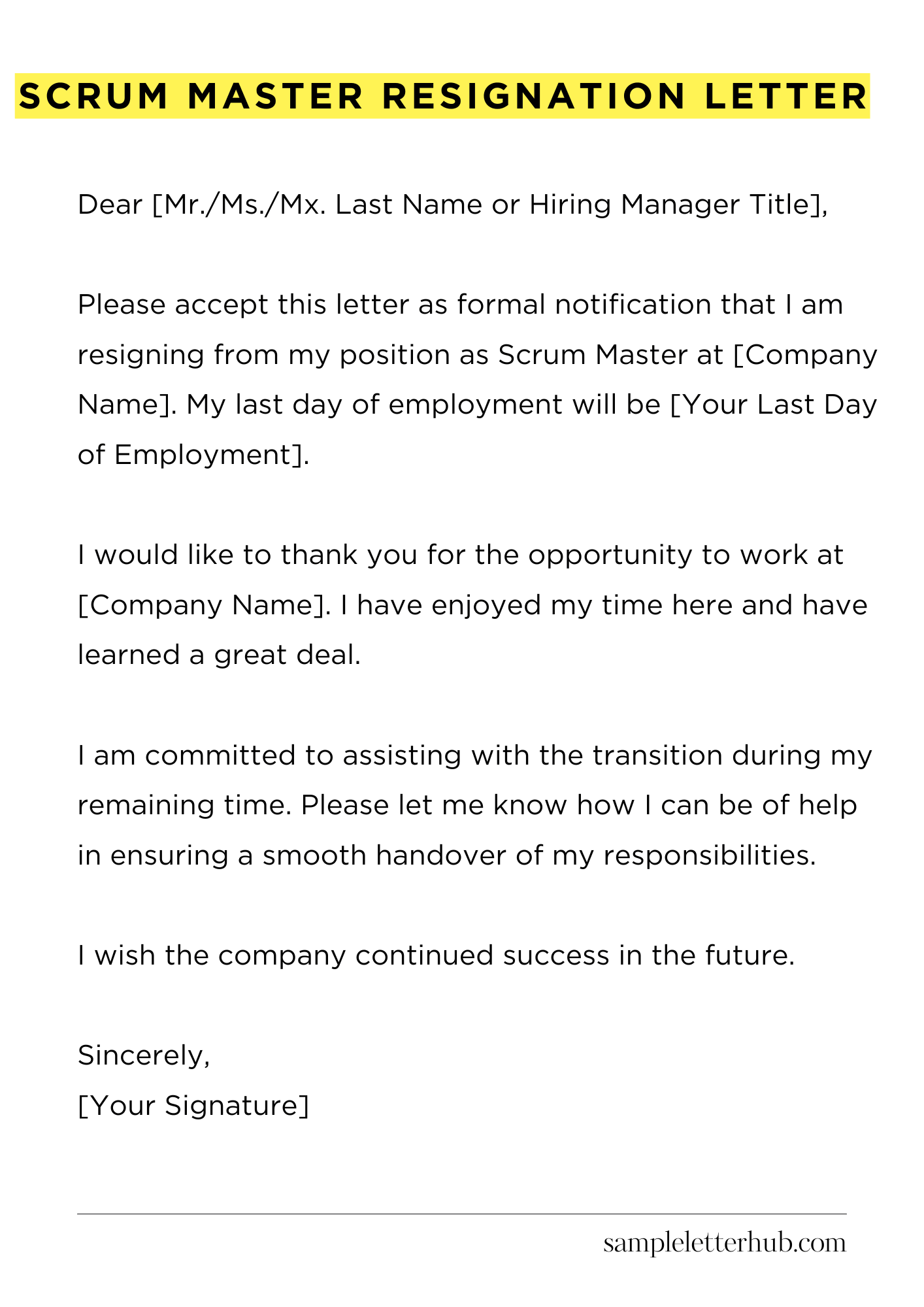
Dear [Mr./Ms./Mx. Last Name or Hiring Manager Title],
Please accept this letter as formal notification that I am resigning from my position as Scrum Master at [Company Name]. My last day of employment will be [Your Last Day of Employment].
I would like to thank you for the opportunity to work at [Company Name]. I have enjoyed my time here and have learned a great deal.
I am committed to assisting with the transition during my remaining time. Please let me know how I can be of help in ensuring a smooth handover of my responsibilities.
I wish the company continued success in the future.
Sincerely,
[Your Signature]
How to Write a Scrum Master Resignation Letter
So, you’re moving on. Leaving your role as a Scrum Master is a big decision! Before you dive into your next adventure, there’s one crucial task remaining: crafting a professional and respectful resignation letter. This document signals your departure and helps maintain positive relationships. Let’s break down how to do it right.
1. Keep it Simple and Direct
Your resignation letter isn’t the place for lengthy explanations or a novel about your time with the company. The goal is clarity. Keep the language straightforward and professional. Use a formal tone.
This is not the time for casual language or office slang. Clearly state your intention to resign and the effective date of your departure. For example: “Please accept this letter as formal notification that I am resigning from my position as Scrum Master, effective [Date].” It’s really that simple! Stick to the core information.
2. Express Gratitude (and Be Sincere)
Even if the role wasn’t perfect, or if you faced challenges, it’s always wise to express gratitude for the opportunity. Thank the company, your team, and perhaps your manager for the experience.
A simple sentence can go a long way. Consider something like, “I am grateful for the opportunities I’ve had during my time here and for the support I’ve received from the team.” Genuine appreciation can leave a lasting positive impression. This is important for future references and maintaining professional relationships.
3. Offer to Help with the Transition
Demonstrating a willingness to assist with the handover process is a sign of professionalism and respect. It shows you care about the team and the continued success of the project. Include a sentence expressing your willingness to help during the transition period.
Say something like, “I am committed to ensuring a smooth transition and am happy to assist in any way possible to onboard my replacement.” This shows your commitment. Be prepared to follow through with this offer, whether it’s through documentation, training, or answering questions.
4. Be Mindful of Tone and Avoid Negativity
The resignation letter is not the place to air grievances or list what you didn’t like about the job. Avoid negative language or criticisms. Even if you’re leaving due to challenging circumstances, maintain a positive and professional tone. Your goal is to leave on a good note.
Remember that this letter is a reflection of you. Keep it positive, even if things were difficult. Keep this a positive communication.
5. Review and Proofread!
Before sending your letter, proofread it carefully. Check for any grammatical errors, spelling mistakes, and ensure the formatting is clean and professional. Read it aloud to catch any awkward phrasing.
Ask a trusted colleague or friend to review it as well. A polished letter demonstrates attention to detail and respect. A well-written letter can make a big difference, showing professionalism and respect.
FAQs about Scrum Master resignation letter
What is the primary purpose of a Scrum Master resignation letter?
The primary purpose of a Scrum Master resignation letter is to formally notify your employer of your intention to leave your position. It serves as an official record of your departure and provides essential details such as the effective date of your resignation.
It also allows you to express your gratitude, offer assistance with the transition, and maintain a professional relationship with your employer.
What key elements should be included in a Scrum Master resignation letter?
A well-crafted Scrum Master resignation letter should include: your official notification of resignation, the effective date of your departure, a concise statement of your reason for leaving (optional, but can be helpful), an expression of gratitude for the opportunity.
How much notice should a Scrum Master give when resigning?
The standard notice period for a Scrum Master, like any other employee, is typically outlined in your employment contract or company policy. Common notice periods range from two weeks to a month. It’s essential to review your contract or consult with HR to determine the specific requirement and ensure you adhere to it.
Should I provide a reason for resigning in my Scrum Master resignation letter?
Providing a reason for your resignation is optional. While it’s generally good practice to keep the tone positive and professional, you may choose to briefly mention your reason if you feel it’s necessary. This could be to pursue a different opportunity, relocation, or personal circumstances. Avoid negative or overly critical statements about the company or its employees.
How can I ensure a smooth transition when resigning as a Scrum Master?
To ensure a smooth transition, offer to assist with the handover process. This might involve documenting your current projects, mentoring your replacement, or providing training on Scrum practices. Be cooperative and available during your notice period to answer questions and facilitate the transfer of knowledge and responsibilities. Leaving on good terms is important.
Related:
Resignation letter due to rude boss
Resignation letter moving to another state
Resignation letter due to illness of family member
Resignation letter due to study