

Need to leave your SAP FI role? You’ll likely need a resignation letter. “SAP FI resignation letter” refers to the formal document. It officially communicates your decision to leave your job. This letter informs your employer about your departure. It also states your last day of employment.
Writing a resignation letter can be tricky. You want to be professional and clear. This article helps you with that. We have compiled various templates for your use. These templates cover different scenarios and situations.
Get ready to draft your letter! We’ll provide helpful examples. These will guide you. Writing your own SAP FI resignation letter will be a breeze. Find the perfect fit for your needs.
Sap Fi Resignation Letter
Below is a sample of a Sap Fi Resignation Letter:
[Your Name]
[Your Address]
[Your Phone Number]
[Your Email Address]
[Date]
[Hiring Manager Name] (If known, otherwise use title)
[Hiring Manager Title]
[Company Name]
[Company Address]
Dear [Mr./Ms./Mx. Last Name],
Please accept this letter as formal notification that I am resigning from my position as a SAP FI [Your Job Title] at [Company Name], effective [Your Last Day of Employment].
My last day of employment will be [Your Last Day of Employment].
I would like to thank you for the opportunity to work at [Company Name]. I have learned a great deal during my time here.
I am committed to ensuring a smooth transition during my departure. I am happy to assist with the handover of my responsibilities and train my replacement, as needed.
I wish you and the company all the best in the future.
Sincerely,
[Your Signature]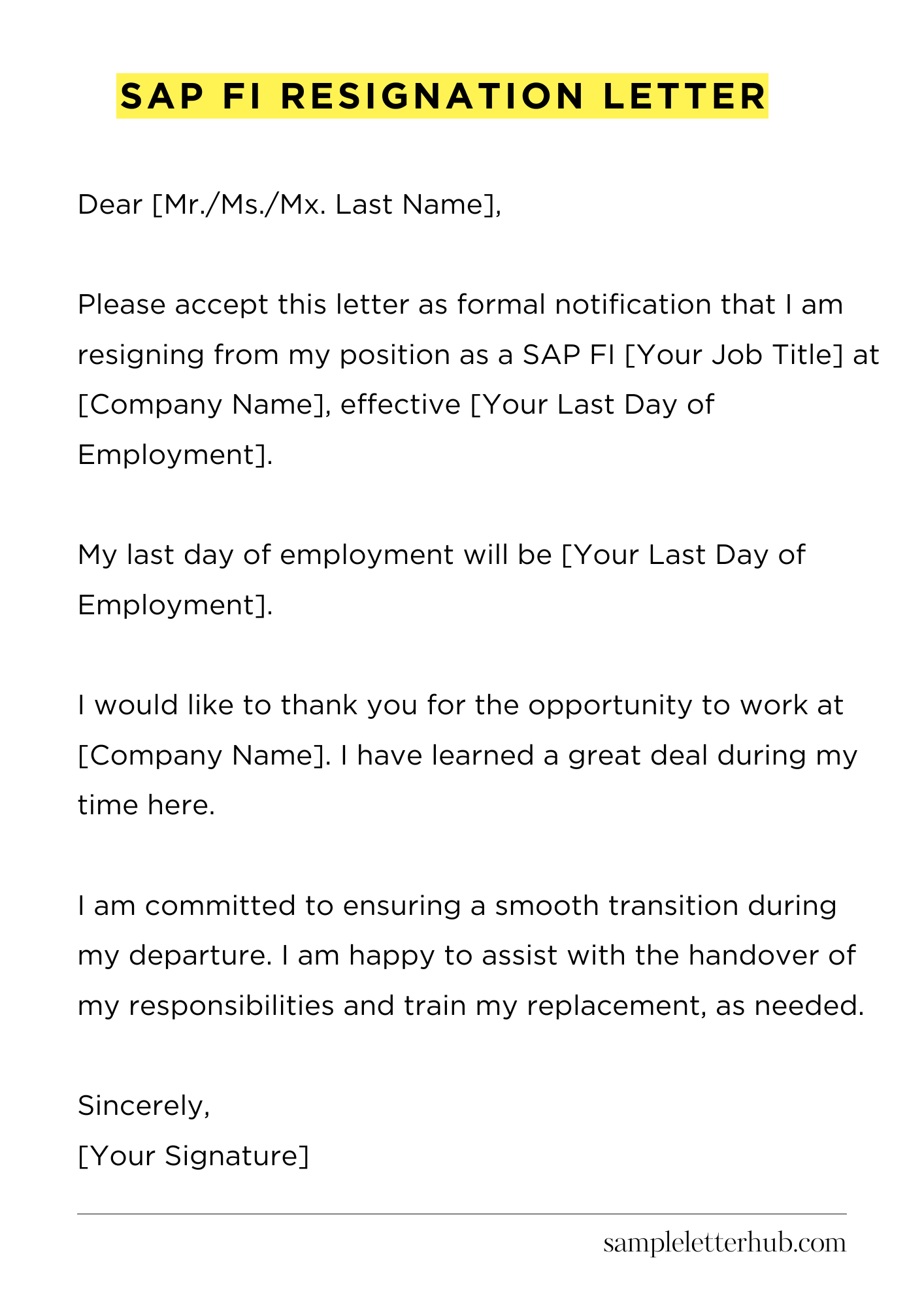
How to Write a SAP FI Resignation Letter
Leaving a job is a big step. Resigning from your SAP FI role requires a professional and clear resignation letter. You must ensure all the correct information is included. This guide will help you craft an effective letter. Let’s get started.
1. Subject Line: Keep it Concise and Clear
The subject line is the first thing your recipient sees. Make it direct and to the point. Avoid ambiguity. Something like “Resignation – [Your Name]” works perfectly. It tells the reader immediately what the email is about. This saves them time and ensures your message doesn’t get overlooked. Using a clear subject line increases the chances of prompt acknowledgement.
2. The Opening: State Your Intent
Your opening paragraph needs to be upfront and professional. Clearly state your intention to resign. Include the specific date of your last day of employment. This is a must.
For example: “Please accept this letter as formal notification that I am resigning from my position as SAP FI Consultant, effective [Your Last Day of Employment].” Remember to check your contract for any required notice period.
3. The Body: Acknowledge and Express Gratitude
The body of your letter should be composed of two key elements. Firstly, briefly acknowledge your time with the company. Expressing gratitude is also good practice.
Mentioning what you’ve learned or the opportunities you’ve been given can be effective. Secondly, briefly summarize your reason for leaving if you wish.
You are not obligated to go into extreme detail, but you can give a brief, neutral explanation. For example: “I have greatly valued my time at [Company Name] and appreciate the opportunities I have been given. I am moving on to pursue another opportunity.”
4. Closing: Offer Assistance and Include Contact Information
End your letter on a positive note. Offer assistance with the transition. Offer to help train your replacement, if possible. Include your contact information.
This is very important. You want to make the departure as smooth as possible. For instance, “I am available to assist with the transition of my responsibilities and can be reached at [Your Phone Number] or [Your Email Address]. I wish the company continued success.”
5. Formatting and Finalization
Formatting is key for a professional impression. Your letter should be well-formatted, easy to read, and free of errors. Use a professional font like Times New Roman or Arial.
Keep the tone formal and respectful throughout. Proofread carefully before sending. Check for any grammatical errors or typos. Remember to sign the letter if it’s a physical copy, or use your full name in the closing if it’s an email. Make sure the letter gets to the correct person, likely your direct supervisor or HR department. Congratulations on your next chapter!
FAQs about SAP FI Resignation Letter
What is the primary purpose of a SAP FI resignation letter?
The primary purpose of a SAP FI resignation letter, like any resignation letter, is to formally communicate an employee’s intent to leave their position.
Specifically, it informs the employer (and often the employee’s direct manager and HR department) of the employee’s decision to resign, the effective date of the resignation, and sometimes the reason for leaving. In the context of a SAP FI role, it also signifies the employee’s departure from responsibilities related to SAP Financial Accounting.
What key information must be included in a SAP FI resignation letter?
A SAP FI resignation letter should include the following essential elements: a clear and concise statement of resignation, the employee’s full name, the employee’s job title, the department, the effective date of resignation (the last day of employment), and a professional closing.
It’s also often beneficial to include a brief, positive statement (optional), expressing gratitude for the opportunity or highlighting specific skills gained. For SAP FI roles, it is advisable to mention any ongoing projects or responsibilities the employee is involved in to facilitate a smooth handover.
Are there specific legal or company policies to consider when writing a SAP FI resignation letter?
Yes, employees should be aware of any relevant legal and company policies. This includes understanding the required notice period as outlined in the employment contract or company handbook, which may vary depending on the employee’s role, the length of employment, or local labor laws.
Additionally, the letter should adhere to the company’s communication protocols, for instance, which department or individual to address the letter to. Compliance with company policies regarding confidentiality, data security, and the return of company property should be considered.
How should a SAP FI resignation letter address the handover of responsibilities?
The letter should explicitly address the handover process. The employee can state their willingness to assist in a smooth transition, potentially by offering to train a replacement or document their work.
Specifics such as deadlines for handover activities, and the key areas of responsibility (e.g., Accounts Payable, General Ledger, Reporting) for handover, can be included, especially if these details are not clearly defined elsewhere. Confirming an employee’s availability during the notice period to support the transition is also a sign of professionalism.
What are some best practices for ensuring professionalism and avoiding common mistakes in a SAP FI resignation letter?
Best practices include using a professional tone and format, ensuring clarity and conciseness, and proofreading carefully for any errors in grammar or spelling.
The letter should be positive and respectful, even if the employee is leaving due to negative experiences. Avoid using negative language, expressing personal grievances in detail, or making unsubstantiated claims. It’s also important to retain a copy of the letter for your records. Consider addressing the letter to the appropriate individual or department head.
Related:
Resignation letter due to rude boss
Resignation letter moving to another state
Resignation letter due to illness of family member
Resignation letter due to study