

As a SAP ABAP Consultant, you might need to resign. A resignation letter is the formal way to do this. It officially communicates your decision to leave your job. The letter informs your employer of your departure.
This article is your guide to crafting the perfect resignation letter. We’ve got you covered with examples. We will share various templates and samples. These will help you compose your own letter.
Need to say goodbye to your SAP ABAP role? Let’s make it easy. We are here to simplify the process. Get ready to write your resignation with confidence.
Sap Abap Consultant Resignation Letter
Below is a sample of a Sap Abap Consultant Resignation Letter:
[Your Name]
[Your Address]
[Your Phone Number]
[Your Email Address]
[Date]
[Hiring Manager Name] (If known, otherwise use title)
[Hiring Manager Title]
[Company Name]
[Company Address]
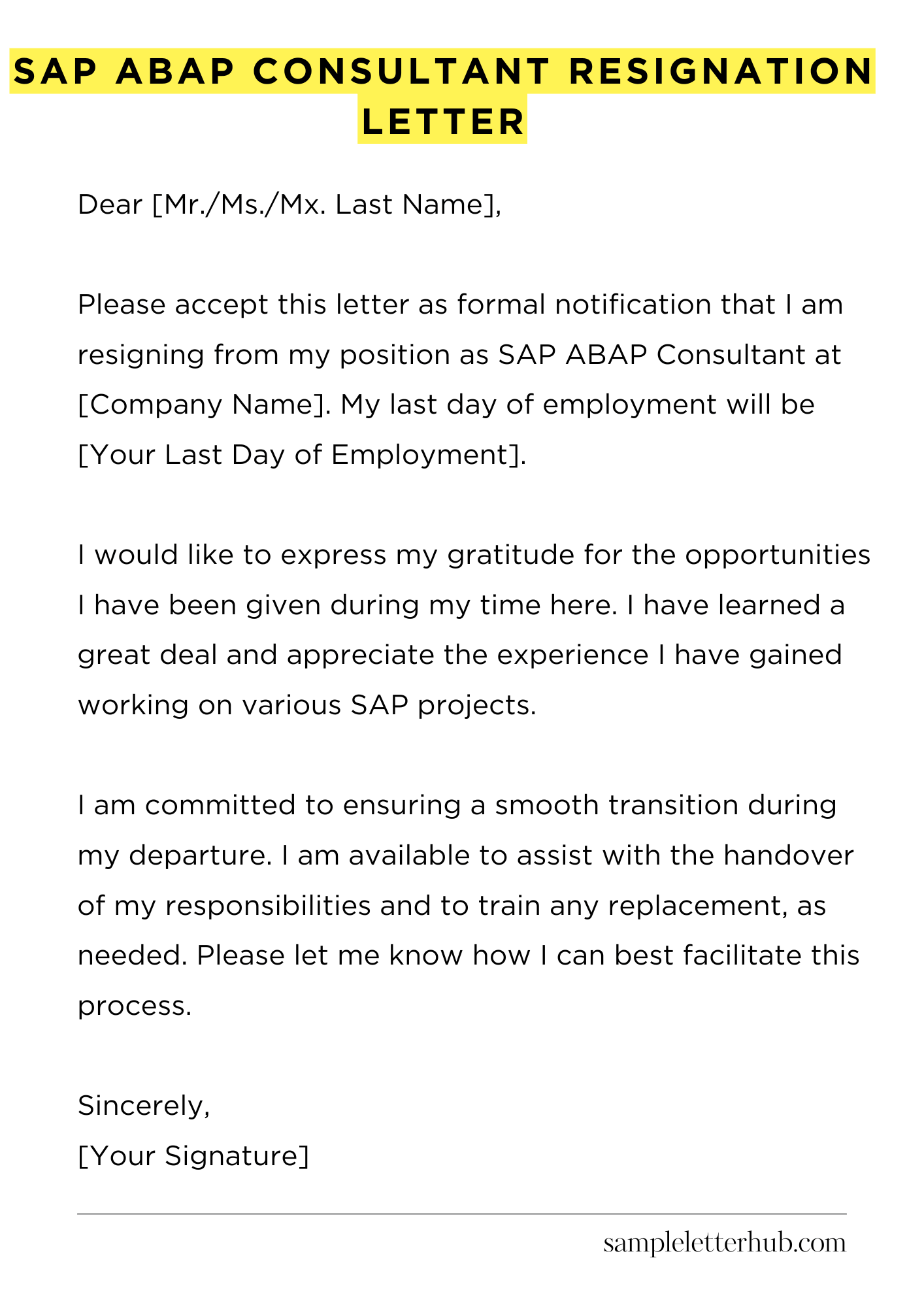
Dear [Mr./Ms./Mx. Last Name],
Please accept this letter as formal notification that I am resigning from my position as SAP ABAP Consultant at [Company Name]. My last day of employment will be [Your Last Day of Employment].
I would like to express my gratitude for the opportunities I have been given during my time here. I have learned a great deal and appreciate the experience I have gained working on various SAP projects.
I am committed to ensuring a smooth transition during my departure. I am available to assist with the handover of my responsibilities and to train any replacement, as needed. Please let me know how I can best facilitate this process.
I wish you and [Company Name] all the best in the future.
Sincerely,
[Your Signature]
How to Write a SAP ABAP Consultant Resignation Letter
Know the Basics Before You Start
Resigning from any job is a big deal. For an SAP ABAP Consultant, it requires a carefully crafted resignation letter. This isn’t just about saying “I quit.” You need to be professional, clear, and concise. Think of it as a final piece of communication representing you. This letter is your official notice, so take it seriously.
Before putting pen to paper (or fingers to keyboard), understand your company’s policy. Check your contract or employee handbook for any specific requirements, such as the required notice period. Adhering to these is crucial for a smooth exit.
Crafting the Core Components
The foundation of your letter includes essential information. Begin with a formal salutation, addressing your direct manager or the appropriate HR representative. Use their correct title and name; accuracy is key. Next, clearly state your intention to resign and the effective date of your resignation. This date is when your employment officially ends.
Provide a brief and polite statement of your reason for leaving. A simple, non-offensive reason is usually sufficient, such as “to pursue other opportunities” or “to relocate.” Avoid overly detailed explanations or negativity. Keep it simple and professional.
Then, express your gratitude. Acknowledge the opportunities you’ve been given and express appreciation for your time with the company. Even if your experience wasn’t perfect, showing gratitude leaves a positive impression. This maintains a good relationship for future references.
Offering a Helping Hand During Transition
Your resignation letter isn’t just about you. Demonstrate your commitment by offering assistance during the transition period. This shows professionalism and a willingness to help. This also makes it a lot easier for you during the handover phase.
State your availability to assist in any way possible to ensure a smooth handover of your responsibilities. This could include training colleagues, documenting your work, or answering questions. Outline any specific handover plans you may have. Be specific and realistic about what you can offer.
Mention that you will follow up and arrange the handover plan if needed and be available after the employment also.
Formatting and Polishing Your Letter
Proper formatting is vital. Keep it clear, concise, and easy to read. Use a professional business letter format. Include your name, contact information, the date, and the recipient’s information. Use a standard font like Arial or Times New Roman, and keep the font size around 12 points.
Proofread the entire letter meticulously. Check for grammar errors, spelling mistakes, and punctuation issues. Errors detract from your professionalism. Ask a colleague or friend to review your letter as a second pair of eyes can often catch mistakes you might miss.
Keep the tone formal and respectful throughout the letter. Avoid slang, jargon, or overly casual language. A well-written and polished letter reflects positively on your professionalism and leaves a lasting good impression.
Finalizing and Delivering Your Resignation
Before submitting, review the entire letter one last time. Ensure all details are accurate, and your tone is appropriate. Once satisfied, make a copy for your records. This is for your own personal documentation.
Deliver the letter according to company policy. This might involve submitting a hard copy to your manager or sending it via email to a designated HR representative. Follow any specific instructions provided by your employer.
After submitting the letter, be prepared to discuss your resignation with your manager. Remain professional and cooperative throughout the exit process. Doing so ensures a positive departure, even if you are moving on.
FAQs about SAP ABAP Consultant Resignation Letter
What is the essential information that must be included in an SAP ABAP Consultant resignation letter?
An effective resignation letter for an SAP ABAP Consultant should include: a clear and concise statement of resignation (e.g., “I hereby resign from my position as SAP ABAP Consultant”), the effective date of your resignation, a formal expression of gratitude for the opportunity (optional but recommended), a professional and respectful tone, and your contact information.
It’s also wise to mention your willingness to assist with the transition of your duties, if possible.
What is the recommended format and structure for an SAP ABAP Consultant resignation letter?
A typical resignation letter should be formatted as a formal business letter. Start with your contact information (name, address, phone number, email) and the date. Then include the recipient’s information (hiring manager/supervisor’s name, title, company name, address).
Use a clear and professional salutation (e.g., “Dear [Manager’s Name]”), followed by the body of the letter, and conclude with a professional closing (e.g., “Sincerely,” or “Regards,”). The body should be concise and focused on the key information mentioned above.
What are the common reasons why SAP ABAP Consultants resign, and how should they be addressed in the letter (if at all)?
Common reasons include better job opportunities, career advancement, higher compensation, dissatisfaction with current work environment, or personal circumstances. You aren’t always required to provide a reason for your resignation. If you choose to, keep the reason brief and professional.
Avoid negativity or overly critical statements. If you’re leaving for a better opportunity, you might simply state it. Otherwise, you can keep the reason ambiguous or omit it.
How much notice should an SAP ABAP Consultant give when resigning?
The standard notice period for SAP ABAP Consultants, as with most professional roles, is typically two weeks. However, the specific notice period might be outlined in your employment contract or company policy. Always review your contract to ensure you comply with the required notice period.
Giving more notice is always appreciated and can help maintain a positive relationship with your former employer.
What are some tips for a smooth transition of duties when resigning as an SAP ABAP Consultant?
To ensure a smooth transition, offer to assist with knowledge transfer. Document your ongoing projects, tasks, and configurations. Prepare any necessary documentation for your replacement (e.g., code documentation, user manuals).
Offer to train your replacement or answer questions during your remaining time. Provide a list of contacts and essential information to help your colleagues continue their work after your departure.
Related:
Resignation letter due to rude boss
Resignation letter moving to another state
Resignation letter due to illness of family member
Resignation letter due to study