

A sales leader resignation letter is a formal document. It announces a sales leader’s departure from a company. Its main purpose is to officially communicate the resignation. It also informs the employer about the last working day.
Leaving a leadership role can be tricky. You need to craft the perfect letter. We’re here to help you get it right. This article provides various templates. We offer examples and samples.
Use these to create your own letter. This will make the process simple. Your resignation letter will be ready in no time. Choose the format that suits you best.
Sales Leader Resignation Letter
Below is a sample of a Sales Leader Resignation Letter:
[Your Name]
[Your Address]
[Your Phone Number]
[Your Email Address]
[Date]
[Recipient Name]
[Recipient Title]
[Company Name]
[Company Address]
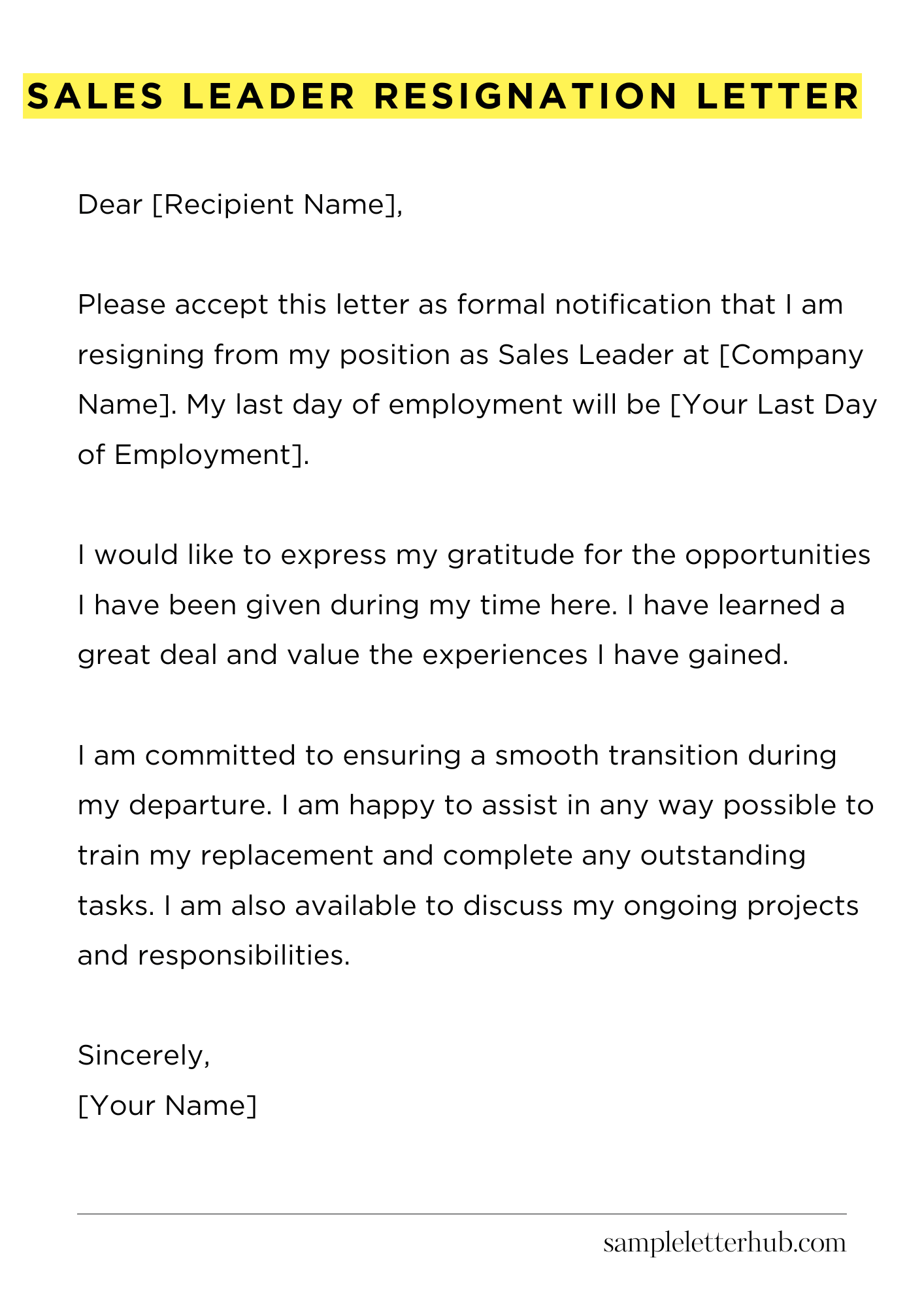
Dear [Recipient Name],
Please accept this letter as formal notification that I am resigning from my position as Sales Leader at [Company Name]. My last day of employment will be [Your Last Day of Employment].
I would like to express my gratitude for the opportunities I have been given during my time here. I have learned a great deal and value the experiences I have gained.
I am committed to ensuring a smooth transition during my departure. I am happy to assist in any way possible to train my replacement and complete any outstanding tasks. I am also available to discuss my ongoing projects and responsibilities.
I wish you and [Company Name] all the best in the future.
Sincerely,
[Your Name]
How to Write a Sales Leader Resignation Letter
So, you’re moving on. Leaving a leadership role, especially in sales, can be a big deal. You’ve likely poured your heart and soul into building teams, crushing targets, and navigating the ups and downs of the market. Now, it’s time to craft that all-important resignation letter. Don’t worry; it’s not as daunting as it seems.
1. Keep it Concise and Clear
First things first: brevity is your friend. Avoid long, rambling paragraphs. Get straight to the point. State your intention to resign clearly and unambiguously. Include the date your resignation will be effective. This leaves no room for confusion or misinterpretation. Stick to the facts, avoid unnecessary drama.
A simple, direct approach is always best in this situation. Remember, you want to leave on a good note. Keep it professional.
2. Express Your Gratitude (and Be Sincere)
Even if things didn’t always go smoothly, there’s almost always something to be thankful for. Perhaps you learned valuable skills, built strong relationships, or achieved significant milestones. Acknowledge these positive aspects. Thank your employer, your team, and perhaps even specific individuals who supported your success.
Sincerity matters here. A genuine expression of gratitude goes a long way. This is not about being fake; it’s about recognizing the experience you’ve had. It’s the right thing to do. Think about what you’ve gained.
3. Provide a Reason (If You Choose To)
You are not obligated to explain *why* you’re leaving. However, it’s often helpful to provide a brief, professional reason. Maybe you’re pursuing a new opportunity, seeking a different challenge, or relocating. Keep it concise. Do *not* dwell on any negative aspects of your current role or company. Your focus is forward.
Mentioning something vague like “pursuing other opportunities” is perfectly acceptable. Avoid negativity at all costs. This keeps the door open.
4. Offer Assistance with the Transition
This is where you demonstrate professionalism and a commitment to a smooth handover. Offer your assistance during the transition period. Suggest ways you can help, such as training your replacement, documenting key processes, or introducing your connections. You can state that you are willing to help them with the transition.
This shows that you are thoughtful. Being helpful reflects well on you. This makes the departure smoother for everyone involved. It reinforces your reputation as a professional.
5. Review and Proofread Carefully
Before hitting “send,” read your resignation letter carefully. Check for any typos, grammatical errors, or awkward phrasing. Ensure the tone is professional and positive. Have someone else review it as well, preferably a trusted colleague or mentor. A fresh pair of eyes can often catch mistakes you might miss.
This shows respect for your company, your colleagues, and, most importantly, yourself. It’s all about making a strong, final impression.
FAQs about Sales Leader resignation letter
What is the primary purpose of a Sales Leader resignation letter?
The primary purpose of a Sales Leader resignation letter is to formally notify the employer of the intent to leave the position. It serves as a written record of the resignation, the effective date of departure, and often includes a brief expression of gratitude or a statement about the handover process.
What key elements should be included in a Sales Leader resignation letter?
A well-crafted resignation letter should include: a clear and concise statement of resignation, the specific date of the last day of employment, a brief expression of gratitude for the opportunity (optional but recommended), and any necessary information regarding the transition of responsibilities or handover plans.
It may also include contact information if the leader wishes to be contacted later.
How much notice should a Sales Leader give when resigning?
The amount of notice a Sales Leader should give is typically dictated by their employment contract or company policy. Common practice is to provide a minimum of two weeks’ notice, but senior roles often require a longer notice period, such as four weeks or even a month or more. It’s crucial to review the employment contract for the specific terms.
Should a Sales Leader provide a reason for resigning in the letter?
While not mandatory, a Sales Leader can choose to provide a reason for resigning. It’s often sufficient to keep the reason brief, such as “to pursue other opportunities.” Avoid overly negative or detailed explanations, as the letter’s primary function is to formally announce the departure.
The employee may be asked to participate in an exit interview where they can provide more information about the reasons for leaving.
How should a Sales Leader handle the handover of responsibilities?
The Sales Leader should offer their full support to ensure a smooth transition. They should: create a list of ongoing projects, client relationships, and key contacts; document processes and procedures; train their replacement or other team members; and be available for consultation during the transition period.
Providing a comprehensive handover document or participating in knowledge transfer sessions is essential.
Related:
Resignation letter due to rude boss
Resignation letter moving to another state
Resignation letter due to illness of family member
Resignation letter due to study