

A “Safety Resignation Letter” is a formal notice. It informs an employer that you are leaving your job. The main purpose is to communicate your departure. It often cites concerns about workplace safety. This helps protect you and the employer.
This article offers guidance. We provide various safety resignation letter templates. You’ll find different examples. These are easy to adapt. Use them to craft your own letter.
We want to make the process simple. Whether you have a specific situation or just need a starting point, we’ve got you. Feel free to use these samples as your guide. Get ready to write a solid letter.
Safety Resignation Letter
Below is a sample of a Safety Resignation Letter:
[Your Name]
[Your Address]
[Your Phone Number]
[Your Email Address]
[Date]
[Employer’s Name]
[Company Name]
[Company Address]
Dear [Employer’s Name],
Please accept this letter as formal notification that I am resigning from my position as [Your Job Title] at [Company Name], effective immediately.
My decision is based on serious safety concerns regarding [briefly and clearly state the safety issue – e.g., the lack of proper safety equipment, unsafe working conditions, failure to follow safety protocols]. I believe these conditions pose a significant risk to the health and safety of myself and potentially other employees.
I have attempted to address these concerns previously by [mention any previous attempts to resolve the issue – e.g., reporting it to management, speaking with colleagues]. Unfortunately, these efforts have not resulted in the necessary changes to ensure a safe working environment.
I am no longer able to continue working in a situation that I believe to be unsafe.
I am available to assist with the handover of my responsibilities in the coming days, if needed, although given the immediate nature of my resignation I may not be available for an extended period. Please contact me to arrange for any handover procedures.
I wish the company well in resolving these issues and improving workplace safety.
Sincerely,
[Your Signature]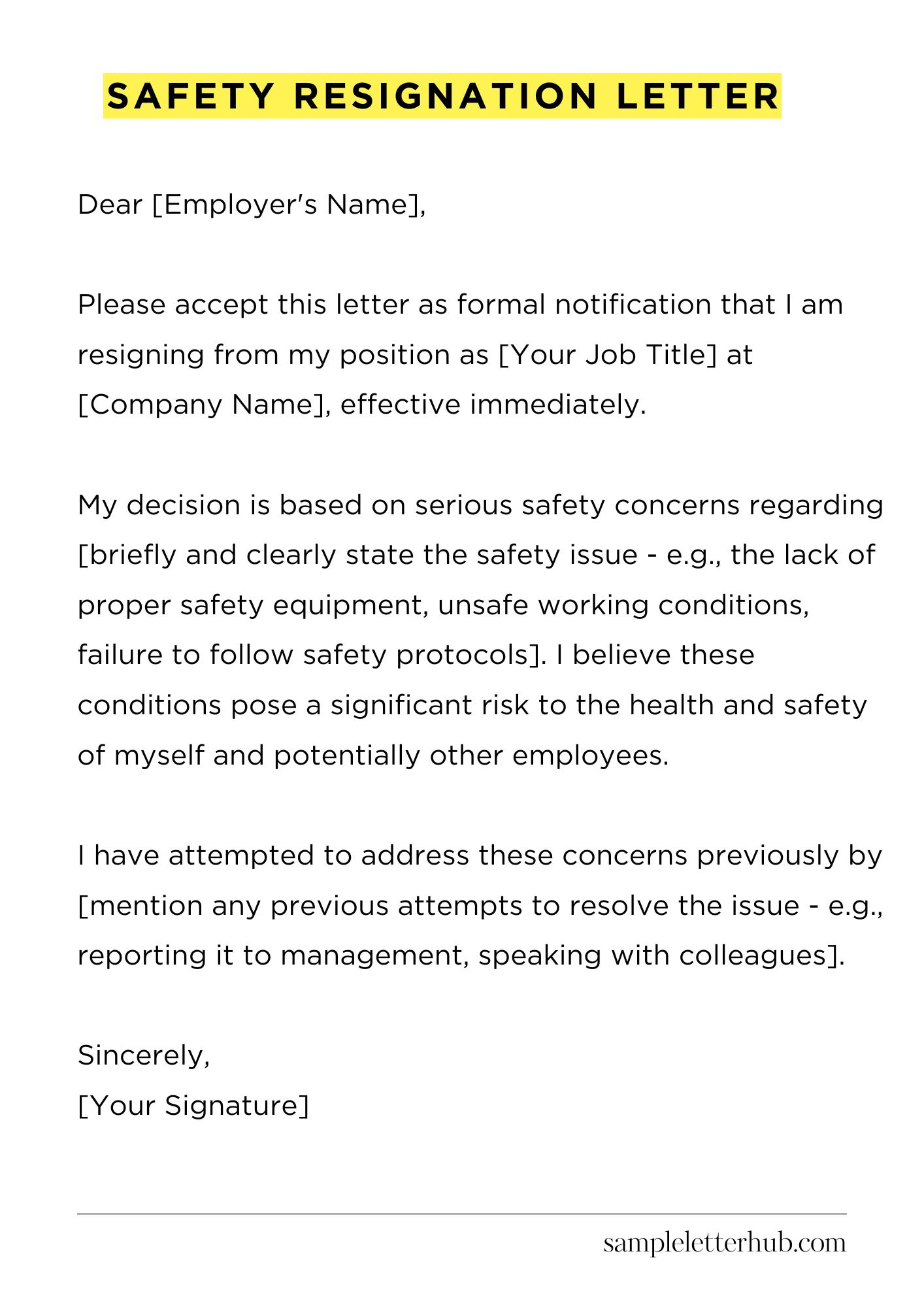
How to Write a Safety Resignation Letter
Know Your Rights and Responsibilities First
Before you even begin, it is important to be aware of your local regulations. Different states or countries have different rules and guidelines regarding the resignation process.
A clear understanding of these will help to ensure your letter is appropriate and effective. You need to review your employment contract. It usually outlines the required notice period. This is the amount of time you are expected to continue working after submitting your letter. This is very important.
Failing to provide adequate notice could lead to financial penalties or legal issues. Familiarize yourself with the company’s internal policies on resignation. They may have a specific form or process.
The policy might also clarify where you submit your letter. Understanding this from the start avoids confusion. And it shows you’re taking this seriously.
Crafting the Core of Your Letter
The body of your letter is where you communicate your intentions. You must start with a direct and clear statement of your resignation. Avoid beating around the bush.
State explicitly that you are resigning from your position. Include the effective date of your resignation. This is the date your employment will officially end. Next, express your gratitude for the opportunity. While you may have reasons for leaving, maintaining a professional tone is key.
This shows respect. Briefly mention the reasons for your departure. Be concise. You don’t need to provide a detailed account. You can simply state that you are pursuing other opportunities.
Offer your assistance during the transition period. This can include training your replacement or completing outstanding tasks. This shows you are a team player. Finally, end the letter with a professional closing, such as “Sincerely” or “Best regards.”
Formatting for a Polished Appearance
Presentation matters. Your letter should look professional and easy to read. Start with a formal heading. Include your name, address, the date, and the recipient’s information. Use a standard business letter format. Ensure the font is readable; Times New Roman or Arial are often good choices.
The font size should be easy to see. Use a font size of 11 or 12. Keep the letter concise and to the point. One page is typically sufficient. Avoid large blocks of text. Use short paragraphs. Check for any grammar mistakes and spelling errors. Proofread the letter carefully before sending it.
What to Avoid in Your Resignation Letter
There are some things you should leave out. Do not include excessive negativity or criticism. Even if you are unhappy with your job, avoid venting frustrations in your letter.
Refrain from burning bridges. Don’t share confidential information. The letter is not the place to reveal sensitive company details or discuss trade secrets. Also, avoid making personal attacks on colleagues.
This can reflect badly on you. Keep it professional. Do not negotiate your departure terms. If you have any concerns about your final paycheck or benefits, address them separately through HR. This ensures your resignation letter remains focused on the act of leaving.
Delivering Your Letter and Next Steps
Decide on the best way to deliver your letter. It’s normally better to submit a physical hard copy and an email. Hand delivering the letter to your manager is generally the preferred method.
This allows for a face-to-face conversation. If that is not possible, email is the next best alternative. After submitting your letter, be prepared for a response. Your manager may want to discuss your resignation.
They might want to discuss your final tasks and responsibilities. Cooperate with any requests. Ensure a smooth transition. Collect any personal belongings. Return company property, such as laptops, phones, and ID badges.
Finally, ensure all financial matters are settled. This includes your final paycheck and benefits. Doing this makes sure your departure is clean and leaves a positive impression.
FAQs about Safety Resignation Letter
What is a safety resignation letter, and when is it necessary?
A safety resignation letter is a formal document an employee submits to their employer to resign from their position due to safety concerns in the workplace.
It becomes necessary when an employee feels their physical well-being, or the well-being of others, is at risk due to unsafe working conditions, lack of proper safety protocols, or failure of the employer to address safety complaints.
This type of letter is often used as a last resort when other attempts to resolve safety issues have failed.
What should be included in a safety resignation letter?
A safety resignation letter should clearly state the employee’s intent to resign due to safety concerns. It should include specific details about the unsafe conditions, such as dates, times, and descriptions of the hazards or incidents.
Reference any previous attempts to address these issues, such as complaints made to supervisors or HR. It is also important to maintain a professional tone, clearly state the date of resignation, and include a formal closing with the employee’s signature and printed name.
Can I be penalized for resigning due to safety concerns?
In many jurisdictions, employees are protected from retaliation for raising safety concerns. Therefore, resigning due to genuine and documented safety concerns should not, in theory, lead to penalty.
However, it’s crucial to document everything thoroughly and retain copies of any relevant correspondence.
If you believe you are being penalized, it’s advisable to seek legal counsel to understand your rights and potential options, such as filing a complaint with the Occupational Safety and Health Administration (OSHA) in the US, or the equivalent in your country.
What legal protections do I have when resigning due to safety concerns?
Depending on your location, you may have legal protections under various labor laws. These protections often prevent employers from retaliating against employees who report unsafe working conditions.
These might include whistleblower protections or specific laws regarding unsafe workplaces.
Maintaining detailed records of the safety issues, your communications, and the resignation process can be critical if you need to pursue legal action. Consult with a lawyer experienced in employment law in your area to determine your specific rights.
How should I deliver a safety resignation letter?
The best practice is to deliver the letter in writing, ideally with a hard copy delivered to the employer and a copy kept for your records.
Sending it via certified mail with a return receipt requested ensures proof of delivery and the date it was received. Alternatively, you can hand-deliver the letter and request a signed acknowledgment of receipt from your supervisor or HR representative.
Additionally, you may also send an electronic copy via email for documentation purposes, but always follow up with a physical copy to the appropriate personnel.
Related:
Resignation letter due to rude boss
Resignation letter moving to another state
Resignation letter due to illness of family member
Resignation letter due to study