

A “Risk Analyst resignation letter” is a formal document. Its purpose is to officially inform an employer of your intent to leave your job. It marks the beginning of your departure process. This letter is a crucial step in maintaining a professional relationship.
Planning to resign? Writing this letter might seem daunting. But, don’t worry. We’ve got you covered. We’ll share several templates and examples. These are tailored for Risk Analysts like you.
Our collection offers different formats. Find one that fits your needs. You can easily adapt them to your specific situation. Craft a letter that is clear, concise, and professional.
Risk Analyst Resignation Letter
Below is a sample of a Risk Analyst Resignation Letter:
[Your Name]
[Your Address]
[Your Phone Number]
[Your Email Address]
[Date]
[Hiring Manager Name] (If known, otherwise use title)
[Hiring Manager Title]
[Company Name]
[Company Address]
Dear [Mr./Ms./Mx. Last Name],
Please accept this letter as formal notification that I am resigning from my position as Risk Analyst at [Company Name]. My last day of employment will be [Your Last Day of Employment].
I would like to thank you for the opportunity to work at [Company Name] over the past [Duration of Employment]. I have learned a great deal and appreciate the experiences I have gained during my time here.
I am committed to ensuring a smooth transition during my departure. I am happy to assist in training my replacement and completing any outstanding tasks to the best of my ability. Please let me know how I can best support the transition process.
I wish you and [Company Name] all the best in the future.
Sincerely,
[Your Signature]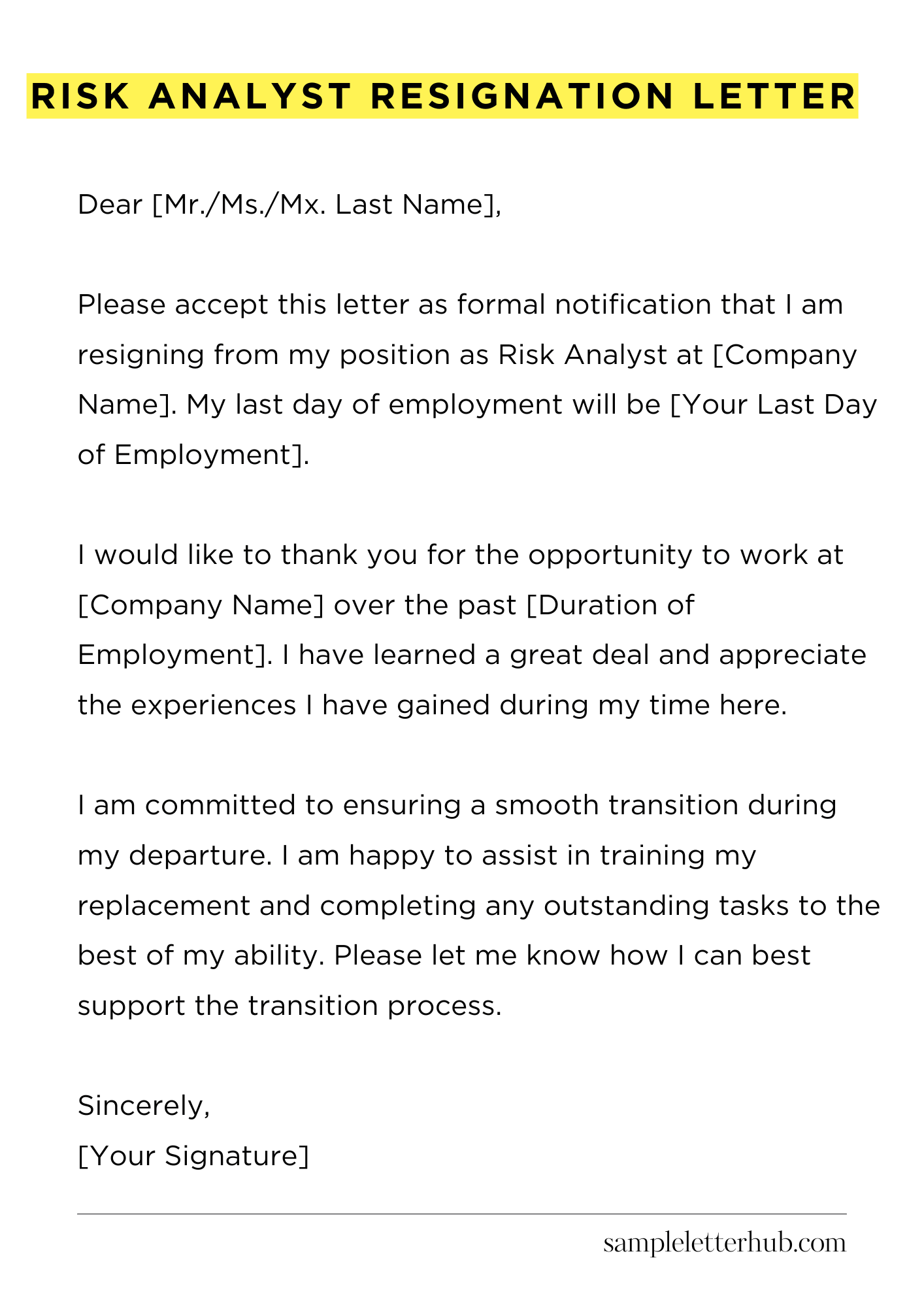
How to Write a Risk Analyst Resignation Letter
1. Getting Started: The Basics You Need to Know
Resigning from your job is a big step. You want to make it as smooth as possible, right? Well, a well-written resignation letter is your first line of defense. Remember, this letter is a formal document. It’s not the place for venting frustrations or burning bridges. Keep it professional.
Start with the basics: your name, the date, and the recipient’s name (your direct supervisor or HR, depending on your company’s policy). Make sure the date is accurate. Triple-check everything!
2. The Core Components: What to Include
Every good resignation letter includes a few essential elements. First, and most importantly, state your intention to resign. Be clear and direct. For example: “Please accept this letter as formal notification that I am resigning from my position as Risk Analyst, effective [Your Last Day of Employment].”
Next, include your last day of employment. This is usually determined by your employment contract or company policy (typically two weeks’ notice). Keep it simple, factual, and to the point.
Next, It’s a nice gesture to express gratitude for the opportunity. Mention something positive about your experience at the company. Consider saying something like, “I have truly valued my time at [Company Name] and appreciate the opportunities I’ve been given.”
3. Optional but Recommended: Adding Extra Touches
Now, let’s look at a few things you can add that are not necessarily required, but highly recommended. Offering assistance with the transition is a classy move. This demonstrates professionalism and a willingness to help.
For instance: “I am committed to ensuring a smooth handover of my responsibilities and am happy to assist in any way possible during the transition period.”
Also, a brief, positive statement about your future plans is optional. You might say, “I am pursuing a new opportunity that aligns with my long-term career goals.” However, avoid going into excessive detail.
Keep it vague.
4. The Tone and Style: Keep it Professional
Your tone is critical. Always maintain a professional and respectful tone. Avoid negativity, even if you had negative experiences. Remember, your resignation letter is a permanent record.
It is not the time or place to air grievances. Proofread carefully before sending. Check for grammar, spelling, and punctuation errors. A polished letter shows that you care.
And it reflects well on you.
5. Formatting and Delivery: Make a Good Impression
Format matters. Use a standard business letter format. Your letter should be single-spaced, with a professional font like Times New Roman or Arial. Keep the font size between 10 and 12 points. Finally, deliver the letter in the appropriate way. Usually, it’s a hard copy given to your supervisor.
Be sure to follow your company’s internal guidelines. This may include emailing a digital copy to HR. Make sure you get a receipt of the submission. Before you go, be sure to wish your boss and colleagues the best.
FAQs about Risk Analyst Resignation Letter
What key information should a Risk Analyst’s resignation letter include?
A Risk Analyst’s resignation letter should clearly state the intention to resign, the effective date of resignation, and a brief and professional expression of gratitude for the opportunity. It may also include details about the handover process, if applicable, to ensure a smooth transition.
Providing contact information for future correspondence is often included. Additionally, it can be considered to provide a brief positive statement about the company or the team.
How far in advance should a Risk Analyst submit their resignation letter?
The standard practice is to adhere to the notice period outlined in the employment contract or company policy. This typically ranges from two weeks to a month. However, the specific requirements can vary depending on the country, the level of seniority, and the terms of the employment agreement. Refer to your employment contract for the exact duration.
Should a Risk Analyst provide a reason for resignation in their letter?
While not mandatory, Risk Analysts have the option to briefly mention the reason for their resignation. It’s generally best to keep the reason concise and professional, focusing on the future and not dwelling on negative aspects of the current role.
Common reasons include accepting a new position, pursuing further education, or seeking a better work-life balance. Remember, the focus is to leave a positive impression.
What is the proper format for a Risk Analyst resignation letter?
The resignation letter should be formatted as a formal business letter. Include your name, address, and contact information at the top, followed by the date. Address the letter to your supervisor or HR department.
Use a professional and polite tone throughout. Keep the language clear, concise, and professional. Ensure to proofread the letter carefully for any errors before submitting it.
Can a Risk Analyst’s resignation be rescinded?
Once a resignation letter has been submitted and accepted, rescinding it is typically possible, but it depends on the company’s policies and the circumstances. It’s crucial to immediately communicate with your supervisor or HR if you have changed your mind.
The employer has the discretion to accept or reject the request, based on factors such as the position’s criticality, the progress of the transition plan, and the company’s needs. It’s generally a good idea to have a frank conversation to discuss this possibility.
Related:
Resignation letter due to rude boss
Resignation letter moving to another state
Resignation letter due to illness of family member
Resignation letter due to study