

You need to write a “Resident Advisor resignation letter”? It is a formal document. You use it to tell your employer you are leaving. It outlines your departure date. It also provides a brief explanation for your leaving.
This can be tricky to do. No worries. We’ve got you covered. We’ll share some fantastic templates. They will make writing your resignation letter a breeze. Use our examples to craft your perfect goodbye.
We’ll offer various samples. These letters cover different scenarios. You can adapt them to fit your needs. Say goodbye professionally and with ease. Let’s get started.
Resident Advisor Resignation Letter
Below is a sample of a Resident Advisor Resignation Letter:
[Your Name]
[Your Address]
[Your Phone Number]
[Your Email Address]
[Date]
[Resident Advisor Supervisor’s Name]
[Resident Advisor Supervisor’s Title]
[Hall Name]
[Address of Hall]
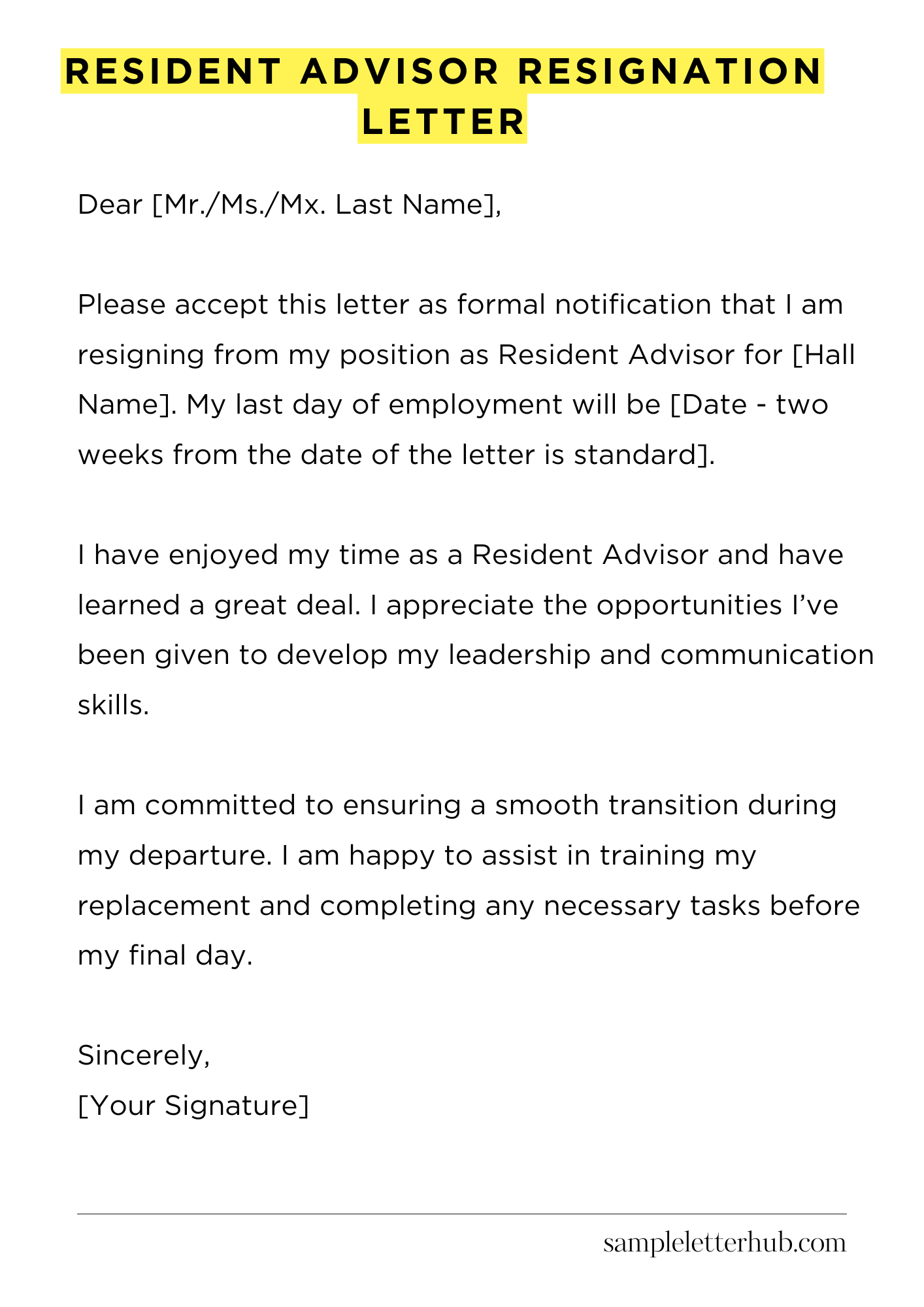
Dear [Mr./Ms./Mx. Last Name],
Please accept this letter as formal notification that I am resigning from my position as Resident Advisor for [Hall Name]. My last day of employment will be [Date – two weeks from the date of the letter is standard].
I have enjoyed my time as a Resident Advisor and have learned a great deal. I appreciate the opportunities I’ve been given to develop my leadership and communication skills.
I am committed to ensuring a smooth transition during my departure. I am happy to assist in training my replacement and completing any necessary tasks before my final day.
Thank you for the experience. I wish you and the residents of [Hall Name] all the best.
Sincerely,
[Your Signature]
How to Write a Resident Advisor Resignation Letter
1. Getting Started: The Basics You Need
So, you’re ready to move on from your role as a Resident Advisor (RA). It’s a common step, and handling it professionally is key. Firstly, you need a resignation letter. This isn’t just a formality; it’s a critical communication. Ensure you clearly state your intention to resign. Include your full name, the date you’re writing the letter, and the date you intend for your resignation to be effective.
Make it easy for them. Keep it simple. Clarity avoids misunderstandings down the road. Double-check your contact information, too, just in case they need to get a hold of you. Remember to address the letter to your supervisor or the appropriate authority within the housing department.
2. Expressing Your Gratitude: Show Appreciation
Before you dive into the specifics, take a moment to express your gratitude. Being an RA is a significant role and it is good to show you have appreciated the experience. Acknowledge the opportunities you’ve been given. Did you learn a lot? Did you grow as a person? Did you meet some awesome people? Let them know. It is a classy move.
Mention anything specific you appreciated. Maybe you enjoyed the training, the team, or the support you received. This doesn’t need to be over the top, but a sincere acknowledgement goes a long way. This makes you look good and leaves a positive lasting impression. Remember, you might need a reference in the future!
3. Stating Your Reason (Briefly): Keeping it Professional
Now, about why you’re leaving. You don’t need to go into a lengthy explanation of every detail, unless you want to. A brief, professional statement is often best. Are you focusing on your studies? Maybe you have a new job or opportunity? Keep it concise.
Avoid any negativity. Even if you had a challenging experience, refraining from griping in the resignation letter is wise. A simple phrase like “to pursue other opportunities” or “to focus on academic goals” is typically sufficient. This keeps the focus on the future, not the past.
4. Detailing Your Transition: Smooth Handover
This is where you show your commitment to a smooth transition. Consider offering assistance during the handover period. Offer to help train your replacement, complete any outstanding tasks, or provide any information to ensure that things don’t fall off the rails after you leave.
Specify any dates you’ll be available. Clearly state your final day of work. This ensures everyone is on the same page and helps avoid confusion. This is a very important step. Remember, you want to leave on a positive note, and helping with the transition does just that. Don’t leave them in a bind!
5. The Final Touches: Polishing Your Letter
Before sending, review your letter carefully. Check for any grammatical errors or typos. Proofread! Ensure the tone is professional and respectful. Get a second pair of eyes to read it over, if possible. A fresh perspective can catch any mistakes that you may have missed.
Keep a copy of your letter for your records. Consider sending it via email and also printing a physical copy. Finally, sign the physical copy (if you print one) and date it. This formalizes your resignation and concludes the process professionally. You’ve got this!
FAQs about Resident Advisor resignation letter
How do I write a Resident Advisor resignation letter?
To write a Resident Advisor (RA) resignation letter, begin by clearly stating your intention to resign. Include your name, the date, and your RA role. Provide a specific and concise date for your last day of employment. Briefly express gratitude for the experience, and optionally, you can state a brief reason for your departure if you wish, though this isn’t mandatory.
Maintain a professional tone throughout. Finally, sign the letter and consider thanking your supervisor for the opportunity.
What information should I include in my RA resignation letter?
Your RA resignation letter should include your full name, the date of the letter, a clear statement of resignation, your specific role (Resident Advisor), and the exact date of your last day of employment. It’s also important to include a professional closing and your signature.
Optional elements include a brief expression of gratitude for the experience and, if desired, a general reason for leaving, keeping it brief and positive.
When should I submit my Resident Advisor resignation letter?
Ideally, you should submit your Resident Advisor resignation letter as soon as you have made your decision to resign. Most institutions require a minimum notice period, typically two to four weeks, to allow sufficient time for your replacement and the transition of your duties.
Check your employment contract or RA handbook to determine the required notice period at your specific institution and plan accordingly.
How can I make my RA resignation letter professional?
To ensure your RA resignation letter is professional, maintain a formal and respectful tone. Use a standard business letter format, including your name, date, and the recipient’s information. Clearly state your intention to resign and the final date of your employment. Keep the language polite and concise.
Express gratitude for the opportunity, if appropriate. Proofread carefully for any spelling or grammatical errors before submission.
Can I provide a reason for resigning in my Resident Advisor resignation letter?
Yes, you can include a reason for resigning in your Resident Advisor resignation letter, although it is not mandatory. If you choose to do so, keep the explanation brief and positive. Common reasons include accepting another job, personal or family obligations, or pursuing academic interests. Avoid including negative comments about the position or the institution.
Related:
Resignation letter due to rude boss
Resignation letter moving to another state
Resignation letter due to illness of family member
Resignation letter due to study