

A researcher resignation letter is a formal document. It notifies an employer of your intent to leave your research position. Its primary purpose is to officially end your employment. It also serves as a record of your departure.
Writing this letter can feel daunting. We’re here to help ease the process. We’ve compiled various templates and examples for you. They will guide you in crafting your own perfect resignation letter.
Whether you’re moving on or pursuing a new opportunity, we’ve got you covered. Consider this your cheat sheet. Let’s get started on making your exit as smooth as possible.
Researcher Resignation Letter
Below is a sample of a Researcher Resignation Letter:
[Your Name]
[Your Address]
[Your Phone Number]
[Your Email Address]
[Date]
[Recipient Name]
[Recipient Title]
[Research Institution Name]
[Institution Address]
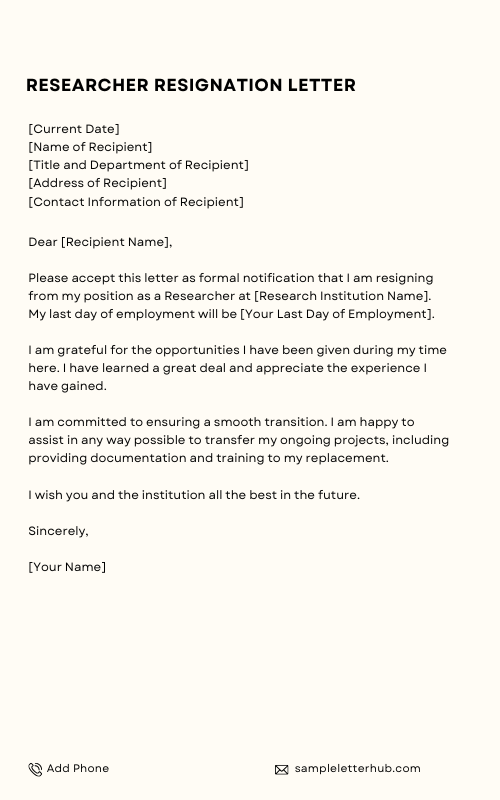
Dear [Recipient Name],
Please accept this letter as formal notification that I am resigning from my position as a Researcher at [Research Institution Name]. My last day of employment will be [Your Last Day of Employment].
I am grateful for the opportunities I have been given during my time here. I have learned a great deal and appreciate the experience I have gained.
I am committed to ensuring a smooth transition. I am happy to assist in any way possible to transfer my ongoing projects, including providing documentation and training to my replacement.
I wish you and the institution all the best in the future.
Sincerely,
[Your Name]
Researcher Resignation Letter Template
Dear [Manager’s Name],
Please accept this letter as formal notification that I am resigning from my position as Researcher at [Institution/Company Name] in the [Specify Department/Lab Name]. My last day of employment will be [Your Last Day, typically two weeks or more, depending on contract].
I have accepted a new position that offers the opportunity to specialize in [Mention specific area, e.g., translational medicine/applied AI], which aligns with my long-term scientific objectives. I am profoundly grateful for the opportunities to conduct meaningful research, publish my findings, and utilize cutting-edge equipment here.
I am committed to ensuring a smooth transition. I will diligently complete all necessary data organization, finalize my lab notebooks, document all ongoing experimental protocols, and prepare detailed summaries of my findings for the team before my departure.
Thank Thank you for the intellectual stimulation and support I have received during my tenure.
Sincerely,
[Your Typed Name]
Resignation Letter For Researcher Position
Dear [Manager’s Name],
This letter serves as official notice that I am resigning from my role as Researcher at [Institution/Company Name]. My final day of employment will be [Your Last Day].
I have made this decision to pursue a principal investigator role that requires a focus on [Mention specific research direction]. I want to express my appreciation for the invaluable experience gained in securing grants, managing research assistants, and navigating the publication process.
I will ensure that all outstanding data sets, material transfer agreements (MTAs), and compliance documentation are meticulously organized and handed over to the appropriate personnel before my departure. I am available to meet to discuss the continuation plan for my projects.
I wish the entire lab/department continued success in its scientific endeavors.
Respectfully,
[Your Typed Name]
Research Scientist Resignation Notice
Subject: Resignation Notice – [Your Name], Research Scientist
Dear [Manager’s Name],
Please accept this letter as formal notification of my resignation from my position as Research Scientist at [Company Name]. My last day of service will be [Your Last Day]. Due to the nature of our work, I am willing to discuss extending this notice period if necessary to ensure project continuity.
I want to thank you for the rewarding opportunity to conduct novel research and contribute to the advancements in [Mention field, e.g., material science/genomics].
During my remaining time, I will prioritize training the team on the established protocols for [Mention specific technique or project] and ensuring all proprietary data and intellectual property documentation are correctly filed and secured.
Thank you for the guidance and the resources provided during my employment.
Best regards,
[Your Typed Name]
Formal Researcher Resignation Letter
Subject: Formal Resignation of Researcher Position
Dear [Mr./Ms. Last Name],
I am writing to formally submit my resignation from the position of Postdoctoral Researcher at [University/Institute Name]. This decision is driven by the acceptance of a tenure-track faculty position. My last day of employment will be [Your Last Day].
I want to convey my deepest gratitude for the mentorship and academic freedom I was afforded in your lab. My experience here was foundational to my career, particularly my work on [Mention key project or publication].
I will use my notice period to finalize all necessary grant reports, transfer cell lines/reagents, and meticulously organize all physical and digital records associated with my experiments. I am dedicated to ensuring the smooth continuation of the research without interruption.
Thank you for the excellent opportunity to advance my scientific career.
Sincerely,
[Your Typed Name]
Researcher Job Exit Letter Example
Dear [Manager’s Name],
Please accept this letter as my official notice of resignation from my position as Researcher at [Company Name]. I am providing notice, and my final day of employment will be [Your Last Day].
I am grateful for the challenging projects and the highly collaborative environment within the research team. I have particularly valued the emphasis on [Mention specific value, e.g., peer review/interdisciplinary collaboration].
I will ensure all necessary experimental write-ups, equipment maintenance logs, and chemical inventory sheets are fully documented and accessible before my departure. Please let me know how else I can facilitate the completion of my projects during this time.
Thank you for the opportunity to have been part of this innovative team.
Regards,
[Your Typed Name]
Employment Resignation Letter Researcher
Dear [Manager’s Name],
This letter is to officially confirm my resignation from my employment as a Researcher in the [Department Name]. My final day of employment will be [Your Last Day].
I am moving to a different research sector where I can focus entirely on [Specific Focus Area]. I sincerely thank you for the hands-on research experience and the opportunity to contribute to [Company’s/Institute’s] reputation.
I am dedicated to making my transition seamless. I will work diligently to complete all final data analysis and prepare a comprehensive verbal and written handover regarding my current projects and future research directions.
I wish [Institution/Company Name] continued scientific breakthrough.
Sincerely,
[Your Typed Name]
Researcher Role Resignation Email
Subject: Resignation – [Your Name], Research Associate
Dear [Manager’s Name],
I am formally submitting this email to resign from my role as Research Associate at [Lab/Group Name]. My effective date of resignation will be [Your Last Day].
I have deeply valued my time contributing to the research conducted here. I am departing to pursue a PhD program, which necessitates my full attention.
I commit to utilizing my remaining time effectively to ensure that all critical samples are correctly stored, all databases are updated, and the team is fully briefed on any remaining research tasks required for my current papers.
Thank you for the employment opportunity and the invaluable laboratory experience.
Respectfully,
[Your Typed Name]
Researcher Position Resignation Notice
Dear [Manager’s Name],
I am writing to formally submit my resignation from the position of Researcher at [Company Name].
Please consider [Your Last Day] as my final day of employment. I understand and respect the need for thorough handover in a research environment and am prepared to work diligently during this notice period.
I appreciate the knowledge and professional network I’ve gained while working here. I will dedicate my remaining time to completing my final reports and assisting in the transfer of my experimental work.
Thank you for your cooperation and understanding.
Respectfully,
[Your Typed Name]
Sample Resignation Letter For Researcher
Dear [Manager’s Name],
This letter is to formally inform you that I am resigning from my role as Researcher at [Institution Name].
My final day of employment will be [Your Last Day].
Thank you for the opportunity to work here. I wish you and the research group all the best in securing future grants and achieving scientific success.
I will ensure all my current research data and lab responsibilities are transferred smoothly during my notice period.
Sincerely,
[Your Typed Name]
Researcher Resignation Letter Format
Dear [Manager’s Name],
Please accept this letter as my formal resignation from the position of Researcher at [Company Name].
I am giving notice, and my final day of employment will be [Your Last Day].
I am grateful for the chance to contribute to the innovation here. I will prioritize the completion of all outstanding documentation and ensure a responsible handover of all intellectual property to the team before I leave.
I wish the team continued success.
Sincerely,
[Your Typed Name]
How to Write a Researcher Resignation Letter
Resigning from a research position is a significant decision. It’s important to approach this process professionally.
This includes drafting a well-written resignation letter. Such a letter can impact your professional reputation and future opportunities. Let’s break down how to create an effective one.
1. Preparation is Key: Before You Start Writing
First things first. Before putting pen to paper (or fingers to keyboard), take a moment to reflect. Consider why you’re leaving.
Think about your last day of employment. Review your employment contract to understand the required notice period. Most importantly, ensure you have a new job or plan in place. This will give you confidence in your letter.
You don’t want to leave your current situation without a plan. Decide on a suitable date to leave. The notice period is important here.
2. The Essential Components: What to Include
Your resignation letter should be clear and concise. Keep it professional. It does not need to be lengthy. At a minimum, include the following:
- Your Formal Statement of Resignation: State clearly that you are resigning. This is your primary purpose.
- Your Position: Specify your role at the research institution.
- The Effective Date: This is the date your employment will officially end. Double-check this against your contract.
- A Brief Expression of Gratitude: Acknowledge the opportunity and any positive experiences.
- Offer of Assistance: State your willingness to help with the transition.
- Your Signature: This validates the letter.
Don’t overcomplicate it. Clarity is the goal.
3. Crafting the Content: Writing with Purpose
Begin with a formal salutation (e.g., “Dear [Recipient’s Name]”). In the first paragraph, make your intention crystal clear.
For example, “Please accept this letter as formal notification that I am resigning from my position as [Your Position] at [Institution Name], effective [Date].” Keep it simple. In the next paragraph, briefly express your thanks. “I am grateful for the opportunity to have worked here”.
If you want to include assistance, do it here. Offer support in transferring your duties. Keep it professional and helpful. If you’ve learned skills, you can acknowledge it here.
4. Examples and Templates: Providing a Guide
Many online resources offer resignation letter templates. Search online for templates. Adapt the examples to fit your unique circumstances.
Remember to personalize these templates. Consider the specific nature of your research role. Tailor your language to reflect your relationship with your supervisor or colleagues. A generic letter is better than nothing, but a personalized letter makes a greater impression.
5. Review and Submission: The Final Steps
Before sending the letter, review it carefully. Check for any grammatical errors or typos. Proofread it thoroughly. Make sure the information is accurate.
Confirm that your effective date adheres to the notice period specified in your contract. Once you are satisfied, submit the letter to the appropriate person, usually your direct supervisor or HR department. Consider delivering it in person or via email. Keep a copy for your records. This is for your own record and proof.
FAQs about Researcher Resignation Letters
Why is a well-crafted resignation letter important for a researcher?
A well-crafted resignation letter is crucial for researchers as it serves as a formal record of departure, reflecting professionalism and respect. It protects the researcher’s reputation, facilitates a smooth transition, and can be vital for future references.
It helps to maintain positive relationships with former colleagues and supervisors, which may be important for future career prospects or collaborations.
What key elements should be included in a researcher’s resignation letter?
A researcher’s resignation letter should contain: a clear statement of resignation, the effective date of departure, a brief expression of gratitude for the opportunity, a concise explanation (optional, but often helpful) for the reason for leaving, a mention of any ongoing projects or responsibilities to be transferred, and an offer to assist with the handover process. Contact information should also be included for any future correspondence.
When is the best time to submit a researcher’s resignation letter?
The best time to submit a resignation letter is typically after you have secured a new position or made a firm decision to leave. It’s best practice to provide adequate notice, as specified in your employment contract or by industry standards, usually two to four weeks.
Presenting the letter in person to your supervisor is generally preferred to maintain a professional approach.
What if a researcher is leaving due to difficult circumstances or ethical concerns?
If a researcher is leaving due to difficult circumstances or ethical concerns, the resignation letter should still maintain a professional tone.
While it’s acceptable to briefly allude to the reason for leaving, it’s often best to avoid overly detailed explanations in the formal letter. It may be more appropriate to discuss the issues with a trusted supervisor or HR representative separately. Documenting any serious concerns is recommended.
How can a researcher ensure a smooth transition after submitting a resignation letter?
To ensure a smooth transition, a researcher should offer assistance with the handover of projects, data, and responsibilities. They should provide clear documentation, train colleagues as needed, and be responsive to questions.
Maintaining open communication with supervisors and colleagues during the notice period is essential. Completing all outstanding tasks and returning any company property before the departure date is crucial.
Related:
Resignation letter due to rude boss
Resignation letter moving to another state
Resignation letter due to illness of family member
Resignation letter due to study
Resignation letter due to long commute
Resignation letter due to insult
Resignation letter to focus on family
Resignation letter to temp agency